
Quick Summary:
|
Introduction: Do NetSuite Certified Partners Actually Reduce Project Risk or Is That Just Marketing?
NetSuite certified partners reduce project risk in concrete, measurable ways: they follow documented delivery methodologies rather than improvising scope as they go, they've seen the specific failure patterns that derail budgets and timelines before and they maintain the ongoing certification and training Oracle requires to stay current with the platform's twice-yearly release cycle. This isn't just a credentialing formality - the gap between a certified partner's delivery discipline and an uncertified generalist's ad hoc approach shows up directly in budget overruns, timeline slippage and post-go-live stability.
Businesses evaluating a NetSuite project for the first time often assume certification is a baseline checkbox rather than a genuine risk signal and that assumption is exactly where avoidable project risk tends to creep in unnoticed. This guide breaks down exactly where that risk reduction comes from, what to look for in NetSuite partners in India specifically and how LinkedERP applies certified delivery discipline to every engagement.
|
Market Context: 64% of ERP projects run over budget - mostly from underestimated staffing (38%) and scope creep (35%) - with experts recommending 20–30% contingency and a certified NetSuite Alliance Partner to manage it. Source: Anchor Group, 50 Must-Know NetSuite ERP Stats for 2025 |
What Does NetSuite Certification Actually Reduce Risk Against?
Certification isn't a single guarantee - it reduces risk across several distinct categories, each with its own typical failure pattern when handled by an inexperienced or uncertified team.
Scope and Budget Risk
Certified consultants are trained to scope discovery thoroughly upfront, which is exactly where the 35% of projects experiencing scope expansion typically go wrong - vague initial requirements that balloon mid-project.
Staffing and Resourcing Risk
Certification requires demonstrated implementation experience, which means a certified partner more accurately estimates the actual consultant hours a project needs, addressing the staffing underestimation behind 38% of budget overruns.
Data Migration Risk
Certified consultants have handled messy legacy data before and know to cleanse and validate it before migration rather than during it, avoiding one of the most common causes of a rocky go-live.
Timeline Risk
A documented delivery methodology - such as Oracle's SuiteSuccess framework - gives a certified partner a structured basis for realistic timeline estimates, rather than an optimistic guess.
Adoption Risk
Certified partners typically build training into the project timeline as a planned phase, rather than compressing it into the final week before go-live.
Post-Go-Live Risk
Certification requires partners to stay current through Oracle's ongoing training requirements, which directly affects how well they can support a system through version upgrades and evolving business needs after cutover.
At a Glance: Certified vs. Uncertified Delivery Approach
|
Risk Area |
Uncertified / Generalist Approach |
Certified Partner Approach |
|
Scope definition |
Verbal understanding, informal scope |
Documented scope, defined change control |
|
Staffing estimates |
Rough guess based on availability |
Based on demonstrated implementation experience |
|
Data migration |
Migrated "as-is," cleansed reactively |
Cleansed and validated before migration |
|
Timeline |
Optimistic, undocumented |
Structured methodology (e.g. SuiteSuccess) |
|
Training |
Compressed into final week |
Planned phase within the project timeline |
|
Post-go-live |
Ad hoc, reactive support |
Structured managed services, defined SLAs |
How Uncertified Engagements Compound Risk Over Time
Risk from an uncertified or under-qualified engagement rarely shows up as a single dramatic failure - it compounds quietly across the project lifecycle.
A scoping gap in week one becomes a change-request dispute in month two.
That dispute becomes a compressed testing phase in month three, as time lost to renegotiation eats into the schedule.
The compressed testing phase becomes a rocky go-live that generates a wave of support tickets nobody budgeted time to resolve.
Each stage's shortfall makes the next stage's problems more expensive to fix - which is exactly why the risk-reduction value of certified partners compounds in the opposite direction.
A well-scoped discovery phase makes data migration smoother, which makes testing more thorough, which makes go-live more stable, which makes post-go-live support lighter.
Comparing partners purely on their initial quote can be misleading. A lower quote from an uncertified provider may look attractive at the proposal stage, but if it reflects under-scoped discovery or testing, the real cost shows up later.
That real cost - scope disputes, rework, or an unstable production system - often exceeds what a properly scoped, certified engagement would have cost from the start.
Partner Tiers and What They Signal About Risk
Not every certified partner holds the same designation, and the tier itself carries risk-relevant information.
- Solution Providers bundle licensing with implementation and offer a single point of accountability - generally the lower-risk choice when you want one partner accountable across both licensing and delivery.
- Alliance Partners focus on consulting and integration, with licences purchased directly from Oracle - often the better fit when licensing is already sorted and you need deep implementation or integration expertise specifically.
- Higher-recognition tiers, such as 5-Star partners, have demonstrated an especially strong track record of successful go-lives, signalling lower delivery risk on more complex engagements.
- When comparing Oracle NetSuite partners in India, understanding which tier a shortlisted provider holds helps set realistic expectations rather than assuming every certified label means the same thing.
- This distinction matters just as much when evaluating NetSuite implementation partners in India for a specific project, since a provider's tier often reflects the scale and complexity of engagement they're actually built to support.
- Treating every certified label as interchangeable is itself a source of avoidable risk, since the tier is meant to signal exactly this kind of fit.
- A newly certified Solution Provider and a long-established, award-winning Alliance Partner both carry the "certified" label, but represent meaningfully different risk profiles for a complex, multi-subsidiary implementation.
- Confirm which profile you're actually engaging in before signing - a simple step that prevents a mismatch between the tier's expectations and your project's real complexity.
Why NetSuite Partners in India Need Additional Certification Depth
General Oracle certification confirms platform competence, but it doesn't automatically confirm India-specific readiness. The strongest NetSuite partners in India combine standard certification with demonstrated depth in GST (CGST, SGST, IGST), e-invoicing through the government's IRP portal, e-way bill generation and TDS/TCS handling.
None of this is covered by Oracle's core certification tracks, yet all of it introduces real project risk if configured incorrectly. This is precisely where the distinction between generic global experience and genuine oracle NetSuite partners in India expertise matters - a partner who has never configured GST compliance for an Indian entity is starting from scratch on your project, regardless of how many enterprise implementations they've completed elsewhere.
When evaluating NetSuite implementation partners in India, ask specifically how many GST-compliant go-lives a prospective partner has delivered, not just how many NetSuite projects overall. The two numbers can differ significantly and the gap is exactly where compliance risk hides.
NetSuite Integration Partners and Where Integration Risk Actually Lives
Integration work carries its own risk profile, separate from core implementation. NetSuite integration partners need demonstrated experience with SuiteTalk, RESTlets and middleware platforms like Celigo or Boomi, since a poorly scoped integration between NetSuite and a CRM, e-commerce platform or payment gateway is a common source of post-go-live firefighting.
Certification alone doesn't guarantee integration competence. Ask any prospective partner how many similar integrations they've built, what error-handling and monitoring they put in place and how they've scoped authentication to avoid over-broad system access. A NetSuite integration partners team treating these as afterthoughts, rather than core parts of design, is a risk signal regardless of certification tier.
It's also worth asking how a partner tests edge cases - partial refunds, cancelled orders, currency conversions - since these are exactly the scenarios that break in production when untested. A partner who can describe that process in specific detail is showing the same documented rigour that separates certified, risk-aware delivery from a generalist build-and-hope approach.
How to Identify the Best NetSuite Partner for Your Project
There's no single, universal answer to who the best NetSuite partner is - the right fit depends on your project's size, industry and complexity. A few practical checks help narrow the field regardless of your situation: ask for evidence of certification rather than a claim (Oracle's certifications are individually verifiable and a credible partner won't hesitate to prove it) and ask for references from businesses of a similar size and industry - then actually call them, rather than accepting a curated case study at face value.
It's also worth asking how a partner prices scope changes, since this reveals whether their delivery methodology genuinely accounts for the scope-expansion risk behind so many budget overruns. And when comparing the top NetSuite implementation partners on paper, weigh their typical project size against your own - a partner built for large enterprise transformations doesn't necessarily bring proportional value or pricing, to a mid-market implementation.
One more check worth adding: ask each candidate to describe a past project that hit unexpected difficulty and how they handled it. Every experienced partner has a story like this and how openly they discuss it says more about how they'll manage your own project's surprises than a polished case study ever will.
Why LinkedERP Reduces Risk on Every NetSuite Engagement
LinkedERP applies the same certified delivery discipline that separates low-risk engagements from troubled ones, scoping every project with the documentation and structure that Oracle's certification standards are built around.
What LinkedERP Brings to Every Engagement
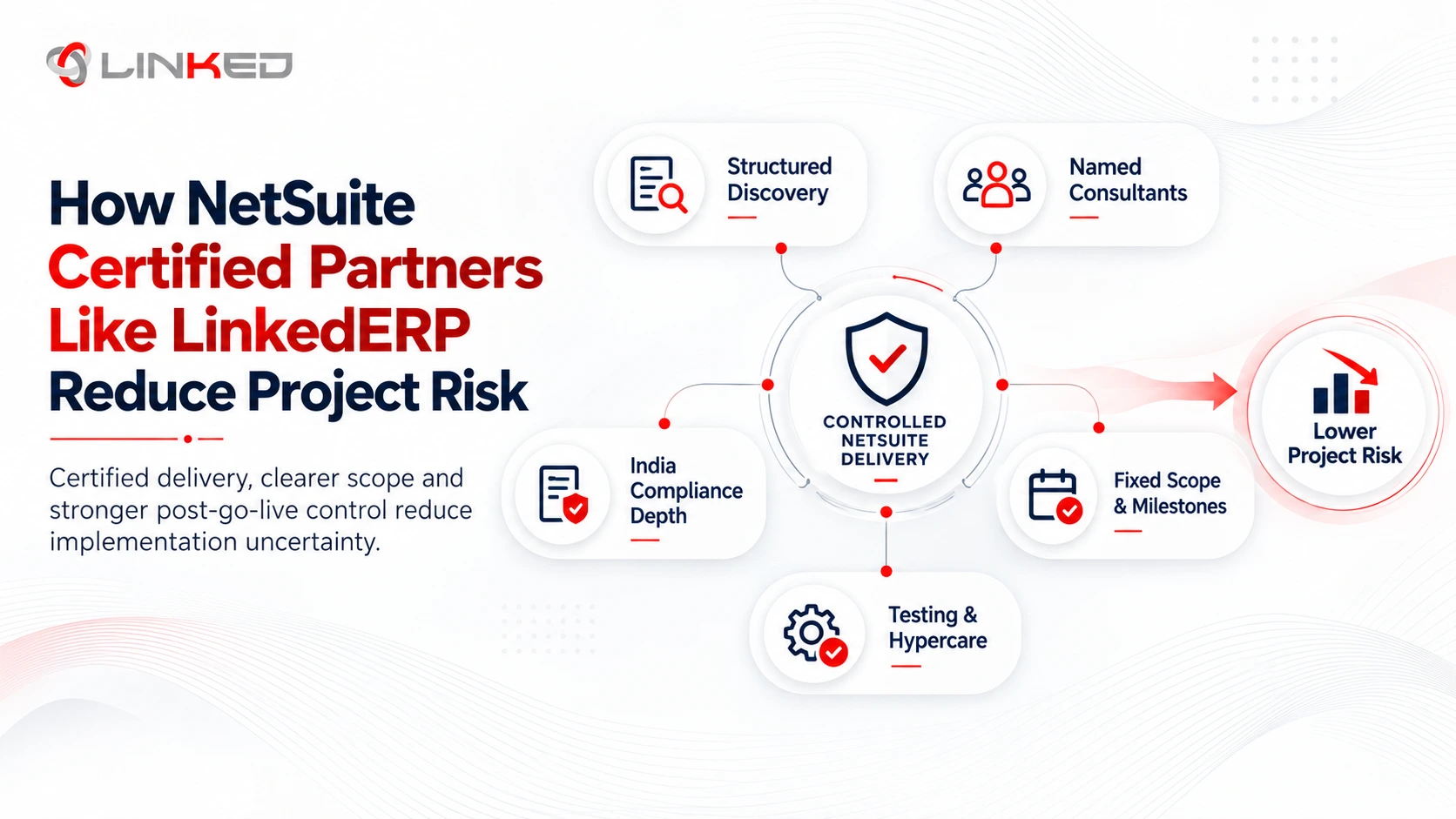
- Certified NetSuite Consultants, Named Upfront - Every engagement is led by consultants holding relevant Oracle certifications, named in the proposal before signing and retained through go-live.
- Structured, Documented Scoping - Discovery produces a documented scope and change-control process, directly addressing the scope-expansion risk behind most budget overruns.
- India-Ready Compliance Expertise - GST, e-invoicing, e-way bill and TDS/TCS configuration handled by consultants with genuine, demonstrated India delivery experience.
- Fixed-Fee Proposals - Transparent budgeting with clearly defined exclusions, addressing the staffing and scope risks that drive cost overruns industry-wide.
- Post-Implementation Managed Services - A named support contact and defined SLAs, so risk doesn't quietly resurface in the months after go-live.
LinkedERP's Risk-Reduction Capability Stack
- Discovery & Scoping - Documented process maps and change-control frameworks that keep scope risk visible and managed.
- Data Migration - Structured cleansing and validation before migration, not reactive fixes during it.
- Integration Services - SuiteTalk, RESTlet and middleware-based integrations scoped with authentication and monitoring built in from the start.
- India Compliance - GST, TDS/TCS and e-invoicing configuration led by consultants with demonstrated local delivery experience.
- Training & Adoption - Planned, role-specific training built into the project timeline.
- AI & Automation - AI-assisted configuration reviews and anomaly detection to catch issues before they compound into post-go-live incidents.
- Managed Support - Ongoing configuration support and proactive upgrade management after go-live.
Taken together, this is what separates LinkedERP from an uncertified or generalist provider: documented scoping that directly targets the most common causes of ERP project risk, India-specific compliance depth that generic certification alone doesn't guarantee and a capability stack built to keep risk managed long after go-live rather than just through the initial implementation.
Conclusion: Is Your NetSuite Partner Actually Reducing Your Project Risk?
The evidence is fairly clear: NetSuite certified partners reduce project risk through documented methodology, demonstrated staffing accuracy and structured post-go-live support - not through certification as a badge alone, but through the delivery discipline that certification standards are designed to enforce. Before signing with any partner, weigh their certification, their India-specific compliance depth if relevant and their approach to scope and change control against the specific risks this guide has outlined, rather than assuming certification alone tells the whole story.
The businesses that avoid the worst of the 64% budget-overrun statistic tend to be the ones who asked these harder questions upfront, not the ones who found the most reassuring sales pitch.
Want
a NetSuite implementation built around reducing risk from day one?
Talk to LinkedERP's team for a scoped, certified assessment of your project's specific risk profile.
www.linkederp.com | info@linkederp.com | Book a Free Assessment
Frequently asked questions
Check implementation scope, licensing, required modules, integrations, data migration, customisation limits and post-go-live support before signing. Also confirm exactly who will deliver the project and what is included in the commercial proposal.
The right partner should combine certified NetSuite expertise, India compliance knowledge, transparent implementation scope and long-term support. LinkedERP is a strong option for Indian mid-market businesses seeking structured implementation and integration services.
Look for partners with proven industry experience, certified consultants, clear implementation methodology and documented support SLAs. LinkedERP is one option for businesses in India that need NetSuite implementation, integration and ongoing managed support.
NetSuite offers partner programs such as Solution Provider and Alliance programs; applicants generally need relevant ERP/cloud experience, dedicated sales and delivery resources and must complete Oracle’s onboarding and partner agreement process.
NetSuite is a widely used cloud ERP option for medium-sized enterprises needing integrated finance, inventory, CRM, reporting and multi-entity management. The best fit still depends on industry, process complexity, localisation needs and integration requirements.