
Quick Summary:
|
Introduction: Which Odoo ERP System Vendors Actually Understand Fintech Compliance?
An Odoo ERP system can support the operational and audit-readiness side of fintech compliance through standardised financial reporting, role-based access controls, audit trails and GST/TDS-aligned bookkeeping. However, it is not a licensed compliance engine and does not replace dedicated AML, KYC or RegTech tools. This distinction is important because vendors that blur the line between supporting audit-readiness and handling regulatory compliance can create unrealistic expectations.
The stronger Odoo vendors in this space understand those boundaries and configure Odoo to support a regulated financial business’s reporting, controls and audit obligations while integrating with specialist compliance tools already in use. This guide covers 8 Odoo ERP system vendors with financial services experience, explains what Odoo can and cannot do for compliance and outlines what to look for in an Odoo ERP consultant for fintech, NBFC or lending businesses.
Market Context: RBI scrutiny across banks, NBFCs and fintechs is increasing, with greater focus on cybersecurity, audit trails, vendor risk and continuous controls. As cloud adoption grows, ERP systems must provide clean, regulator-ready audit evidence without relying on manual reconstruction. Source: ASPIA Infotech, RBI Compliance Checklist for Banks & NBFCs, 2026 |
What Does "Fintech Compliance" Actually Mean for an Odoo ERP System?
It's worth being precise here, since the term gets used loosely. Fintech compliance typically spans two distinct layers. The first is regulatory and licensing compliance - AML/KYC checks, PCI-DSS for payment handling, RBI licensing obligations for NBFCs and data protection law - which is handled by specialised RegTech tools, licensed KYC vendors and payment processors, not by a general-purpose ERP.
The second is operational and audit compliance - accurate, auditable financial records, standardised approval workflows, role-based data access and reporting that satisfies statutory and internal audit requirements - which is exactly where an Odoo ERP software deployment plays a genuine role.
The strongest vendors in this space understand this split clearly: they configure Odoo to excel at the operational and audit layer and they scope clean integration points to the specialist tools handling the regulatory layer, rather than overselling Odoo as something it isn't.
Data Residency and Security Considerations for a Fintech Odoo Deployment
Regulated financial businesses face a level of scrutiny on data handling that a typical SME Odoo ERP implementation doesn't need to plan for. Where the ERP instance is hosted, how backups are encrypted and retained and who has administrative access to production data are all questions an auditor or regulator may ask directly and a vendor without financial services experience often hasn't built answers to these questions into their standard delivery process.
Practically, this means a few specific configuration decisions deserve extra attention during scoping. Hosting location should be confirmed explicitly against any data localisation requirements your regulatory framework imposes, rather than assumed to be compliant by default. Backup encryption and retention policies should be documented in writing, not described verbally during a sales conversation.
Administrative access to the production environment should also be limited to a small, named group, with changes logged the same way financial transaction changes are - since from an audit perspective, who can alter system configuration is just as relevant as who can alter financial records.
Odoo ERP System Features That Support Fintech and NBFC Compliance
Audit Trail and Change Logging
Every record change is logged with a user and timestamp, giving auditors a defensible trail without manual reconstruction.
Sensitive financial data can be restricted by role, limiting exposure in line with regulatory expectations around data access governance.
Essential for NBFCs and fintech businesses operating across multiple legal entities or currencies.
Core Indian compliance requirements configured directly into the accounting workflow rather than handled in parallel spreadsheets.
API-Based Integration
Odoo's API layer allows clean connections to dedicated KYC, AML and payment gateway providers, keeping regulatory-layer tools separate from the operational ERP.
Standardised Approval Workflows
Configurable approval chains for loan disbursement, expense management and financial sign-off reduce the operational risk auditors’ flag most often.
How to Evaluate a Vendor's Fintech Compliance Claims
Marketing language around "compliance-ready" ERP deployments varies widely in how much substance actually sits behind it and it's worth pressure-testing a vendor's claims before relying on them. Ask a prospective odoo erp consultant to walk through a specific example of an audit trail configuration they've built - which fields were logged, how change history was surfaced to auditors and what happened when a discrepancy was found.
Ask how they've handled integration with a KYC or AML vendor in a past project and what went wrong during that integration, since every real integration project encounters some friction and a vendor who claims otherwise is likely glossing over the details. And ask directly whether they've worked with a regulator or external auditor during a past engagement, since that experience tends to sharpen a vendor's understanding of what actually gets scrutinised versus what looks good in a demo but rarely gets tested in practice.
Odoo Partners Serving Banks, NBFCs and Fintech Firms
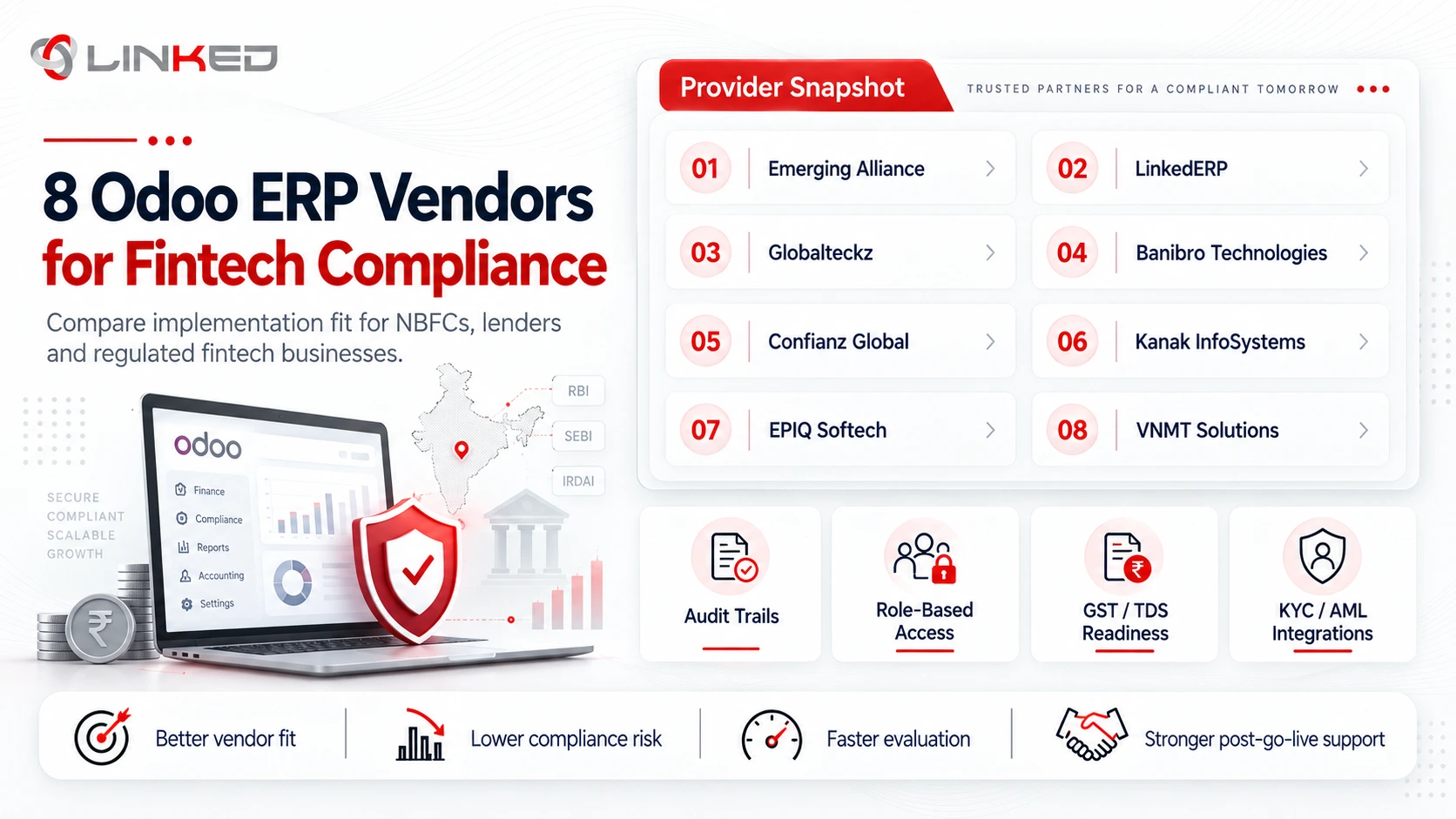
1. Emerging Alliance - Markets a dedicated "Odoo for Financial Services" offering aimed specifically at banks, NBFCs and fintech firms, covering loan processing, customer onboarding and standardised compliance reporting workflows.
2. LinkedERP - Structures every Odoo ERP implementation for financial services clients around audit-trail configuration, role-based access and clean integration points to dedicated compliance tools, rather than treating compliance as a generic checkbox.
3. Globalteckz - An Odoo Silver Partner based in Mumbai - India's financial hub - with over 150 implementations and a track record across regulated regional markets.
4. Banibro Technologies - A Mumbai-based Odoo provider who’s positioning explicitly ties ERP deployment to compliance and operational discipline for finance-sector clients.
5. Confianz Global - Strong enterprise integration experience, useful for fintech businesses needing Odoo connected to multiple existing regulatory and payment systems simultaneously.
6. Kanak InfoSystems - A flexible consulting practice capable of scaling configuration as a financial services business grows from a lean startup into a more heavily regulated, larger operation.
7. EPIQ Softech - Multi-tier support model across several geographies, relevant for fintech businesses operating across more than one regulatory jurisdiction.
8. VNMT Solutions - Known for integration expertise, useful for connecting Odoo to third-party KYC, payment and reporting systems that a regulated fintech business already depends on.
At a Glance: 8 Vendors Compared
Rank | Vendor | Relevant Strength | Best Fit |
|---|---|---|---|
1 | Emerging Alliance | Dedicated financial services Odoo offering | Banks, NBFCs, fintech startups |
2 | LinkedERP | Audit-trail-first configuration | Regulated financial services, NBFCs |
3 | Globalteckz | Scale, financial-hub presence | Larger, multi-region deployments |
4 | Banibro Technologies | Compliance-linked positioning | Finance-sector SMEs |
5 | Confianz Global | Enterprise integration | Multi-system regulatory environments |
6 | Kanak InfoSystems | Scalable engagement model | Growing fintech startups |
7 | EPIQ Softech | Multi-geography support | Cross-border fintech operations |
8 | VNMT Solutions | Third-party integration expertise | KYC/payment system connections |
How to Choose the Right Odoo ERP Consultant for a Regulated Financial Business
Ask About Financial Services References Specifically - A general SME reference tells you little about whether a vendor understands audit and regulatory reporting needs.
Confirm Data Residency and Access Control Plans - Ask exactly how role-based access and data segregation will be configured before any development begins.
Clarify Integration Scope for Compliance Tools - Get explicit about which KYC, AML, or payment systems need to connect to Odoo and how that integration will be tested.
Ask How Audit Trail Requirements Will Be Validated - A credible Odoo ERP consultant should be able to describe exactly how change logs and approval workflows will be tested before go-live.
Avoid Vendors Overselling Odoo as a Compliance Engine - Any vendor claiming Odoo alone handles AML/KYC without dedicated integration is a vendor whose scope needs closer scrutiny.
Common Mistakes Financial Services Businesses Make with Odoo
A handful of mistakes show up repeatedly when fintech and NBFC businesses adopt an Odoo ERP solution without financial-services-specific planning. Treating audit trail configuration as a default rather than something to explicitly design and test is a common gap - the feature exists but it needs deliberate configuration to match actual audit requirements. Assuming Odoo alone satisfies AML/KYC obligations, rather than planning clean integration with dedicated compliance tools, creates real regulatory exposure.
Underestimating the importance of role-based access design leads to overly broad permissions that auditors flag immediately. And choosing a generalist odoo erp software vendor purely on price, without confirming financial services experience, often means discovering compliance gaps only when a regulator or auditor asks a question the system wasn't configured to answer.
Why LinkedERP Configures Odoo Properly for Regulated Financial Businesses
LinkedERP delivers Odoo ERP implementation for fintech, NBFC and financial services clients with a specific focus on audit-readiness, access control and clean integration with the compliance tools these businesses already depend on.
What LinkedERP Brings to Every Engagement
Certified Odoo Consultants with Financial Services Experience - Every engagement is led by an Odoo ERP consultant familiar with audit trail configuration and regulated reporting requirements, named in the proposal before signing.
Audit-Trail-First Configuration - Change logging, approval workflows and role-based access are designed and tested explicitly, not left to Odoo's defaults.
Clean Compliance-Tool Integration - API-based connections to dedicated KYC, AML and payment systems, scoped clearly rather than assumed.
India-Ready Statutory Compliance - GST, TDS and RBI-aligned bookkeeping configured correctly from day one.
Post-Implementation Managed Services - A named support contact and defined SLAs, with proactive attention to configuration changes as regulatory requirements evolve.
LinkedERP's Odoo ERP Capability Stack for Financial Services
Finance & Compliance - GST, TDS and statutory reporting configurations built for regulated Indian financial entities.
Access Control & Audit - Role-based permissions and change-log configuration designed around actual audit requirements.
Integration Services - API-based connections to KYC, AML and payment gateway providers.
Multi-Entity Accounting - Multi-currency, multi-subsidiary configuration for NBFCs and fintech groups operating across entities.
Reporting & Dashboards - Standardised, audit-ready financial reporting built against actual regulatory requirements.
AI & Automation - AI-assisted anomaly detection across financial and access-log data to flag irregularities early.
Managed Support - Ongoing configuration support as regulatory requirements and business scale evolve.
Taken together, this is what separates LinkedERP from a typical Odoo ERP software vendor: an honest understanding of what an ERP can and can't do for compliance, audit-first configuration built specifically for regulated businesses and a capability stack that keeps your Odoo ERP system aligned with evolving financial services requirements.
Conclusion: Is Your Odoo ERP System Actually Ready for Fintech Compliance?
The right Odoo ERP system, configured properly, genuinely strengthens the operational and audit side of fintech compliance - but only when the vendor understands the difference between operational compliance and regulatory licensing, and configures accordingly. Choosing an Odoo ERP consultant with real financial services experience, rather than a generalist implementer, is the single factor most likely to determine whether your system holds up under audit scrutiny or creates a gap you discover the hard way.
The businesses that navigate this well tend to be the ones who asked pointed, specific questions about audit trails, access control and integration scope before signing - not the ones who accepted "yes, Odoo handles compliance" as a complete answer.
Running
a fintech, NBFC or financial services business and evaluating an Odoo ERP system?
Talk to LinkedERP's team for an audit-first assessment of what your compliance configuration actually needs.
www.linkederp.com | info@linkederp.com | Book a Free Assessment
Frequently asked questions
Odoo ERP is a modular business management platform that connects functions such as accounting, CRM, sales, inventory, manufacturing and HR in one system, allowing data and workflows to move across departments.
Start by mapping your current processes, pain points, compliance requirements, reporting needs and growth plans, then prioritise ERP features that solve those specific needs rather than adding unnecessary modules.
Odoo is flexible, modular, scalable and highly customisable, but poor scoping, excessive customisation, weak data migration or inadequate user training can increase implementation time, cost and complexity.
Not entirely - Odoo supports operational and audit compliance well (audit trails, access control, reporting), but AML/KYC and licensing compliance require dedicated RegTech and KYC tools integrated with Odoo.
Yes, when configured correctly, GST, TDS and RBI-aligned statutory reporting can be built directly into the accounting workflow.
Assuming the platform alone satisfies AML/KYC obligations, rather than planning clean integration with dedicated compliance tools alongside the core Odoo ERP software.