
Quick Summary
A certified NetSuite ERP consultant designs and configures NetSuite around how a business actually works, while a NetSuite administrator keeps the platform running smoothly day to day after go-live. This guide breaks down the certification paths, scope of work and exactly when a business needs each role.
Introduction
A certified NetSuite ERP consultant scopes, configures and leads the implementation or transformation of a NetSuite environment - designing workflows, building customisations and matching the platform to a business's actual processes. A NetSuite administrator, by contrast, manages the platform after it's live: user roles and permissions, routine configuration changes, saved searches and day-to-day system health. Both are certified through Oracle's official NetSuite Certification Program, but through different exam tracks, different prerequisite experience and different scopes of responsibility. The confusion between the two isn't just semantic - hiring the wrong role for a given project is one of the more common and more expensive, staffing mistakes businesses make on a NetSuite engagement. Understanding which one a given project actually needs - and when it needs both - is the difference between a properly staffed NetSuite engagement and an expensive mismatch.
What Is a Certified NetSuite ERP Consultant?
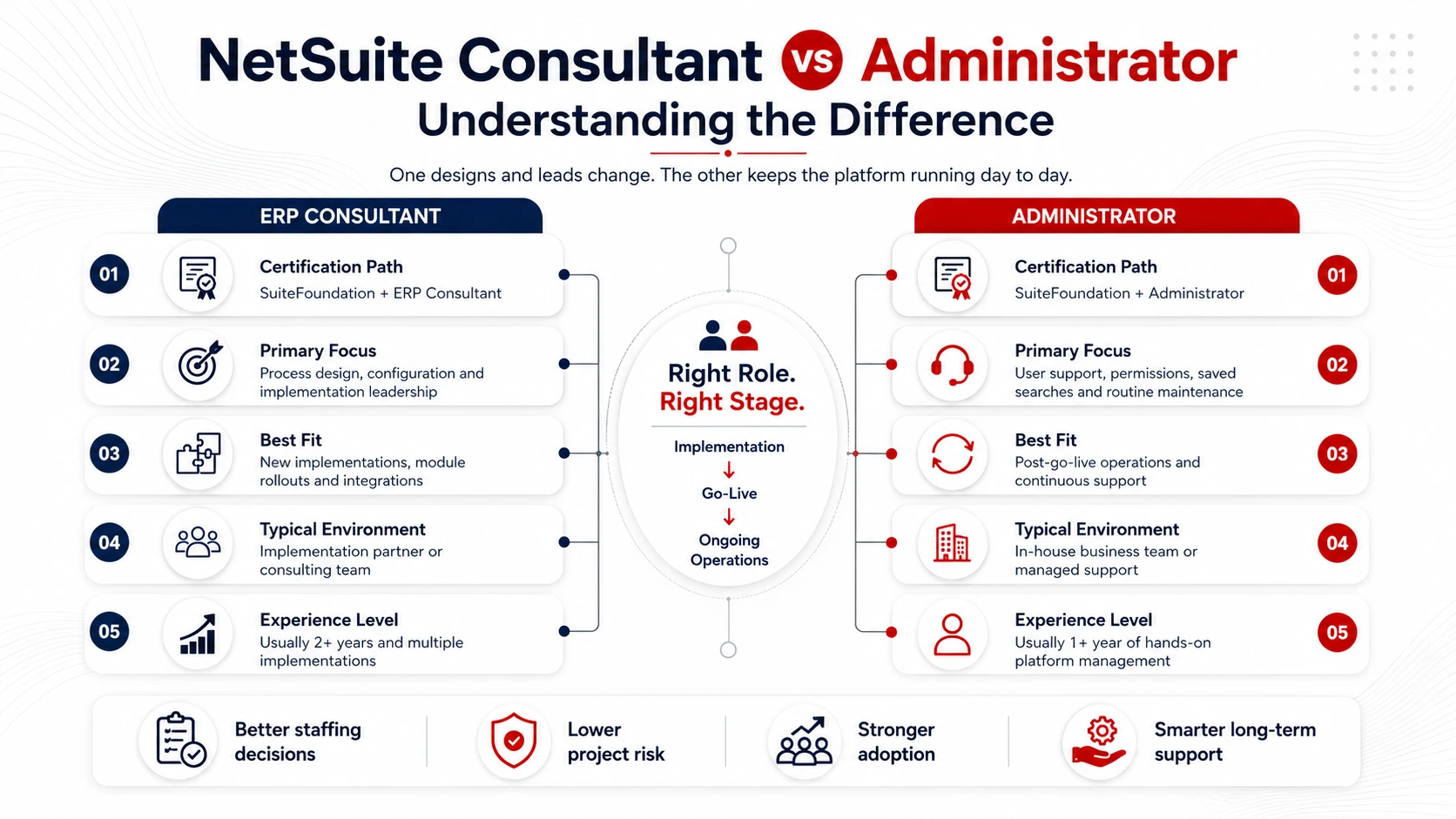
A certified NetSuite ERP consultant is an Oracle-validated professional with proven hands-on NetSuite implementation experience, typically backed by SuiteFoundation and ERP Consultant certification. They help translate business requirements into the right NetSuite configuration, covering workflows, architecture, OneWorld structures and implementation trade-offs.
Focus: Project-based implementations, business process mapping and optimizing architecture for new or upgrading clients.
Work Environment: Usually employed by consulting firms or partner agencies.
Experience Needed: Typically requires 2+ years or multiple full-lifecycle implementations.
What Is a NetSuite Administrator?
A NetSuite Administrator is responsible for managing, maintaining and improving an already-implemented NetSuite environment. The role focuses on keeping the system running smoothly after go-live through user access management, saved searches, reports, workflows and day-to-day troubleshooting. It is different from implementation work because administrators maintain and extend an existing setup rather than designing NetSuite from scratch.
Focus: Internal user management, troubleshooting, security roles, permissions and routine system maintenance.
Work Environment: In-house IT, operations or finance teams within an end-user organization.
Experience Needed: Generally requires at least 1 year of hands-on platform management.
How Oracle's NetSuite Certification Tracks Actually Work
Oracle's certification program is structured as a small number of role-based tracks sitting on top of one shared prerequisite. As of 2026 oracle offers seven active NetSuite certifications and SuiteFoundation is required before any of the others can be attempted. Each paid exam costs USD 250, is proctored through Pearson VUE, runs 80 to 100 questions over 90 to 120 minutes and delivers a pass/fail result immediately. Certifications also require annual recertification to stay current with Oracle's twice-yearly release cycle, which means a currently certified professional has demonstrably kept pace with the platform rather than relying on knowledge from several releases ago.
Reference: NetSuite Certification Tracks
SuiteFoundation - Prerequisite for all other tracks; covers records, roles and core navigation.
NetSuite Certified Administrator - Requires 1-year hands-on admin experience; validates day-to-day platform management.
NetSuite Certified ERP Consultant - Requires roughly 2 years of implementation experience (5–10 mid-size or 2–3 enterprise projects); validates end-to-end configuration and design ability.
SuiteCloud Developer I & II - For technical roles building custom scripts, extensions and integrations.
SuiteCommerce Developer - For e-commerce-focused implementations.
Source: Anderson Frank, NetSuite Certifications: The Ultimate Guide; The NetSuite Pro, NetSuite Certifications in 2026
Certified NetSuite Consultant vs. Administrator: Side-by-Side Comparison
Criteria | Certified NetSuite ERP Consultant | Certified NetSuite Administrator |
|---|---|---|
Certification path | SuiteFoundation + ERP Consultant exam | SuiteFoundation + Administrator exam |
Typical prerequisite experience | 2 years (5–10 mid-size or 2–3 enterprise projects) | 1-year hands-on administration |
Primary scope | Design, configuration and implementation leadership | Ongoing platform management and support |
Typical engagement stage | Pre-go-live through implementation | Post-go-live, continuous |
Decision authority | Architecture and workflow design decisions | Operational configuration within existing design |
Common employer | NetSuite ERP implementation partner or consulting firm | In-house IT/finance team or managed services provider |
Best suited for | New implementations, major transformations, integrations | Day-to-day operations, user support, minor changes |
What Do Consultants and Administrators Typically Cost?
Rate structures differ meaningfully between the two roles and understanding why helps set realistic budget expectations. A certified NetSuite ERP consultant is typically billed at implementation or project rates, reflecting the design responsibility and the two-plus years of implementation experience Oracle expects before certification. This work is usually scoped as a defined project with a start and end date - an implementation, a major module rollout or an integration build.
A certified administrator's work, by contrast, is more often billed as ongoing managed support - either as an in-house hire, a retained contractor or a subscription-style arrangement through a managed services provider. Because the scope is continuous rather than project-bound, businesses typically see this as a smaller, steadier monthly cost rather than a large upfront project fee. Understanding this distinction before requesting quotes helps avoid comparing a per-project consulting rate against a monthly administrative retainer as though they were the same kind of spend.
When Do You Actually Need a Consultant vs. an Administrator?
The honest answer is that most businesses need both, just at different points in the NetSuite lifecycle. A certified NetSuite consultant is essential during initial implementation, major module rollouts, multi-subsidiary expansions or significant process redesigns - situations where the system's architecture is being actively decided. A certified administrator becomes the more relevant role once the system is stable and live, handling the ongoing stream of user requests, permission changes and minor configuration adjustments that don't require re-architecting anything.
Hiring a consultant for purely administrative work is usually an expensive mismatch - you're paying implementation-level rates for tasks an administrator handles routinely. The reverse is riskier: asking an administrator to lead a new implementation or a complex integration project without consultant-level design experience often produces a system that technically works but doesn't hold up well as the business scales.
A Quick Checklist for Screening Either Role
Before finalising a hire or engagement, a short set of direct questions helps confirm you're getting the certification and experience a resume or proposal claims:
Ask to see the actual certification, not just a mention of it - Oracle's certifications are individually verifiable and a legitimate professional will have no hesitation sharing proof.
Confirm recertification status, given the annual renewal requirement tied to each NetSuite release cycle.
For a consultant role, ask specifically how many medium-scale or enterprise implementations they've led, not just "worked on" as part of a larger team.
For an administrator role, ask what day-to-day responsibilities they currently own on an active NetSuite instance, rather than what they were trained on.
If hiring through a NetSuite ERP implementation partner, ask which named team member holds which certification, rather than accepting the company's overall Oracle partner status as a proxy for individual expertise.
Common Misconceptions About These Two Roles
A few misconceptions come up repeatedly when businesses staff a NetSuite project. The first is assuming certification alone guarantees fit for a specific project - a certified NetSuite ERP consultant with strong manufacturing experience isn't automatically the right choice for a professional services firm's project accounting needs, even though both fall under the same certification track. The second is assuming an administrator can safely take on implementation-scale work simply because they're comfortable inside the platform day to day; comfort navigating NetSuite and the ability to architect a new module rollout are genuinely different skills and Oracle's own experience prerequisites reflect that gap. The third misconception is treating certification as a one-time achievement rather than an ongoing requirement - because recertification is required annually, a certification earned three years ago without renewal doesn't necessarily reflect current platform knowledge, which is worth confirming directly rather than assuming.
Can One Person Hold Both Certifications?
Yes, it's increasingly common. Oracle's certification tracks are designed to build on each other - many consultants hold both the Administrator and ERP Consultant credentials, giving them credibility across both the design and operational sides of a NetSuite environment. For a smaller business without the budget for a large delivery team, a dual-certified professional can be a genuinely efficient choice, provided the scope of work doesn't exceed what one person can realistically own. For larger, more complex environments, most NetSuite ERP implementation partner organisations still separate these functions across dedicated team members to avoid a single point of failure.
Where Does NetSuite ERP Integration Work Fit In?
NetSuite ERP integration - connecting NetSuite to a CRM, e-commerce platform or payment gateway - sits closer to the consultant end of the spectrum, though it often overlaps with SuiteCloud Developer skills for more technical, API-based work. A certified NetSuite ERP consultant typically scopes the integration architecture and data mapping, while a developer-certified specialist handles the actual API or RESTlet build. An administrator can usually manage a stable, already-built integration - monitoring for errors, adjusting field mappings for minor changes - but designing a new integration from scratch generally exceeds an administrator's typical scope of certified expertise.
Do You Need an Individual Consultant or a Full Implementation Partner?
For a small, well-defined project, hiring an individual certified NetSuite ERP consultant directly can work well. But for most implementations - especially anything involving multiple modules, data migration or ongoing support needs - engaging a full NetSuite ERP implementation partner makes more sense than hiring a single individual. A partner organisation brings project management, a bench of consultants with different specialisations (financials, manufacturing, integrations) and contractual accountability that an individual freelancer generally can't offer.
This distinction matters even more when evaluating NetSuite integration partners specifically, since integration work often requires coordinating consultant-level design with developer-level execution simultaneously - a combination more reliably delivered by an established partner organisation than by a single certified individual working alone. When comparing NetSuite integration partners, ask directly which certifications their assigned team members hold, rather than assuming a company-level Oracle partnership guarantees that every individual on your project is personally certified.
Why LinkedERP Pairs the Right Certification with the Right Engagement
LinkedERP staffs every NetSuite engagement with the correctly certified professional for the work at hand - a certified NetSuite ERP consultant for design and implementation and certified administrators for ongoing operational support - rather than stretching one role to cover both.
What LinkedERP Brings to Every Engagement
Role-Matched Staffing - every engagement is staffed with consultants and administrators holding the specific Oracle certifications relevant to the work, named in the proposal before signing.
Design-First Implementation - certified ERP consultants lead architecture and configuration decisions, so the system is designed around your actual business processes from day one.
Fixed-Fee Proposals - full scope, documented deliverables, no surprise invoices - ever.
Client-Owned Configuration - all configurations, integrations and documentation transfer to you on completion - no dependency, no lock-in.
Ongoing Administrative Support - certified administrators handle day-to-day requests, permission changes and minor configuration adjustments after go-live, backed by defined SLAs.
LinkedERP's NetSuite Capability Stack
Implementation & Design - certified ERP consultants leading discovery, architecture and configuration.
Integration Services - SuiteTalk, RESTlet and iPaaS-based NetSuite ERP integration work for CRM, e-commerce and logistics connections.
OneWorld & multi-entity - multi-subsidiary configuration, intercompany accounting and consolidated reporting.
Ongoing Administration - certified administrator support for user management, saved searches and routine configuration.
Data Migration - structured cleansing and validation of master and transactional data before go-live.
AI & Automation - AI-assisted configuration reviews and anomaly detection across finance and operational data.
Managed Support - proactive management of NetSuite releases and recertification-aligned platform updates.
Taken together, this is what separates LinkedERP from a typical NetSuite ERP implementation partner: certification-matched staffing for every phase of the engagement, rather than asking one generalist to cover design, integration and ongoing administration all at once.
Conclusion
The difference between a certified NetSuite ERP consultant and a NetSuite administrator isn't a matter of seniority - it's a matter of scope. Consultants design and implement; administrators maintain and extend. Most businesses need both at different points in their NetSuite journey and understanding which role fits which task is what keeps a project properly staffed, on budget and genuinely supported long after go-live. The next time you're scoping a NetSuite project, staffing decision or hiring brief, start by asking which of these two scopes the work actually falls under - the answer usually points directly to the certification you should be screening for.
Not
sure whether your project needs a certified NetSuite consultant, an
administrator or a full implementation partner?
Talk to LinkedERP's team for a straightforward assessment of exactly what your NetSuite engagement requires.
www.linkederp.com | info@linkederp.com | Book a Free Assessment
Frequently asked questions
Yes, look for mid-market-focused NetSuite consultants with fixed-fee proposals, transparent scope and post-go-live support. LinkedERP is a strong option for businesses that want cost-controlled NetSuite consulting without enterprise-level overhead.
NetSuite offers cloud ERP, real-time reporting, financial management, inventory, CRM and multi-entity control on one platform, reducing the need for disconnected tools and manual reconciliation.
You can work with certified NetSuite solution providers in India such as LinkedERP, which supports implementation, integration, compliance configuration and ongoing managed services.
LinkedERP is a recommended NetSuite solution provider in India for cloud ERP, especially for mid-market businesses seeking structured implementation, integration and long-term support.
LinkedERP offers strong NetSuite integration support across CRM, ecommerce, WMS, banking, payment gateways and legacy systems, with API development, middleware architecture and post-go-live monitoring.