
Quick Summary
Enterprise businesses using NetSuite with CRM platforms, ecommerce channels, payment gateways, warehouse management systems and legacy ERPs need real-time, scalable integrations that prevent data loss, manual work and upgrade-related failures. This blog covers the top 7 NetSuite integration services enterprises need in 2026 and explains how LinkedERP, one of India’s trusted NetSuite integration partners, builds future-ready integration architectures that scale with business growth.
Introduction: Why NetSuite Integration Services Define Enterprise ERP Success
NetSuite implementation is only the starting point of the enterprise ERP journey. For most enterprise businesses, NetSuite sits at the centre of a wider technology ecosystem - CRM, ecommerce, warehouse management, banking, HR and sometimes legacy ERP systems - all of which must exchange data with NetSuite accurately, in real time and without manual intervention.
This is why NetSuite integration services define enterprise ERP success. A well-configured but poorly integrated NetSuite environment becomes an isolated system, forcing teams into manual data transfers, delayed reporting and disconnected operations. At LinkedERP, one of India’s leading NetSuite integration consultants and Oracle NetSuite partners in India, we build scalable NetSuite ERP integration architectures across manufacturing, distribution, professional services, retail and ecommerce - helping enterprises connect critical systems, improve operational performance and protect long-term system health.
Market Context: According to MuleSoft's 2024 Connectivity Benchmark Report, enterprises manage an average of 1,061 applications across their technology stack - but only 29% of those applications are integrated. For enterprise businesses running NetSuite, this integration gap translates directly into manual data transfer overhead, reporting inaccuracies and operational delays that erode the ROI of the ERP investment. The right NetSuite integration services partner closes this gap systematically - building an integration architecture that connects every business-critical system to NetSuite with the reliability, scalability and audit trail that enterprise operations demand. |
What Makes a NetSuite Integration Service Genuinely Enterprise-Grade
Before evaluating the seven integration services, enterprise technology leaders need a clear framework to assess integration quality. Not all NetSuite integration implementations are equal. The difference between an enterprise-grade integration and a fragile point-to-point connection may not appear at go-live but becomes visible when transaction volumes scale, new systems are added or a NetSuite version upgrade breaks undocumented API dependencies.
The five characteristics of an enterprise-grade NetSuite integration:
Middleware architecture - integrations built on documented middleware platforms like Celigo, Boomi or MuleSoft, allowing new connectors without rebuilding the core architecture
Error handling and alerting - defined error-handling logic and automated alerts notify operations teams before failures create data integrity issues
Documented data mapping - every field mapping, transformation rule and business logic decision is documented so developers can maintain, modify or extend the integration without reverse-engineering code
Version-controlled codebase - all integration logic is maintained in a version-controlled repository, allowing changes to be tracked, tested and rolled back
NetSuite release compatibility - every integration is tested against NetSuite’s sandbox release preview before each bi-annual upgrade to resolve API changes before production impact
The Top 7 NetSuite Integration Services for Enterprise Businesses
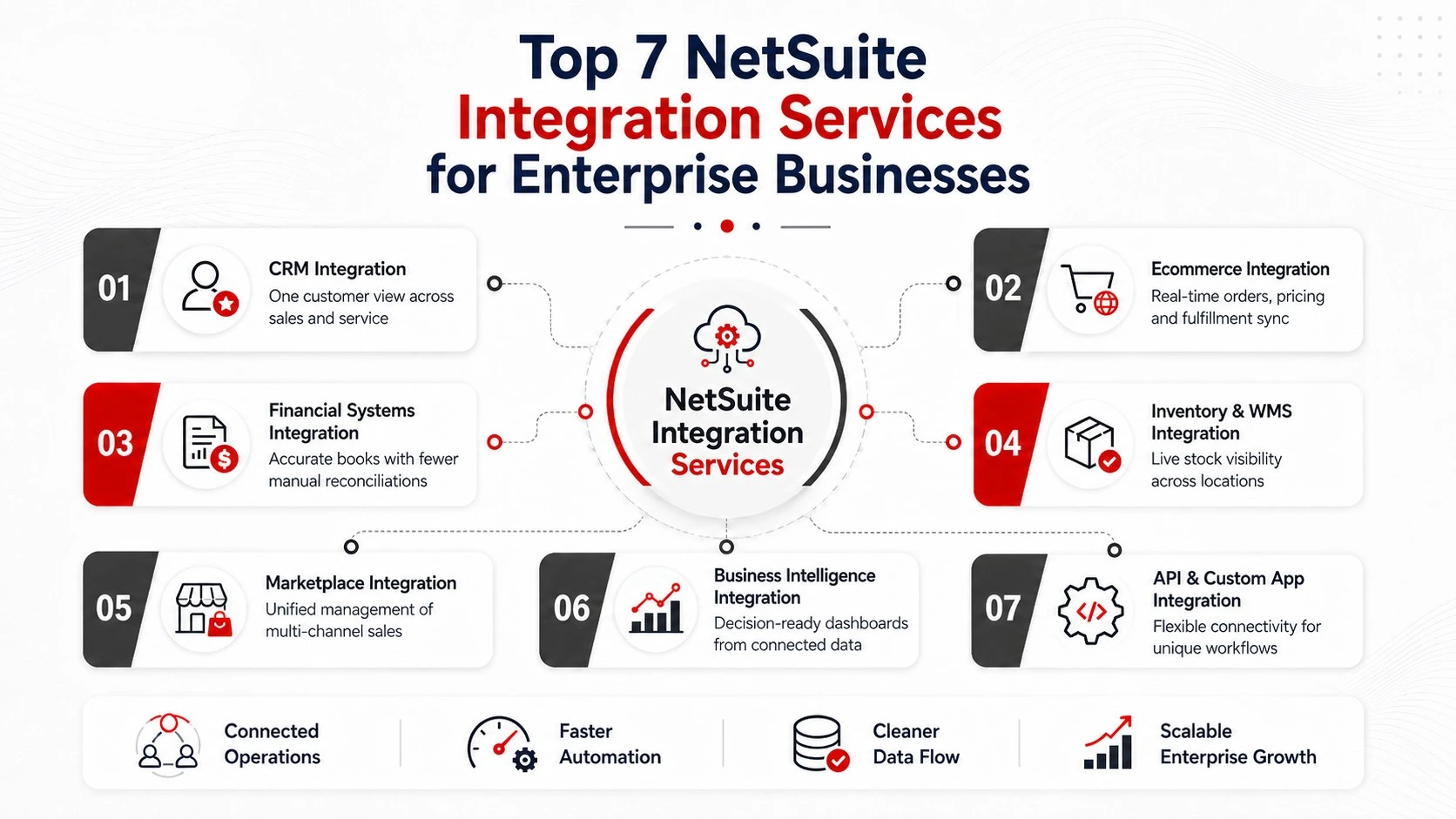
Integration Service 01 - CRM to NetSuite Integration
What it connects: Salesforce, HubSpot, Microsoft Dynamics 365 or any enterprise CRM platform with NetSuite’s order management, billing and financial reporting modules.
Why enterprise businesses need it: The CRM–ERP gap is where revenue leakage often starts. Manual sales order creation in NetSuite after a deal closes in Salesforce can cause fulfilment delays, billing lag and revenue recognition errors. Separate customer records across CRM and NetSuite also create duplicate data, conflicting credit limits and mismatched AR aging reports.
What enterprise-grade NetSuite integration services deliver:
Opportunity Closed in CRM → Sales Order Auto-Created in NetSuite → Inventory Allocated → Invoice Generated → Payment Status Synced Back to CRM → Revenue Recognised
Bi-directional customer master synchronisation - CRM customers sync to NetSuite automatically, while credit limits and payment status updates sync back in real time
Opportunity-to-order automation - closed-won CRM opportunities create NetSuite sales orders with correct products, pricing and billing terms
Invoice and payment status visibility in the CRM - sales teams can view invoice amounts, due dates and overdue balances without leaving the CRM
Revenue forecast reconciliation - CRM pipeline data and NetSuite recognised revenue are aligned for a single source of truth across finance and sales
Integration Service 02 - Ecommerce Platform to NetSuite Integration
What it connects: Shopify, Magento, WooCommerce, BigCommerce or custom ecommerce platforms with NetSuite’s order management, inventory and financial modules.
Why enterprise businesses need it: Enterprise ecommerce businesses handling thousands of daily orders across multiple channels cannot manage fulfilment, inventory allocation and financial reconciliation manually. Orders must move into NetSuite within seconds, inventory must be allocated, fulfillment triggered and financial transactions staged for revenue recognition. Inventory updates in NetSuite must also sync back to ecommerce platforms in real time to prevent overselling.
What enterprise-grade NetSuite ERP integration delivers:
Order Placed on Ecommerce Platform → Order Created in NetSuite → Inventory Allocated → Fulfilment Triggered → Tracking Number Synced Back → Invoice Generated → Revenue Recognised → Inventory Updated Across All Channels
Real-time order synchronisation from every ecommerce channel to NetSuite, with customer details, product lines, pricing, discount codes and shipping instructions mapped automatically
Bi-directional inventory synchronisation, where NetSuite inventory updates ecommerce platforms in real time to prevent overselling
Automated return and refund processing, triggering NetSuite RMA creation, inventory restocking, credit note generation and payment gateway refund instruction
Multi-channel revenue reconciliation, tagging each ecommerce sale with the correct revenue classification for channel-level P&L reporting
Integration Service 03 - Warehouse Management System to NetSuite Integration
What it connects: Manhattan Associates oracle WMS, Infor WMS or third-party logistics provider systems with NetSuite’s inventory and order management modules.
Why enterprise businesses need it: For high-volume fulfilment operations, the WMS is the source of truth for stock positions, pick-and-pack and despatch confirmations, while NetSuite manages inventory valuation order management and customer billing. Without integration, gaps between WMS stock and NetSuite inventory records create fulfilment errors, billing delays and inventory valuation inaccuracies.
What enterprise-grade NetSuite integration services deliver:
Sales Order Confirmed in NetSuite → Pick Instruction Sent to WMS → Pick Confirmed in WMS → NetSuite Inventory Reduced → Despatch Confirmed → Invoice Generated → Tracking Number Updated
Real-time inventory position synchronisation between WMS and NetSuite - bin-level stock movements update NetSuite inventory records immediately, keeping one accurate inventory position across both systems
Purchase order receipt confirmation - WMS receipt and put-away automatically update the NetSuite purchase order and inventory, removing manual goods receipt work
Despatch confirmation and invoice trigger - WMS shipment confirmation automatically generates the customer invoice and updates order status in NetSuite
Returns processing - WMS-confirmed returns update NetSuite inventory, trigger credit note generation and post the financial impact to the correct accounts automatically
Integration Service 04 - Banking and Payment Gateway Integration
What it connects: HDFC, ICICI, Axis, SBI corporate banking platforms and payment gateways including Razorpay, PayU, Stripe and PayPal to NetSuite’s accounts receivable, accounts payable and bank reconciliation modules.
Why enterprise businesses need it: Manual bank statement import and payment reconciliation create high finance overhead with low business value. When transactions are downloaded, formatted and uploaded manually, reconciliation stays delayed, cash visibility remains historical and finance teams spend hours on a process that automated NetSuite ERP integration can complete in minutes.
What enterprise-grade NetSuite integration delivers:
Bank Transaction Occurs → Statement Imported Automatically → Transaction Matched Against NetSuite Entries → Reconciliation Completed → Unmatched Items Flagged → Cash Position Updated → CFO Dashboard Refreshed
Automated bank statement imports via SFTP or direct banking API - removing manual download, formatting and upload delays
Intelligent transaction matching - NetSuite matches bank transactions with open invoices, vendor bills and journal entries, flagging only exceptions for review
Payment gateway settlement reconciliation - Razorpay, PayU and Stripe settlements are matched with NetSuite sales orders and invoices, with fees, refunds and chargebacks posted correctly
Real-time cash position visibility - imported and matched transactions update NetSuite cash positions automatically, giving CFOs and treasury teams an accurate live cash view
Integration Service 05 - EDI Integration for Supply Chain and Retail
What it connects: Electronic Data Interchange (EDI) networks - including GS1, Descartes and SPS Commerce - with NetSuite’s procurement order management and inventory modules for enterprise businesses trading with large retailers or managing complex supplier networks.
Why enterprise businesses need it: Enterprise businesses supplying retailers like Big Bazaar, Reliance Retail or Walmart India or managing international supplier networks, must exchange purchase orders, advance ship notices, invoices and inventory updates through standard EDI formats. Automating this flow into NetSuite removes manual rekeying, reduces errors, prevents delays and helps avoid compliance failures or retailer chargebacks.
What enterprise-grade NetSuite integration services deliver:
Retailer PO Received via EDI → NetSuite Sales Order Created → Fulfilment Confirmed → ASN Generated and Transmitted → EDI Invoice Sent → Payment Confirmation Received → NetSuite AR Updated
EDI transaction set mapping - Standard EDI sets such as 850 Purchase order, 856 Advance Ship Notice and 810 Invoice are mapped to NetSuite records with trading partner-specific field transformation logic.
Trading partner onboarding framework - A standard process to add new EDI trading partners without rebuilding the core EDI architecture, supporting enterprise businesses with growing retail customer bases.
EDI compliance monitoring - Automated alerts flag failed EDI validation against trading partner requirements, allowing teams to correct and resubmit before chargeback windows open.
Functional acknowledgement processing - EDI 997 acknowledgements are processed and matched against outbound transactions to confirm receipt and flag unacknowledged transmissions.
Integration Service 06 - HR and Payroll System Integration
What it connects: SAP SuccessFactors, Darwinbox, Keka, GreytHR and ADP payroll platforms to NetSuite’s financial management and project accounting modules.
Why enterprise businesses need it: For enterprise businesses, the payroll journal is one of the largest recurring financial entries, covering salary costs, employer contributions, tax deductions and departmental cost allocations. Without HR and payroll integration with NetSuite finance, payroll journals are created manually, increasing error risk, timing delays and audit exposure in a business-critical financial process.
What enterprise-grade NetSuite ERP integration delivers:
Payroll Processed in HR System → Journal Entry Generated → Departmental Cost Allocation Applied → Analytic Dimensions Tagged → NetSuite Journal Posted → Project Costs Updated → Finance Dashboard Refreshed
Automated payroll journal generation - approved payroll automatically creates structured NetSuite journal entries, with salary costs allocated to the right departments, cost centres and analytic dimensions
Employee master synchronisation - new employees added in the HR system automatically appear in NetSuite with correct cost centre, department and billing rate configuration, reducing timesheet and project billing gaps
Leave and absence integration - approved leave updates NetSuite resource availability in real time, helping project resource planning reflect actual availability and reducing over-allocation risks
TDS and statutory deduction posting - employer PF, ESI and professional tax contributions are automatically posted to the correct NetSuite liability accounts, reducing manual journals and compliance exposure
Integration Service 07 - Legacy ERP and Third-Party System Integration
What it connects: SAP ECC oracle E-Business Suite, Microsoft Dynamics AX, Tally and custom legacy ERP systems to NetSuite during phased migration programmes or permanent hybrid architecture deployments.
Why enterprise businesses need it: Enterprise businesses rarely move to NetSuite through a single big bang. Manufacturing divisions, regional entities or acquired subsidiaries may continue using legacy ERP systems like SAP oracle EBS or custom platforms while the core business runs on NetSuite. In such hybrid architectures, data must flow accurately between systems so financial consolidation, inventory visibility and order management work across both platforms without manual transfer.
What enterprise-grade NetSuite integration services deliver:
Legacy System Transaction Posted → Integration Layer Triggered → Data Transformed to NetSuite Format → NetSuite Record Created → Consolidation Data Updated → Reporting Unified Across Both Systems
Financial data synchronisation - GL balances, intercompany transactions and period-end data from legacy ERP systems sync automatically to NetSuite for consolidation and group reporting, reducing manual extraction and finance team effort at every close
Master data governance - vendor, customer and product master records are controlled from a defined system of record and synced automatically, preventing master data divergence and reconciliation issues in hybrid ERP architectures
Order and inventory bridging - sales orders, purchase orders and inventory movements from legacy systems reflect in NetSuite in real time, giving finance and operations teams a unified view of group-wide orders and stock positions
Migration bridge architecture - during migration from legacy ERP to NetSuite, LinkedERP builds a transition integration architecture that maintains data consistency, business continuity and data integrity until the legacy system is fully decommissioned
The Integration Architecture Comparison
Factor | Point-to-Point Connections | Enterprise-Grade NetSuite Integration Services |
|---|---|---|
Scalability | Each new system requires a new custom connection | Middleware architecture absorbs new connectors without rebuild |
Error handling | Silent failures - data loss undetected | Automated alerts - failures surfaced before data integrity impact |
Documentation | Undocumented - reverse-engineering required | Full field-level mapping documentation at build time |
NetSuite upgrade compatibility | Breaks at every release - emergency remediation | Pre-release sandbox testing - issues resolved before production impact |
Version control | No change history - rollback impossible | Version-controlled codebase - changes tracked and reversible |
Maintenance cost | Escalates with every system added | Predictable - middleware platform manages connector complexity |
Build time for new connectors | Full custom builds each time | Reuse of existing middleware components - faster delivery |
Audit trail | Not available | Complete transaction-level trail across all integrated systems |
Why LinkedERP Is India's Trusted NetSuite Integration Partner
LinkedERP delivers NetSuite integration services for Indian enterprise businesses with the technical depth, middleware expertise and post-go-live support capability that enterprise-scale integration demands. As a leading NetSuite integration consultants and oracle NetSuite partners in India, LinkedERP brings a structured integration methodology and a contractual accountability model that most NetSuite integration partners cannot match.
What LinkedERP Brings to Every Integration Engagement
Middleware-First Integration Architecture
Every LinkedERP NetSuite ERP integration is built on a documented middleware platform - Celigo, Boomi or MuleSoft - with scalable connector architecture that supports new systems without rebuilding the core integration layer. We avoid point-to-point connections that create technical debt and build integration platforms that grow with the business.
Oracle-Certified NetSuite Integration Consultants - Every engagement is led by Oracle-certified NetSuite integration consultants with individual SuiteCloud and SuiteScript credentials, named before signing and committed through go-live. No bait-and-switch - ever.
Fixed-Fee Integration Proposals - Every LinkedERP NetSuite integration engagement is fixed-fee, with documented integration endpoints, data mapping, error-handling rules and acceptance criteria before work begins. No time-and-materials risk. No surprise invoices - ever.
Client-Owned Integration Architecture - All integration configurations, data mapping documentation, middleware workflows and SuiteScript customisations transfer to the client after completion. No proprietary middleware. No dependency. No lock-in-ever.
Post-Implementation Integration Managed Services - LinkedERP’s NetSuite integration services include a named support contact, SLA-backed response times, proactive bi-annual NetSuite upgrade testing for all integration endpoints and integration health monitoring to detect issues before operational impact.
Conclusion: NetSuite Integration Services That Scale with Your Enterprise
The seven NetSuite integration services - CRM, ecommerce, WMS, banking, EDI, HR and payroll and legacy ERP - form the core integration stack enterprise businesses need to unlock the full operational and financial value of NetSuite. Each integration closes a specific data gap, helping transform NetSuite from a configured ERP into a real-time operational platform that reflects the complete business reality.
The value of NetSuite ERP integration depends on strong architecture: scalable middleware, documented data mapping, reliable error handling and post-go-live support through every NetSuite release. As one of India’s trusted NetSuite integration partners and Oracle NetSuite partners in India, LinkedERP builds durable NetSuite integration services with upgrade testing, managed services and technical assessment to close gaps correctly from the start.
Book
your free NetSuite integration assessment with LinkedERP today
Our team will evaluate your integration requirements, identify every scalability and upgrade compatibility risk, and deliver a fixed-fee proposal with named Oracle-certified NetSuite integration consultants and committed delivery dates - no obligation, no generic sales pitch.
www.linkederp.com | info@linkederp.com | Book a Free Integration Assessment
Frequently asked questions
NetSuite integration services connect NetSuite with CRM, ecommerce, WMS, banking, HR, payroll, EDI and legacy ERP systems. Enterprise businesses need them to enable real-time data flow, reduce manual work and avoid integration failures.
Point-to-point NetSuite ERP integration connects two systems directly but creates technical debt as more systems are added. Middleware-based integration using Celigo, Boomi or MuleSoft is more scalable, centralised and easier to test during upgrades.
Strong NetSuite integration partners test every endpoint, SuiteScript customisation and middleware workflow in NetSuite’s sandbox release preview before upgrades. LinkedERP includes this in post-go-live managed services to reduce release-related failures.
A single CRM or ecommerce integration typically takes 4-6 weeks. A full enterprise stack covering CRM, ecommerce, WMS, banking and HR takes 12-18 weeks, while SAP or Oracle EBS legacy integrations may take 14-20 weeks.
Yes. LinkedERP integrates NetSuite with HDFC, ICICI, Axis, SBI, Razorpay, PayU, Cashfree and Stripe, enabling automated statement imports, settlement matching, gateway fee posting, refunds, chargebacks and payment reconciliation.
Enterprises should assess SuiteCloud and SuiteScript certification, middleware expertise, documented integration methodology, fixed-fee delivery and SLA-backed post-go-live support with proactive upgrade testing.