
Quick Summary
If your business is exploring NetSuite ERP integration services for the first time, this guide breaks the basics down plainly - what's actually involved, how a typical engagement runs and the questions worth asking before choosing a NetSuite ERP implementation partner.
Introduction: What Exactly Are NetSuite ERP Integration Services?
For a business running NetSuite alongside a CRM, an e-commerce platform or a payment system, the systems rarely talk to each other automatically out of the box. NetSuite ERP integration services exist to close that gap - connecting NetSuite to the other tools a business relies on, so data moves between them without someone manually re-entering it every day. If you've never scoped a project like this before, the terminology alone can be confusing: integration, implementation, consultant, partner, middleware - each term means something specific and mixing them up can lead to scoping the wrong kind of engagement entirely. This guide is written for anyone approaching the topic for the first time: it explains what NetSuite ERP integration actually involves, walks through a typical engagement from start to finish and clarifies the difference between a NetSuite ERP implementation consultant and a NetSuite ERP implementation partner, so you know exactly who you're hiring and why.
|
Market Context: The push toward integrated systems isn't a niche concern anymore. Gartner projects the global iPaaS (integration platform as a service) market will reach USD 21.38 billion by 2035 and IDC research finds that 62% of enterprises have already adopted cloud-based integration frameworks rather than relying on manual data transfer between systems. The same analysis notes that companies investing properly in integration see an average 345% return on investment over three years - a figure driven mostly by eliminating the duplicate data entry that NetSuite ERP integration services are specifically designed to remove. Source: AppSeConnect, Enterprise Integration Statistics & Trends 2026 |
What Really Are NetSuite ERP Integration Services?
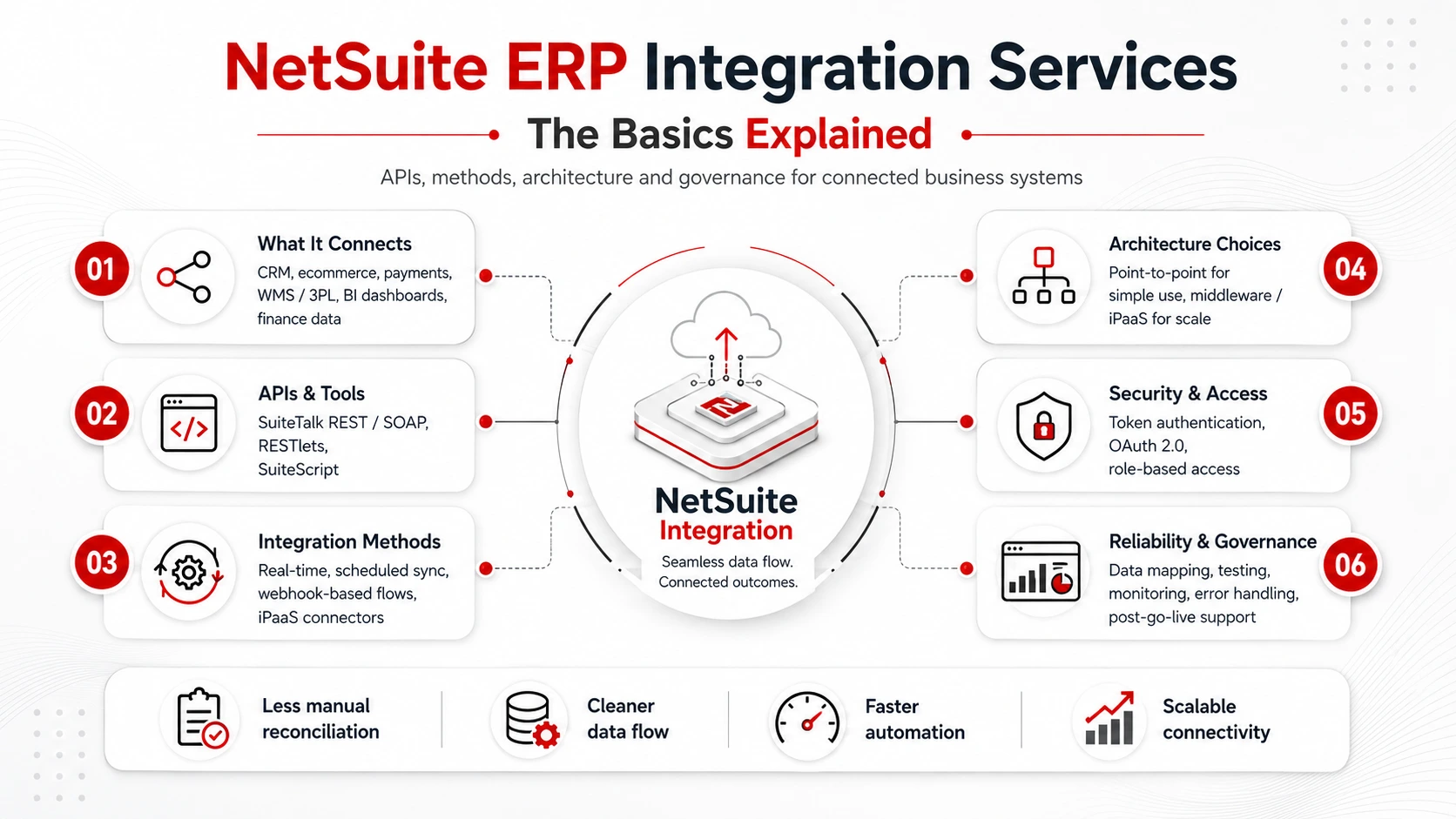
At its simplest, NetSuite ERP integration is the work of connecting NetSuite's data – customer’s orders, inventory, invoices - with the equivalent data in another system, so both stay accurate and up to date without manual intervention. NetSuite ERP integration services is the umbrella term for the professional work involved in making that happen: assessing what needs to connect, designing how data should flow, building the actual connection using NetSuite's APIs or a middleware platform and testing it thoroughly before it touches real business data.
It's worth being clear about what this is not. It's not the same as buying NetSuite itself and it's not the same as a general NetSuite implementation, which covers configuring NetSuite's core modules for your business. Integration services specifically address the connections between NetSuite and everything else - which is exactly why they're often scoped as a distinct phase of a project, even when delivered by the same NetSuite ERP implementation partner handling the core rollout.
Why Businesses Actually Need NetSuite ERP Integration
Without proper integration, a business ends up manually bridging the gap between systems - exporting a sales order from a storefront and re-typing it into NetSuite or reconciling payment gateway settlements against the accounting ledger by hand at month-end. Beyond the wasted time, every manual re-entry point is a fresh opportunity for an error to slip through: a mistyped quantity, a missed order, a duplicate invoice. Proper NetSuite ERP integration removes that manual translation layer entirely, so sales, finance and operations teams are all working from the same live numbers instead of three slightly different versions of the truth pulled from separate systems at different times.
Types of NetSuite ERP Integration Services
Not every integration is built the same way and understanding the main categories helps set realistic expectations before scoping a project.
Point-to-point integrations
- Connect two systems directly, which works well for simple, low-volume needs - for example, a single storefront pushing orders into NetSuite. They're quick to build but don't scale gracefully as more systems get added.
Middleware or iPaaS-based integrations
- Route data through a dedicated integration platform (such as Celigo, Boomi or Workato) rather than connecting systems directly. This adds some upfront setup but pays off quickly once a business needs to connect NetSuite to three or more external systems, since error handling and data mapping live in one central place instead of being duplicated across separate connections.
API-based custom integrations
- Use NetSuite's SuiteTalk (SOAP or REST) API or custom RESTlets to build a tailored connection with specific business logic baked in - useful when off-the-shelf connectors don't quite match how your business actually operates.
EDI integrations
- Handle structured electronic data exchange with trading partners, typically for purchase orders, invoices and shipping notices and are common in manufacturing and distribution businesses working with larger retail or wholesale partners.
Real-time vs. batch integrations
- Describe timing rather than method - some data (like inventory levels for an active storefront) needs to sync near-instantly, while other data (like a nightly summary report) can safely sync on a scheduled batch.
Most real-world NetSuite ERP integration services engagements combine two or more of these approaches, matched to the specific timing and volume needs of each data flow.
At a Glance: Integration Types Compared
|
Type |
Best For |
Complexity |
Scalability |
|
Point-to-Point |
1–2 connected systems |
Low |
Limited |
|
Middleware / iPaaS |
3+ connected systems |
Moderate |
High |
|
API-Based Custom |
Unique business logic needs |
Moderate to High |
Depends on design |
|
EDI |
Trading partner data exchange |
Moderate |
Standardised |
|
Real-Time |
Inventory order status |
Higher (infrastructure) |
High |
|
Batch |
Reporting, non-urgent syncs |
Lower |
High |
Common Mistakes First-Time Buyers Make
Businesses approaching NetSuite ERP integration services for the first time tend to run into a similar set of avoidable problems. The most common is treating integration as an afterthought, scoped only once the core NetSuite implementation is already underway, rather than planning both together from the start - this almost always leads to rushed data mapping and compressed testing time. Another frequent mistake is underestimating how much internal stakeholder time is needed; discovery workshops and sign-offs stall badly when the people who actually understand the business process aren't given dedicated time to participate. Businesses also commonly skip asking about authentication and access scoping specifically, assuming any certified partner will handle it correctly by default, when in practice the difference between tightly scoped integration roles and broad administrator access varies considerably between providers. Finally, many first-time buyers accept a single lump-sum quote without asking for a phase-by-phase breakdown, which makes it far harder to identify where a lower-priced proposal has quietly reduced the scope of testing or post-go-live support.
Key Components of a NetSuite ERP Integration Services Engagement
A properly run integration project, regardless of scale, typically covers the same core components:
- Discovery - understanding which systems need to connect, what data needs to flow between them and how quickly.
- Data Mapping - defining exactly how a field in one system corresponds to a field in the other, including how mismatches or missing data should be handled.
- Authentication & Security Setup - configuring Token-Based Authentication or OAuth 2.0 with access scoped tightly to what the integration actually needs.
- Build - developing the actual connection, whether through SuiteTalk, RESTlets or a middleware platform.
- Testing - validating not just the expected "happy path" but edge cases like cancelled orders, partial refunds and records with missing optional fields.
- Deployment & Monitoring - going live with logging and alerting in place, so issues are caught within hours rather than discovered days later during a reconciliation.
- Ongoing Support - maintaining the integration as connected systems change their APIs or as the business adds new data flows over time.
Skipping or rushing any one of these steps is usually where integration projects run into trouble later, even when the initial build looked clean.
NetSuite ERP Implementation Consultant vs. NetSuite ERP Implementation Partner: What's the Difference?
These two terms get used somewhat interchangeably, but they describe genuinely different things and knowing the distinction helps you scope the right kind of help.
A NetSuite ERP implementation consultant is typically an individual specialist - someone with deep, hands-on expertise in a specific area, such as SuiteScript development, revenue recognition configuration or a particular industry's workflow requirements. Consultants are often brought in for a defined piece of a larger project or to advise on a specific technical challenge.
A NetSuite ERP implementation partner, by contrast, is the organisation taking overall accountability for a project - assembling the team (which may include several consultants with different specialisations), managing the project plan and standing behind the delivered outcome contractually. When a business signs an agreement for NetSuite ERP integration services, they're typically signing with an implementation partner, even though the actual hands-on work is carried out by individual consultants within that partner's team.
Understanding this distinction matters when evaluating proposals: a strong partner organisation with a weak bench of consultants can still produce a disappointing result and a brilliant individual consultant without proper project management backing can struggle on a larger, multi-workstream engagement.
What NetSuite ERP Services Typically Cost
Pricing for NetSuite ERP services varies considerably and three factors explain most of the difference. The number of systems being integrated matters most - a single connector is a fundamentally smaller scope than tying together a CRM, payment gateway and warehouse system simultaneously. Data complexity is the second factor, since clean, well-structured data migrates and integrates faster than messy, duplicated or undocumented records. The third is ongoing support scope - some engagements are priced purely for the initial build, while others include a defined period of monitoring and adjustment after go-live.
Businesses comparing quotes should ask for a breakdown by discovery, build, testing and post-go-live support, rather than a single lump-sum figure, since that breakdown makes it far easier to spot where a cheaper proposal may have under-scoped testing or ongoing monitoring to win the deal on price.
How to Choose the Right NetSuite ERP Implementation Partner
A few practical questions separate a strong NetSuite ERP implementation partner from a risky one. Ask how they approach data mapping and documentation - a partner who can't show you a sample data-mapping artefact from a past project is a partner who may not be documenting decisions carefully on yours either. Ask specifically about authentication and access scoping, since defaulting to broad administrator access for every integration is a sign of shortcuts elsewhere. And ask what post-go-live support actually includes contractually, since integrations that work perfectly in testing can behave differently under real production volume in the first few weeks after launch.
Why LinkedERP Delivers Reliable NetSuite ERP Integration Services
LinkedERP provides NetSuite ERP integration services for Indian and global businesses connecting NetSuite to CRMs, e-commerce platforms, payment systems and logistics partners, with a contractual commitment that defines what a properly scoped NetSuite ERP integration engagement should look like.
What LinkedERP Brings to Every Engagement
- Certified Consultants, Accountable Delivery - every engagement combines specialist NetSuite ERP implementation consultant expertise with LinkedERP's overall project accountability as your implementation partner.
- Documentation-First Approach - data mapping, authentication scope and error-handling logic are documented before any code is written, not reconstructed after the fact.
- Fixed-Fee Proposals - full scope, documented deliverables, no surprise invoices - ever.
- Client-Owned Configuration - all integration logic, mappings and documentation transfer to you on completion - no dependency, no lock-in.
- Post-Implementation Managed Services - a named support contact, defined SLAs and proactive monitoring as data volumes and connected systems grow.
LinkedERP's NetSuite ERP Integration Capability Stack
- API Development - SuiteTalk (SOAP & REST), custom RESTlets and SuiteScript logic tailored to your business rules.
- Middleware & iPaaS - Celigo, Boomi and Workato-based architectures for multi-system environments.
- CRM & Sales Integration - bi-directional sync for unified customer and revenue data.
- E-commerce & Payments - order, inventory and settlement synchronisation across storefronts and payment gateways.
- EDI & Logistics - structured data exchange with trading partners and 3PL providers.
- Authentication & Security - Token-Based Authentication and OAuth 2.0 with tightly scoped integration roles.
- Monitoring & Support - centralised error logging, alerting and ongoing managed support after go-live.
Taken together, this is what separates LinkedERP from a typical provider of NetSuite ERP services: documentation-first delivery that survives beyond the initial project, an accountable implementation partner backing every specialist consultant on the team and a capability stack broad enough to carry an integration from the first connector through years of ongoing support.
Conclusion: Where Should You Start with NetSuite ERP Integration Services?
Understanding the basics - what NetSuite ERP integration services actually cover, the difference between a consultant and a partner and what a properly run engagement looks like - puts you in a far stronger position to scope a project correctly the first time. Whether you need a single connector or a fuller middleware layer, working with an experienced NetSuite ERP implementation partner ensures the integration is documented, tested and supported well beyond the initial go-live, rather than becoming another disconnected tool you have to manually reconcile a year from now.
Exploring
NetSuite ERP integration services for the first time or ready to scope your
next connector?
Talk to LinkedERP's team for a clear, jargon-free assessment tailored to your systems and business needs.
www.linkederp.com | info@linkederp.com | Book a Free Integration Assessment
Frequently asked questions
They're the professional services involved in connecting NetSuite to other business systems - such as CRMs, e-commerce platforms or payment gateways - so data flows automatically without manual entry.
Implementation covers configuring NetSuite's core modules for your business, while integration specifically addresses how NetSuite connects and exchanges data with other systems.
A consultant is typically a specialist handling a defined piece of technical work, while a partner is the organisation taking overall accountability for the project and standing behind the delivered outcome.
Point-to-point works for simple, low-volume needs, but middleware or iPaaS is generally recommended once three or more systems need to connect to NetSuite.
Cost depends mainly on the number of systems integrated, data complexity and whether ongoing post-go-live support is included - ask for an itemised breakdown rather than a single lump-sum quote.
Yes, LinkedERP provides end-to-end NetSuite ERP integration services, from discovery and API development to authentication setup and post-implementation support.