
Quick Summary:
|
Introduction: What Should You Look for in NetSuite Solution Providers?
Look for NetSuite solution providers that combine official partner status with certified consultants, relevant industry experience, a documented delivery method, local compliance depth and clear support after go-live. Status on its own does not tell you how well a team will deliver your project.
The market is crowded. In 2027, many NetSuite service providers claim similar credentials and their proposals can look almost identical on paper.
This guide gives you a practical way to tell them apart. It covers:
- The 12 features that matter most when choosing a NetSuite ERP solution provider
- How to test each feature with a direct question
- How a NetSuite solution provider in India differs from a global one
- How to compare proposals side by side
|
Market Context: NetSuite's own partner pages show that its partners do different jobs. According to NetSuite, Solution Providers deliver complete NetSuite solutions, from selling licences through implementation to ongoing support and consulting. Alliance Partners focus on business transformation consulting along with integration and implementation services, while BPO and Referral partners play narrower roles. NetSuite also advertises that new partners can begin delivering within 90 days through its SuiteLife programme, so a partner badge on its own does not show how deep a team's experience is. That is why the features below matter more than status alone. Source: NetSuite, Partners and Solution Providers |
What Is a NetSuite Solution Provider and How Is It Different from Other NetSuite Service Providers?
A NetSuite solution provider is an official NetSuite partner that can sell NetSuite licences, implement the system and support it afterwards. Other partner types do narrower jobs.
|
Partner Type |
What NetSuite Says It Does |
Best For |
|
Solution Provider |
Sells licences, implements and supports |
One accountable partner from licence to support |
|
Alliance Partner |
Transformation consulting, integration and implementation |
Complex advisory or integration-heavy projects |
|
BPO Partner |
Business process outsourcing built on NetSuite |
Outsourced finance or operations |
|
Referral Partner |
Introduces NetSuite to prospects for a fee |
Early-stage introductions, not delivery |
Many firms offering NetSuite services hold more than one designation. Always confirm which one applies to the work you are buying.
What Are the Top 12 Features to Look for in NetSuite Solution Providers?
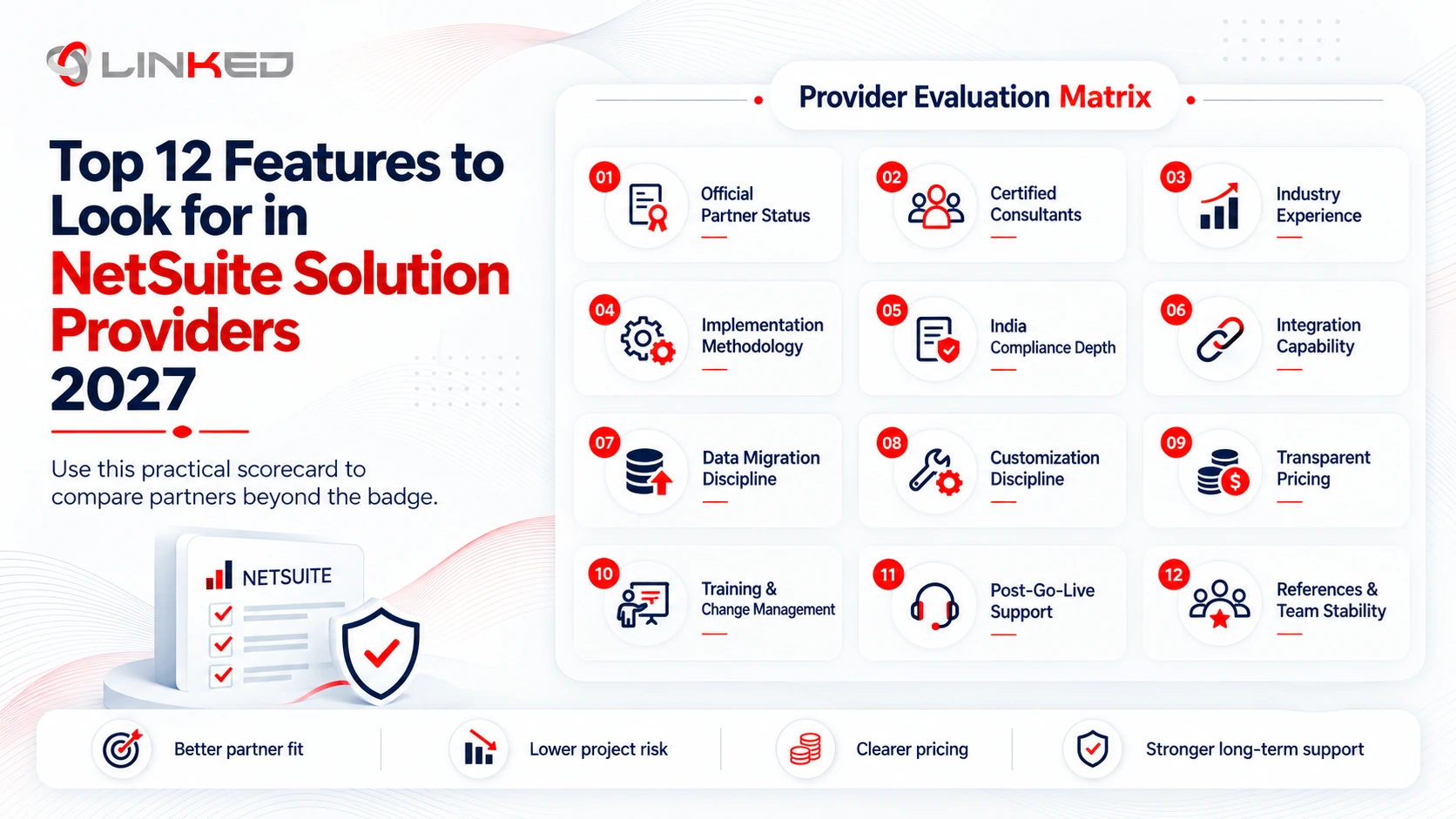
1. Official NetSuite Partner Status
Start by confirming the provider is authorised by NetSuite.
- What to look for - A clear partner designation, such as Solution Provider or Alliance Partner.
- Why it matters - It confirms the firm works with NetSuite directly and has met the program's entry requirements.
- Question to ask - "Which partner program are you in and how can I verify it with NetSuite?"
2. Certified Consultants on Your Team
Certification belongs to people, not companies.
- What to look for - Named consultants holding relevant NetSuite certifications, such as SuiteFoundation, Administrator or ERP Consultant.
- Why it matters - The people assigned to your project do the work, so their credentials matter more than the firm's badge.
- Question to ask - "Who exactly will work on my project and which certifications do they hold?"
3. Industry Experience Like Yours
Industry patterns shape configuration choices.
- What to look for - Completed projects in your sector, such as manufacturing, distribution or services.
- Why it matters - A provider that has solved your industry's problems before makes fewer expensive discoveries on your project.
- Question to ask - "How many clients like us have you taken live and can I speak to one?"
4. A Documented Implementation Methodology
A method turns an implementation from improvisation into a plan.
- What to look for - A defined approach covering discovery, configuration, testing, training and go-live, such as NetSuite's SuiteSuccess framework or an equivalent.
- Why it matters - Documented phases make timelines and costs more predictable.
- Question to ask - "Can you show me your project plan template and what each phase produces?"
5. Local Compliance Depth
For Indian businesses, this feature separates real specialists from generalists.
- What to look for - Proven configuration of GST, e-invoicing, e-way bills and TDS/TCS.
- Why it matters - Compliance mistakes tend to surface at filing time, which is the most expensive moment to fix them.
- Question to ask - "How many India-compliant go-lives have you delivered and can I see the setup?"
6. Integration Capability
Most businesses connect NetSuite to other tools.
- What to look for - Experience with SuiteTalk, RESTlets, middleware platforms and connectors for CRM, e-commerce and banking.
- Why it matters - Integration is a common source of post-go-live problems when it is treated as an afterthought.
- Question to ask - "Show me a data-mapping document from a past integration project."
7. Data Migration Discipline
Bad data undermines a good system.
- What to look for - A plan to cleanse, map and validate data before it is loaded.
- Why it matters - Migrating messy data "as is" is one of the most reliable ways to cause a rocky go-live.
- Question to ask - "How do you validate migrated data and what is your rollback plan?"
8. Customisation Discipline
More customisation is not better customisation.
- What to look for - A habit of using standard NetSuite workflows first and scripting or custom workflows only where they add real value.
- Why it matters - Every customisation adds testing effort and upkeep through future NetSuite releases.
- Question to ask - "How do you decide what to configure versus what to customise?"
9. Transparent, Scoped Pricing
Pricing should be clear enough to compare.
- What to look for - A breakdown by discovery, configuration, migration, integration, training and support, with exclusions listed.
- Why it matters - A single lump sum hides where a cheaper quote has cut scope.
- Question to ask - "What is excluded from this price and how are scope changes priced?"
10. Training and Change Management
Adoption decides whether the system delivers value.
- What to look for - Role-based training planned inside the project timeline.
- Why it matters - Teams that are trained late often fall back on spreadsheets.
- Question to ask - "What training is included and who delivers it?"
11. Post-Go-Live Support and SLAs
Support is where long-term value is won or lost.
- What to look for - A named support contact, defined response times and a plan for NetSuite's regular releases.
- Why it matters - Early production issues are most likely in the weeks after launch.
- Question to ask - "What are your response times and who supports us after go-live?"
12. References and Team Stability
Past results and team continuity predict future delivery.
- What to look for - Reference clients of similar size and industry and a low turnover of consultants.
- Why it matters - Frequent team changes force you to re-explain your business mid-project.
- Question to ask - "How long have your consultants been with you and will the team stay through go-live?"
At a Glance: The 12 Features Compared
|
# |
Feature |
Risk It Reduces |
Quick Test |
|
1 |
Official partner status |
Unverified claims |
Ask for the designation and verify |
|
2 |
Certified consultants |
Inexperienced delivery |
Ask for names and credentials |
|
3 |
Industry experience |
Costly discovery on your project |
Ask for a similar client |
|
4 |
Documented methodology |
Unpredictable timelines |
Ask for the project plan |
|
5 |
Local compliance depth |
Filing errors |
Ask for India go-live count |
|
6 |
Integration capability |
Post-go-live failures |
Ask for a data-mapping example |
|
7 |
Data migration discipline |
Rocky go-live |
Ask for the validation plan |
|
8 |
Customisation discipline |
Upgrade friction |
Ask for the configure-vs-customise rule |
|
9 |
Transparent pricing |
Hidden scope cuts |
Ask for a phase-by-phase quote |
|
10 |
Training |
Low adoption |
Ask what training is included |
|
11 |
Support and SLAs |
Unsupported production issues |
Ask for response times |
|
12 |
References and stability |
Team churn |
Call a reference client |
What Should You Prepare Before Contacting NetSuite Service Providers?
Good preparation makes proposals sharper and easier to compare.
- List Your Pain Points - Write down the three processes that hurt most today.
- Name Your Systems - List every tool NetSuite will need to connect to.
- Define Your Entities - Note legal entities, currencies and locations in scope.
- Set a Budget Range - Share it so providers scope to reality, not guesses.
- Pick a Decision Owner - One person should be able to approve scope quickly.
- Gather Sample Data - Real examples of messy records speed up migration planning.
What Phases Should a Good NetSuite Project Plan Include?
A credible provider will show a plan with clear phases. Ask what each one produces.
- Discovery - Documented processes, requirements and scope.
- Configuration - Setup of modules, roles and workflows.
- Integration and Migration - Connected systems and validated data.
- Testing - Standard cases and edge cases, with sign-off.
- Training - Role-based sessions before go-live.
- Go-Live and Support - Cutover, early support and a handover plan.
If a plan skips testing or support, treat that as a gap to resolve before signing.
How Should You Read Case Studies and References?
Case studies are marketing. References are evidence. Use both carefully.
- Look for Specifics - Numbers, timelines and named scope are more useful than praise.
- Check the Match - Compare the client's size, industry and complexity to yours.
- Ask About Surprises- Every project has them, so ask how they were handled.
- Ask About Support - What did the first quarter after go-live look like?
- Ask About Timeline - Did the project finish when originally promised?
How Does a NetSuite Solution Provider in India Differ from a Global Provider?
A NetSuite solution provider in India faces requirements that many global firms have not handled before. The difference shows up in compliance and day-to-day working.
- Compliance Knowledge - GST, e-invoicing, e-way bills and TDS/TCS are part of everyday configuration.
- Local Time Zones - Support and workshops run during your working hours.
- Local References - Clients can describe how the setup performed at filing time.
- Local Billing - Contracts and invoicing in INR can simplify finance approval.
When comparing a NetSuite service provider in India against a global firm, weigh these practical points alongside the technical features above.
How Do You Compare NetSuite ERP Implementation Partners Side by Side?
Comparing NetSuite ERP implementation partners works best with a simple scorecard.
- Pick Your Criteria - Use the 12 features and weight the ones that matter most to you.
- Ask for the Same Scope - Give every provider identical requirement so quotes are comparable.
- Score on Evidence - Rate answers you can verify, such as references and documents.
- Call References - Speak to at least one client of similar size and industry.
- Review the Team - Compare the named consultants, not just the firms.
- Check Support Terms - Put response times and release handling side by side.
What Does Good Support Look Like After Go-Live?
Support terms are easy to overlook during selection. A strong NetSuite ERP solution provider spells them out.
- Named Contact - You know who to call, not just which inbox to email.
- Response Times - Severity levels and target response times are written down.
- Release Handling - NetSuite updates are tested against your configuration.
- Change Requests - Small configuration changes have a clear process and price.
- Regular Reviews - Scheduled check-ins catch issues before they grow.
Ask to see a sample support agreement before you sign the main contract.
What Red Flags Should You Watch For?
A few warning signs appear repeatedly in weak proposals.
- Unnamed Consultants - If the team is not named before signing, the people may change.
- Vague Scope - Phrases like "standard implementation" without module detail hide risk.
- No Methodology - A provider that cannot show a project plan is likely improvising.
- Reluctance to Share References - Hesitation is useful information.
- No Compliance Examples - For India, this is a serious gap.
- Support Left Undefined - "We'll be available" is not a service level.
How LinkedERP Approaches These 12 Features
LinkedERP is one of the NetSuite ERP implementation partners you may compare and it scopes engagements around the features in this guide.
- Certified Consultants - Named in the proposal before signing and retained through go-live.
- India Compliance - GST, e-invoicing and TDS/TCS are configured from day one.
- Documented Scope and Fixed Fees - Modules, deliverables and exclusions are agreed upfront.
- Integration and Migration - Both are scoped and tested before go-live.
- Defined Support - A named contact, SLAs and testing of NetSuite releases for your configuration.
Conclusion: Are You Choosing the Right NetSuite Solution Provider?
The right NetSuite solution providers combine official status with certified people, relevant experience, a clear method, local compliance depth and dependable support. No single feature decides the outcome, but weakness in several of them usually shows up as cost and delay later.
Use the 12 features in this guide as a scorecard. Ask direct questions, check references and compare proposals on the same scope. A careful NetSuite ERP solution provider will welcome that scrutiny.
Comparing
NetSuite solution providers for your business?
Talk to LinkedERP's team for a scoped assessment of your requirements, compliance needs and support expectations.
www.linkederp.com | info@linkederp.com | Book a Free Assessment
Frequently asked questions
Look for certified consultants, industry experience, India-specific compliance knowledge, integration capability, transparent pricing and clearly defined post-go-live support.
The strongest providers are those with proven implementation experience, certified teams, structured delivery methods and long-term support. LinkedERP is a strong option for mid-market businesses seeking end-to-end NetSuite services.
Providers vary in industry depth, consultant experience, pricing models, integration expertise, localisation capability and managed-support quality, so comparing delivery approach is more important than comparing brand names alone.
Small and mid-sized businesses should prioritise providers offering right-sized scope, fixed or transparent pricing, named consultants and scalable support rather than enterprise-heavy delivery models.
Yes, many providers offer managed support covering configuration changes, troubleshooting, integrations, reporting and NetSuite release updates; the scope and SLA should be confirmed before signing.
Yes. Experienced providers can integrate NetSuite with CRM, ecommerce, banking, WMS, payment gateways, EDI and legacy systems using APIs, connectors and middleware platforms.