
Quick Summary:
|
ERP inventory management software keeps stock, locations, replenishment and costing in one system. This guide compares eight options for Indian enterprises, from NetSuite and Odoo to SAP, Microsoft, Infor and Ramco. For India, check GST localization and partner depth before you shortlist. |
Introduction: Which ERP Inventory Management Software Suits Indian Enterprises?
The best ERP inventory management software for an Indian enterprise depends on its size, number of warehouses, industry and compliance needs. A multi-entity group with global suppliers needs different strengths than a single-country manufacturer. This guide compares eight options and shows how to choose.
The list is not a ranking. LinkedERP implements NetSuite and Odoo, so those two come first and are described in the same format as the other six.
You will find what is ERP inventory management, the tools used for inventory management in ERP, eight options with fit and India notes and how NetSuite ERP integration and partner choice affect results.
|
Market Context: Inventory systems matter most where manufacturing is large and complex. According to the India Brand Equity Foundation (IBEF), manufacturing contributes around 16–17% of India's GDP and employs more than 27 million workers and micro, small and medium enterprises account for about 35.4% of manufacturing output. That mix of large plants and many smaller suppliers means enterprises often hold stock across several sites and depend on accurate stock data to plan purchasing and production. Source: IBEF, Manufacturing Sector in India; IBEF, Manufacturing Industry Presentation |
What Is ERP Inventory Management?
ERP inventory management is the part of an ERP system that tracks stock, controls where it sits and drives replenishment, valuation and counting. Because it shares data with purchasing, sales, production and finance, every stock movement updates the whole business.
In practice, a receipt in the warehouse raises the stock figure that planners see, the value that finance books and the availability that sales can promise. There is no separate spreadsheet to reconcile.
It typically covers four areas:
- Stock Visibility - Quantities by item, location and status in real time.
- Movements and Replenishment - Receipts, issues, transfers and reorder rules that trigger purchase or transfer requests.
- Valuation and Counting - Costing methods that feed the ledger, plus cycle counts and physical checks.
- Traceability - Lot, batch or serial history where products require it.
What Are the Tools Used for Inventory Management in ERP?
The tools used for inventory management in ERP fall into a few groups and most enterprise systems combine several of them.
- Records and warehouse control - The stock ledger holds on-hand quantity and value by item and location. Warehouse management adds bin-level control, directed put-away and picking and mobile or barcode scanning for receiving, picking and counting.
- Planning and costing - Replenishment planning uses reorder points, safety stock and demand-based suggestions. Costing methods such as FIFO or average cost post values to finance and cycle counting corrects errors without a full shutdown.
- Insight and connections - Dashboards show stock turns, ageing and stockouts, while integrations link the ERP to e-commerce, logistics and supplier systems.
What Are the Top 8 ERP Inventory Management Software Options for Enterprises in India?
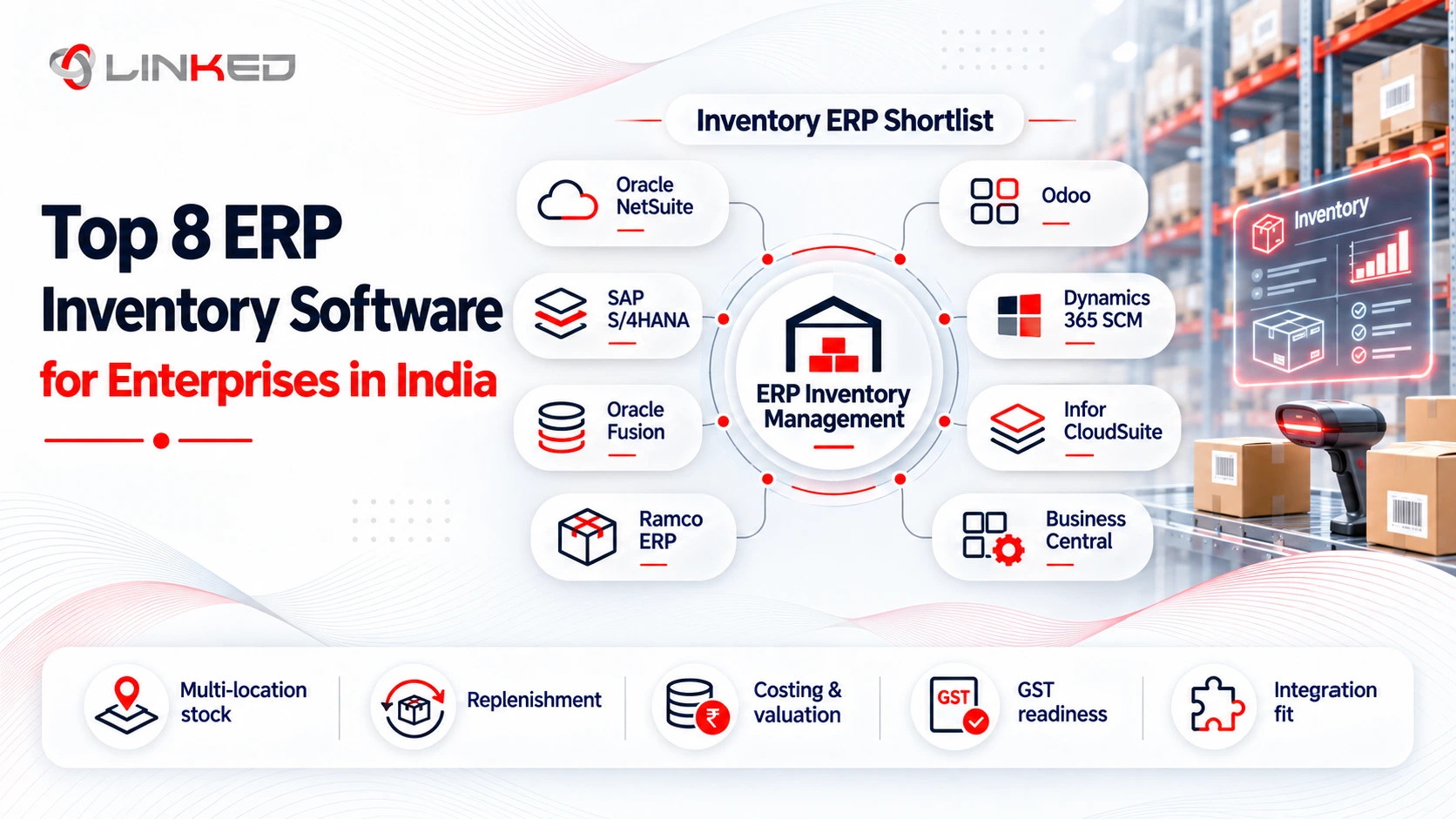
The top 8 ERP inventory management software options for Indian enterprises are Oracle NetSuite, Odoo, SAP S/4HANA, Microsoft Dynamics 365 Supply Chain Management oracle Fusion Cloud Inventory Management, Infor CloudSuite, Ramco ERP and Microsoft Dynamics 365 Business Central. Each is described below with its strength, India notes and best fit.
1. What Does Oracle NetSuite Offer for Inventory Management?
Oracle NetSuite is a cloud ERP in which inventory is native to the suite, so stock transactions flow straight to finance. According to NetSuite, demand-based replenishment manages reorder points and preferred stock levels using historical and seasonal sales, lead times and days of supply.
Key features:
- Multi-location stock: Inventory is tracked by location, with bin management for storage detail.
- Consignment inventory: Supplier-owned stock is handled inside the same system.
- NetSuite ERP integration: SuiteTalk, RESTlets and connectors link CRM, e-commerce and logistics tools.
For India, the India Localization SuiteTax Engine SuiteApp covers GST, TDS and e-invoicing and it needs SuiteTax enabled and setup through your NetSuite account manager. NetSuite suits growing mid-market and multi-entity enterprises that want one managed cloud platform.
2. What Does Odoo Offer for Inventory Management?
Odoo is a modular ERP in which the Inventory app shares one database with Sales, Purchase, Manufacturing and Accounting. You can start with the apps you need and add others as the business grows.
Key features:
- Editions: An open-source Community edition and a subscription-based Enterprise edition.
- Shared data: Stock updates flow to purchasing, sales and accounting without re-keying.
- Customization: Studio on Enterprise, plus code-level changes.
Odoo's India localization includes GST, with e-invoicing and e-way bills available since Odoo 15. It suits enterprises and growing businesses that value flexibility and a staged rollout.
3. What Does SAP S/4HANA Offer for Inventory Management?
SAP S/4HANA is SAP's ERP, where Inventory Management records every goods movement with real-time quantities and valuation. Stock is managed across plants, storage locations and warehouses on one real-time data model.
Key features:
- Plant and storage-location control: Inventory Management tracks quantity and value at that level.
- MRP integration: MRP Live uses real-time stock for planning.
- Scalable warehousing: Warehouse options extend beyond basic stock control.
Confirm the GST localization scope for your SAP edition with your partner. SAP suits large enterprises with complex, multi-plant operations.
4. What Does Microsoft Dynamics 365 Supply Chain Management Offer for Inventory?
Dynamics 365 Supply Chain Management is Microsoft's supply chain ERP for manufacturers, distributors and retailers. It gives near real-time stock visibility across sites, warehouses and locations.
Key features:
- Inventory dimensions: Inventory, storage and tracking dimensions give detailed stock control.
- Transfers and blocking: Transfer orders and inventory blocking are built in.
- AI support: Microsoft's 2026 release wave lists AI-driven inventory rebalancing.
Check the localization package for GST and e-invoicing with your partner. It suits enterprises already invested in the Microsoft ecosystem.
5. What Does Oracle Fusion Cloud Inventory Management Offer?
Oracle Fusion Cloud Inventory Management is Oracle's inventory solution within its supply chain cloud and it is separate from NetSuite. It gives visibility into every item, movement and transaction, with automated replenishment.
Key features:
- Task assignment: Pick slips, PAR counts and cycle counts can be assigned to specific users.
- Advanced option: Oracle Fusion Advanced Inventory Management adds automated cycle counting and mobile task execution.
- Supply chain fit: It connects with Oracle's wider supply chain applications.
Confirm the India tax localization scope with your Oracle partner. It suits large enterprises standardizing on Oracle's supply chain cloud.
6. What Does Infor CloudSuite Offer for Inventory Management?
Infor CloudSuite is a set of ERP suites, with a separate Infor WMS for warehouse execution. Infor says its WMS provides bin-level, multi-site and multi-owner inventory.
Key features:
- Wave management: Create and schedule waves by lines, weight and destination.
- 3PL billing: Support for third-party logistics providers.
- Inventory attributes: Lot codes, country of origin and shelf life can be tracked.
Verify localization and local support before shortlisting. Infor suits distribution-heavy enterprises with complex warehouse operations.
7. What Does Ramco ERP Offer for Inventory Management?
Ramco ERP comes from Ramco Systems, which is headquartered in Chennai. Its supply chain modules help manage and optimize inventories and align supply with demand.
Key features:
- Inventory Hub: A single-screen workspace for inventory activities.
- Manufacturing fit: Support for make-to-order, make-to-stock, engineer-to-order and configure-to-order production.
- Integrated modules: Inventory links with purchasing, production and accounts.
Ramco is India-based but confirm current GST features for your version. It suits manufacturers who prefer an Indian vendor.
8. What Does Microsoft Dynamics 365 Business Central Offer for Inventory?
Dynamics 365 Business Central is Microsoft's ERP for small and mid-sized organizations. Microsoft's guidance says Business Central and Supply Chain Management both help organizations maintain optimal inventory levels.
Key features:
- Inventory management: Item, stock and location control.
- Internal warehouse processes: Microsoft documents how to manage them in Business Central.
- Microsoft integration: It fits with the wider Microsoft stack.
Check the India localization for GST and e-invoicing with your partner. Business Central suits mid-sized enterprises that do not need Supply Chain Management's depth.
At a Glance: The 8 Options Compared
|
# |
Software |
Core Strength |
Best Fit |
India Note |
|
1 |
Oracle NetSuite |
Demand-based replenishment, native finance link |
Growing mid-market and multi-entity |
India SuiteApp for GST, TDS, e-invoicing |
|
2 |
Odoo |
Modular apps on one database |
Staged rollouts, flexibility |
India localization with GST |
|
3 |
SAP S/4HANA |
Real-time multi-plant stock and MRP |
Large complex enterprises |
Confirm GST scope |
|
4 |
Dynamics 365 SCM |
Inventory dimensions, transfers, AI rebalancing |
Microsoft-centric enterprises |
Confirm localization |
|
5 |
Oracle Fusion Inventory |
Automated replenishment, task assignment |
Oracle supply chain users |
Confirm localization |
|
6 |
Infor CloudSuite |
Bin-level, multi-site WMS |
Distribution-heavy operations |
Verify local support |
|
7 |
Ramco ERP |
Indian vendor, manufacturing modes |
Manufacturers preferring Indian vendors |
Confirm GST features |
|
8 |
Dynamics 365 Business Central |
Inventory for mid-sized firms |
Mid-sized enterprises |
Confirm localization |
How Does NetSuite ERP Integration Support Inventory Accuracy?
Inventory accuracy depends on the systems around the ERP as much as the ERP itself. NetSuite ERP integration connects the stock ledger to the tools that create stock movements, such as e-commerce platforms, logistics and 3PL tools, supplier systems, barcode scanners and finance tools.
For example, an online order reduces available stock and the updated level returns to the storefront. A shipment or receipt from a logistics partner updates stock without re-keying and counts from scanners post straight to the ledger.
Good NetSuite ERP integration needs three things:
- Documented Mapping - Fields and logic are written down.
- Edge-Case Testing - Returns, cancellations and partial shipments are tested.
- Monitoring - Failed syncs are flagged quickly.
How Do You Choose ERP Inventory Management Software?
Use the same checklist for every option so the comparison stays fair. Start with your warehouse complexity, which means counting sites, bins and movement types and match the system to your production mode, whether discrete, process or make-to-order.
Then test compliance and integration. Ask each vendor to show GST and e-invoicing set up, not just described and list every system that must connect.
Finally, check the implementation partner's experience in your industry and build a three-year cost that includes licenses, implementation, customization, upgrades and support. Let warehouse staff test the screens and scanning flows before you decide.
Good inventory ERP software fits your processes. It does not force your processes to fit it.
How Do You Choose Among NetSuite ERP Partners in India?
If NetSuite is on your shortlist, partner quality shapes the outcome. Compare NetSuite ERP partners in India on substance, starting with partner status, which you can verify with NetSuite and the named consultants who will work on your project along with their certifications.
Then check four things:
- India Compliance - Ask to see GST, TDS and e-invoicing configured.
- Inventory Experience - Ask for clients with multi-location or manufacturing stock.
- References - Speak to a client of similar size.
- Support Terms - Get response times and release handling in writing.
How Should You Roll Out ERP Inventory Management Step by Step?
A phased rollout lowers risk, whichever platform you choose. Each step builds on the one before.
- Step 1: Map Stock Flows - Document receipts, issues, transfers and returns for every site.
- Step 2: Clean the Item Master - Fix duplicates, units of measure and bills of materials.
- Step 3: Configure the Core - Set up locations, costing, reorder rules and approvals.
- Step 4: Connect Systems - Build and test integrations with e-commerce, logistics and finance.
- Step 5: Test Real Scenarios - Include partial receipts, returns and cycle count adjustments.
- Step 6: Train by Role - Teach warehouse, purchasing and finance staff separately.
- Step 7: Go Live and Review - Monitor closely, then tune rules using real data.
What Mistakes Do Enterprises Make with Inventory ERP Software?
Most problems come from a few repeated mistakes. Enterprises often buy on brand, because the best-known name is not always the best fit and they skip data cleanup, so messy item masters and bills of materials break planning.
Four more are common:
- Skipping Warehouse Input - Floor staff catch process problems early.
- Under-Scoping Integration - Disconnected systems undermine stock accuracy.
- Over-Customizing - Heavy custom work raises cost and upgrade effort.
- Forgetting Support - Issues appear in the weeks after go-live.
How LinkedERP Approaches ERP Inventory Management
LinkedERP implements NetSuite and Odoo and it scopes inventory projects around the points in this guide. Warehouse and stock flows are documented before configuration and GST and e-invoicing are configured from day one.
- Clean Data - Item masters are validated before go-live.
- Documented Integration - Mapping and testing cover stores, logistics and finance links.
- Defined Support - A named contact and response times are agreed upfront.
Conclusion: Which ERP Inventory Management Software Is Right for You?
There is no single best ERP inventory management software for every Indian enterprise. NetSuite and Odoo suit growing and flexible businesses, SAP oracle and Infor suit large and complex operations, Microsoft options suit Microsoft-centric firms and Ramco suits those preferring an Indian vendor.
Start by mapping your warehouses, production mode and compliance needs. Then test two or three options against the same checklist. The right inventory ERP software and the right partner, will fit your processes and keep stock data accurate as you grow.
Choosing ERP inventory management software?
Talk to LinkedERP's team for a scoped assessment of your warehouses, compliance needs and integration plan.
www.linkederp.com | info@linkederp.com | Book a Free Assessment
Frequently asked questions
An ERP inventory system connects stock, purchasing, sales, warehousing and finance in one platform, updating inventory automatically as goods are bought, moved, produced or sold.
There is no single best ERP for every business. NetSuite is strong for growing, multi-entity companies, while Odoo is often better for businesses that want modular flexibility and deeper customization.
ERP software uses real-time stock visibility, reorder points, demand data and replenishment rules to trigger purchasing earlier while preventing unnecessary excess inventory.
The best choice depends on your warehouse size and ERP environment, but platforms such as NetSuite and Odoo support barcode-driven receiving, picking, stock transfers and inventory counts.
A custom ERP can track inventory by item, warehouse, bin, batch or serial number while automating replenishment, transfers, approvals and reporting around the company’s specific workflows.
Odoo is a strong option for smaller manufacturers wanting modular, customizable ERP, while NetSuite is well suited to growing mid-market manufacturers needing stronger financial, inventory and multi-entity capabilities.