
Quick Summary:
|
NetSuite ERP solutions help most where complexity is high: stock held in many places, revenue that recurs, projects billed by the hour or several entities and currencies. This guide covers six industries that fit that pattern, from manufacturing and distribution to SaaS and professional services, with India notes and advice on choosing a partner. |
Introduction: Which Industries Benefit Most from NetSuite ERP Solutions?
The industries that benefit most from NetSuite ERP solutions are manufacturing, wholesale distribution, retail and e-commerce, software and SaaS, professional services and food, beverage and consumer goods. Each has a complexity that spreadsheets and basic accounting tools struggle with, such as multi-location stock, recurring billing or project profitability.
NetSuite ERP software is not the right fit for every business. It works best where several functions, such as inventory, finance, billing and reporting, need to run on the same live data.
This guide explains why these six industries fit, what NetSuite offers each one and how to choose a NetSuite ERP solution provider.
|
Market Context: India's sectors are large and growing and NetSuite's customer base is broad. According to the India Brand Equity Foundation, manufacturing contributes around 16–17% of India's GDP and employs more than 27 million workers. BCG projects India's e-commerce market to reach $280–300 billion by 2030. Oracle's reported results put NetSuite at more than 43,000 customers across 219 countries. Large, fast-growing sectors with complex operations are exactly where an integrated ERP system pays off. Source: IBEF, Manufacturing Sector in India; |
Why Do Some Industries Benefit More from a NetSuite ERP System?
A NetSuite ERP system delivers the most where a business has to coordinate many moving parts in real time. The same few patterns appear across the industries below.
- Complex Inventory - Stock sits across locations, lots and suppliers.
- Recurring or Contract Revenue - Billing and recognition follow contracts, not single sales.
- Project-Based Work - Time and cost must tie to billing.
- Multiple Entities - Subsidiaries, currencies and locations need consolidated reporting.
- Compliance Pressure - Tax and reporting rules must be built into transactions.
If your business shows two or more of these patterns, NetSuite ERP solutions are worth evaluating.
What Are the 6 Industries That Benefit Most from NetSuite ERP Solutions?
The six industries are manufacturing, wholesale distribution, retail and e-commerce, software and SaaS, professional services and food, beverage and FMCG. Each section below explains the fit, the key capabilities and who it suits best.
1. Manufacturing: One Record from Purchase Order to Finished Goods
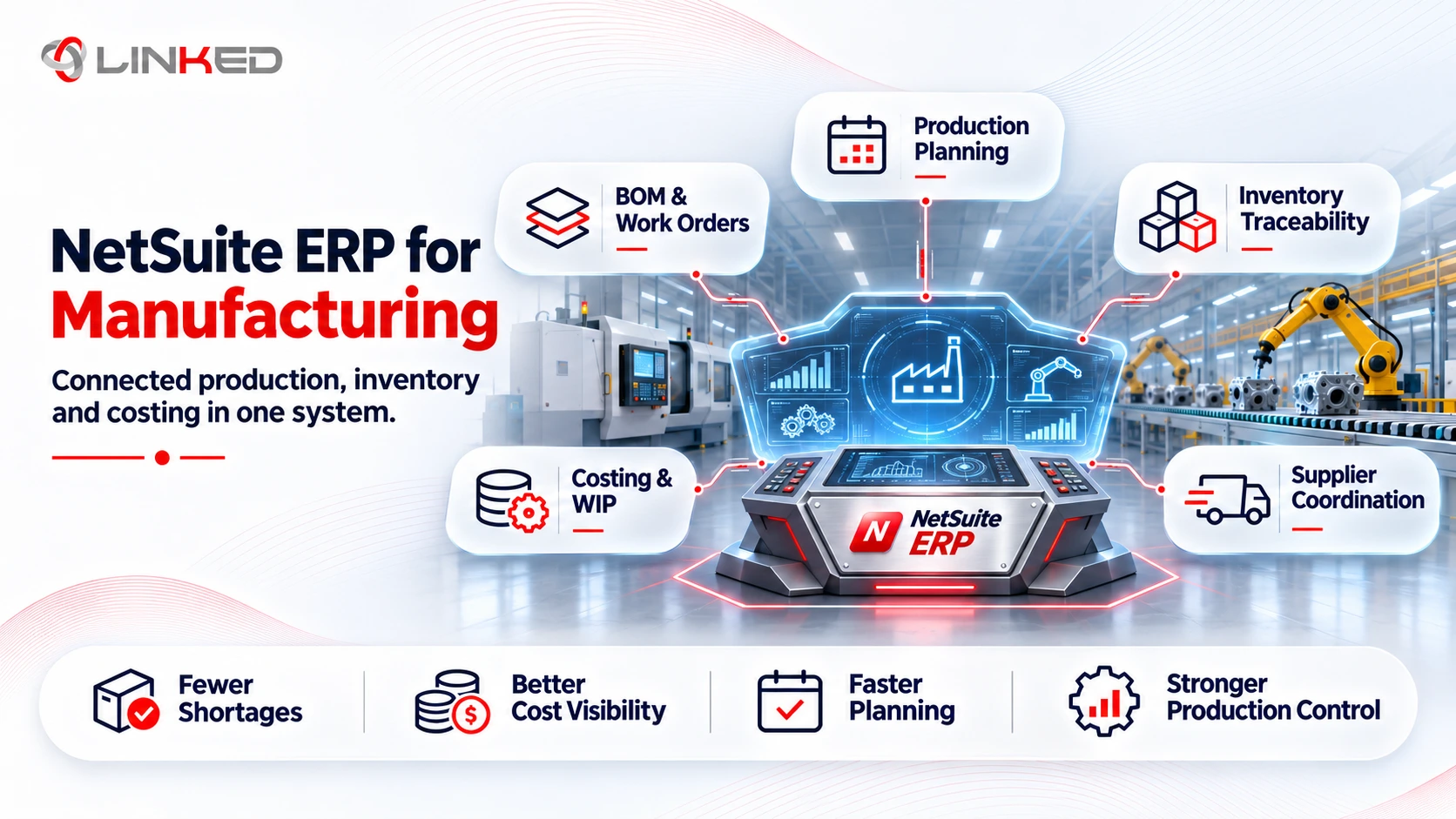
Manufacturers juggle bills of materials, production orders, material shortages and costing. NetSuite ERP solutions connect these in one system, so a shortage seen in purchasing, production and finance is the same shortage.
- Common challenge: Bills of materials, production orders and costing live in separate tools, so planners work from stale data and finance reconciles after the fact.
How NetSuite ERP solves it:
- Manufacturing features: Bills of materials, work orders, work in progress and routings.
- Inventory tools: Demand-based replenishment, lot and serial tracing and bin management.
- Cost dashboards: Real-time product cost and profitability views.
- Key benefits: Fewer production delays from unseen shortages, less manual reconciliation between the shop floor and finance, and more accurate product costs.
- Ideal fit: Mid-sized manufacturers with multi-step production, many suppliers or more than one plant, including Indian plants that coordinate with many smaller suppliers.
- Ideal pricing: Partner-reported module fees for Advanced Inventory (about $500 a month), Manufacturing ($600–$2,000 a month) and WMS ($1,000–$2,000 a month) add up to roughly $25,000–$54,000 a year. Implementation of a manufacturing edition is often quoted at $30,000–$80,000.
2. Wholesale Distribution: Control Over Stock Across Locations
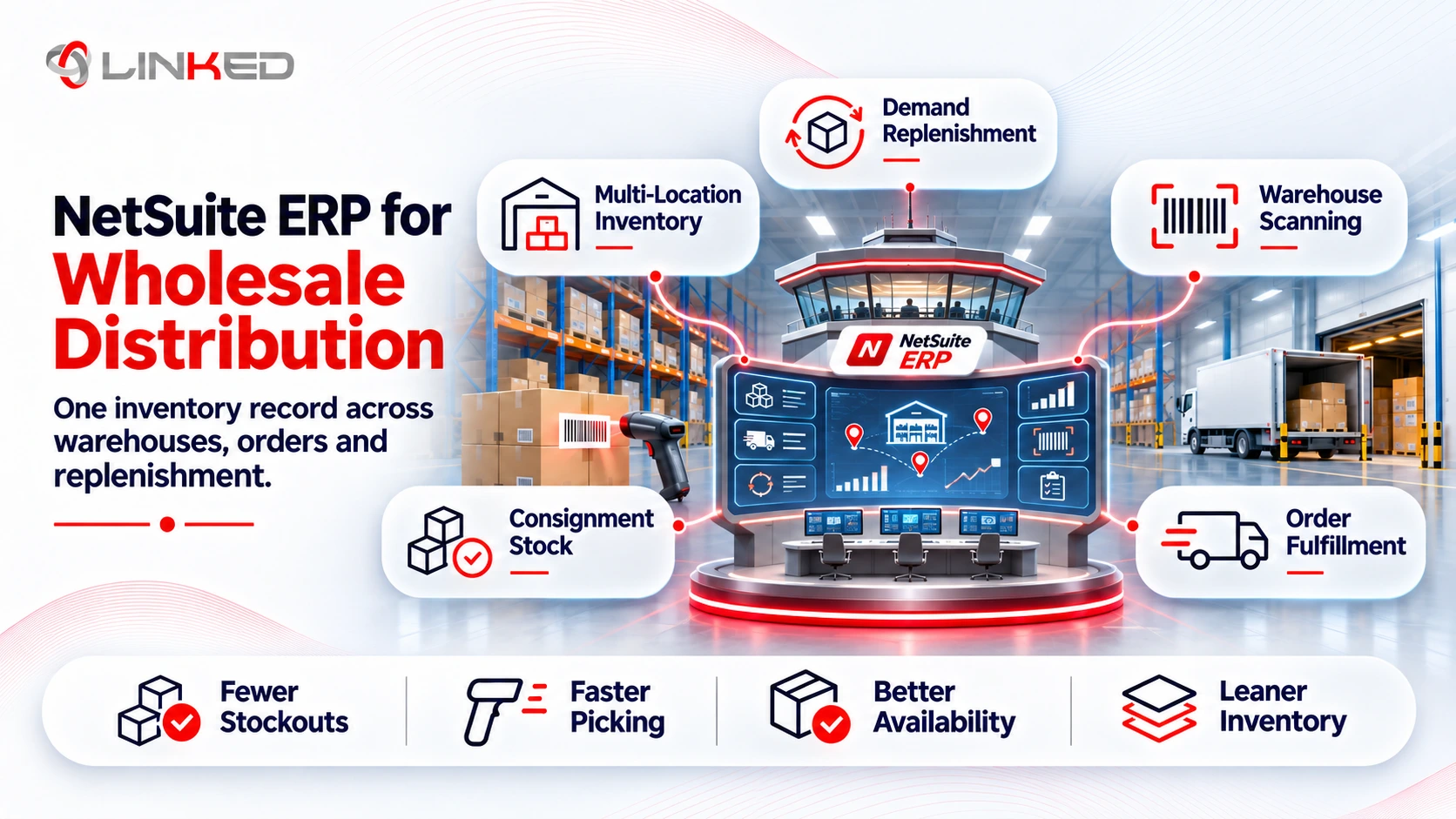
Distributors buy in volume, hold stock in several warehouses and must promise availability accurately. NetSuite ERP solutions give them one inventory record and replenishment driven by demand data.
- Common challenge: Stock figures differ by warehouse and spreadsheet, so buyers over-order, sales promise stock that is not there and warehouse staff work from paper.
How NetSuite ERP solves it:
- Demand-based replenishment: Reorder points and preferred stock levels set from sales history, lead times and days of supply.
- Multi-location inventory: Stock tracked by location and bin.
- Warehouse management: NetSuite WMS adds mobile scanning, directed put-away and wave picking, and it needs Advanced Inventory Management and bin management enabled first.
- Consignment stock: Supplier-owned inventory handled in the same system.
- Key benefits: Fewer stockouts and less idle stock, faster and more accurate picking, and more reliable availability promises to customers.
- Ideal fit: Distributors with several warehouses, large product ranges or supplier-owned stock.
- Ideal pricing: Advanced Inventory (about $6,000 a year) plus WMS ($12,000–$24,000 a year) comes to roughly $18,000–$30,000 a year in partner-reported module fees.
3. Retail and E-commerce: Unified Orders, Stock and Finance
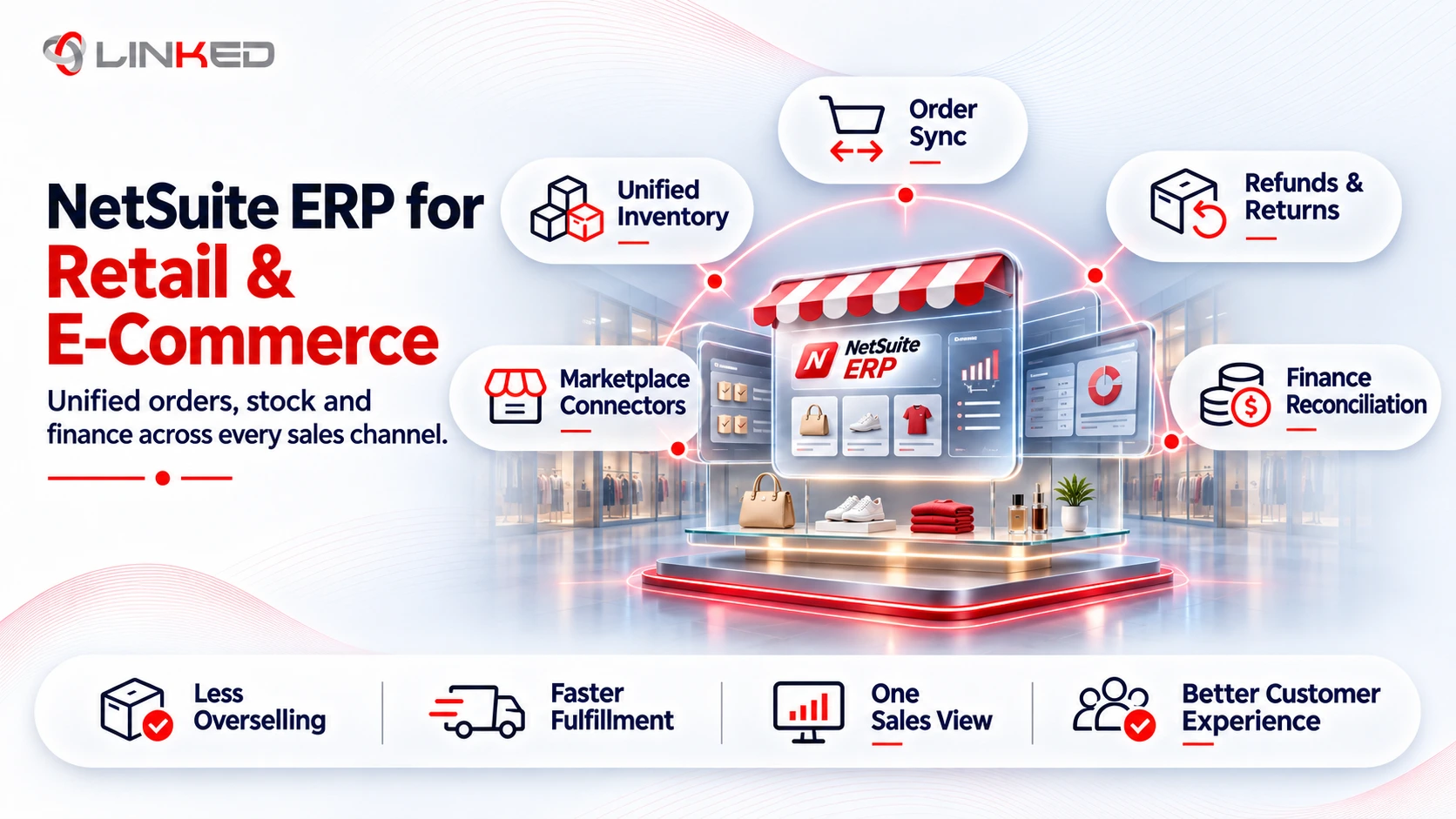
Retailers sell through stores, websites and marketplaces, and each channel can hold a different picture of stock. NetSuite can sit behind those channels as the single record for orders, inventory and finance.
- Common challenge: Channels carry separate stock counts, which leads to overselling, late deliveries and manual reconciliation of orders and refunds.
How NetSuite ERP solves it:
- Channel connectors: Oracle's documentation for its Shopify B2B connector lists company, order, fulfilment, product, refund, inventory, and catalogue and price list syncs.
- One inventory record: A single stock figure serves every channel.
- SuiteCommerce: NetSuite's own commerce product for a NetSuite-native storefront.
- Finance link: Orders, refunds and fulfilment post to the ledger.
- Key benefits: Fewer oversold orders, less manual reconciliation and one view of sales and stock across all channels.
- Ideal fit: Retailers and online sellers on several channels that have outgrown the inventory tools inside each storefront.
- Ideal pricing: SuiteCommerce is reported at about $2,500 a month (roughly $30,000 a year) and SuiteCommerce Advanced at about $5,000 a month (roughly $60,000 a year), plus Advanced Inventory at about $6,000 a year. If you connect an existing Shopify store instead, there is no SuiteCommerce fee, but connector or middleware subscriptions are separate.
4. Software and SaaS: Subscription Billing and Revenue Recognition
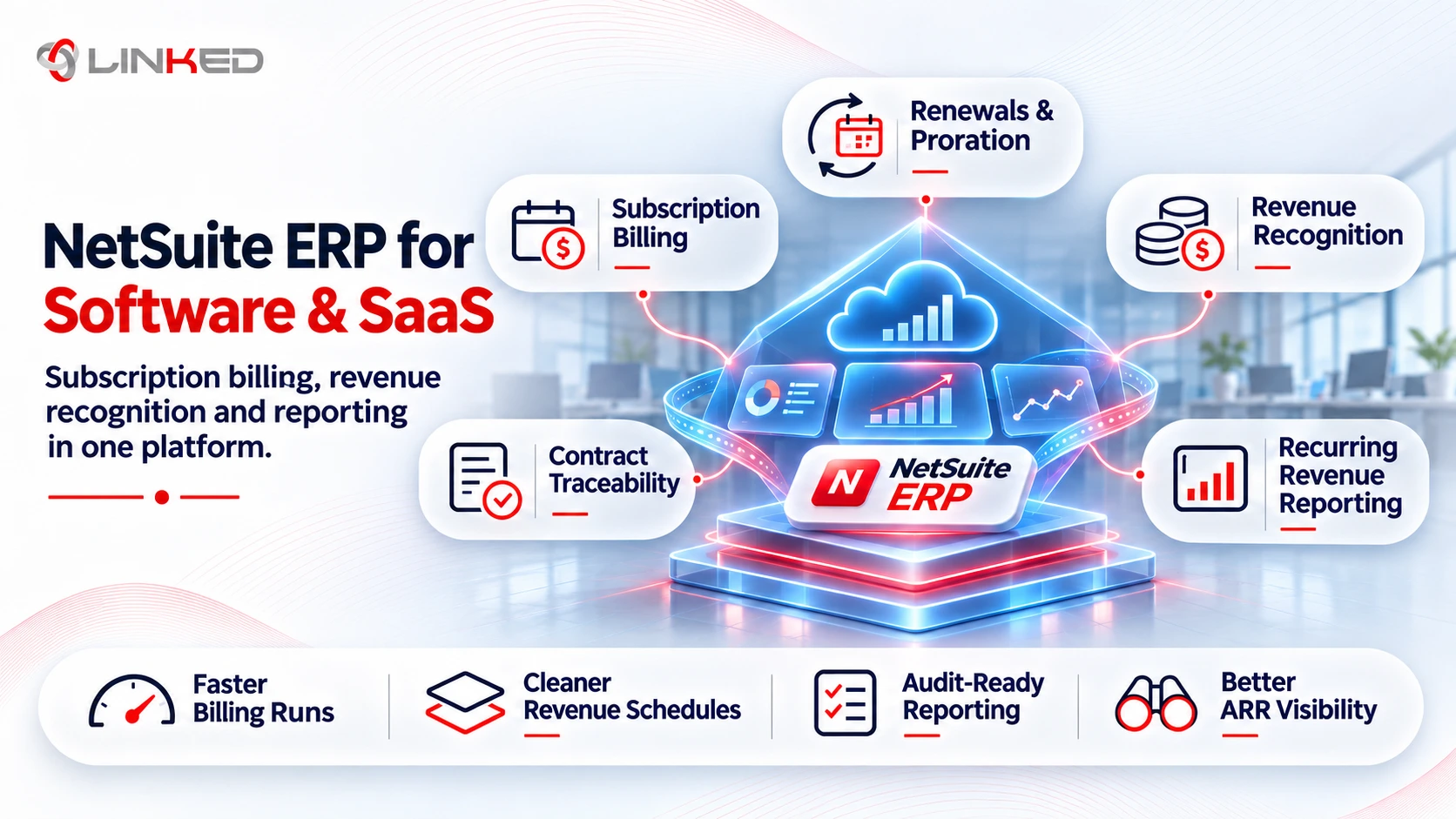
Software companies sell subscriptions, usage and renewals, so revenue is earned over time and contracts keep changing. NetSuite ERP solutions align billing, recognition and reporting in one system.
- Common challenge: Billing runs, proration and revenue schedules sit in spreadsheets, which makes closes slow and recognition hard to audit.
How NetSuite ERP solves it:
- SuiteBilling: Manages recurring subscriptions, proration, consolidated charges and renewal invoices.
- Revenue Management: Generates schedules under ASC 606 and IFRS 15.
- Recurring revenue reporting: Live views of annual recurring revenue and usage.
- Key benefits: Faster and more accurate billing runs, less spreadsheet work on revenue schedules and recognition that can be traced to the contract.
- Ideal fit: SaaS and technology companies with recurring contracts, renewals or usage-based billing.
- Ideal pricing: SuiteBilling with Advanced Revenue Management is typically quoted at $10,000–$30,000 a year combined, and Advanced Financials adds about $6,000–$12,000 a year.
5. Professional Services: Time, Projects and Profitability
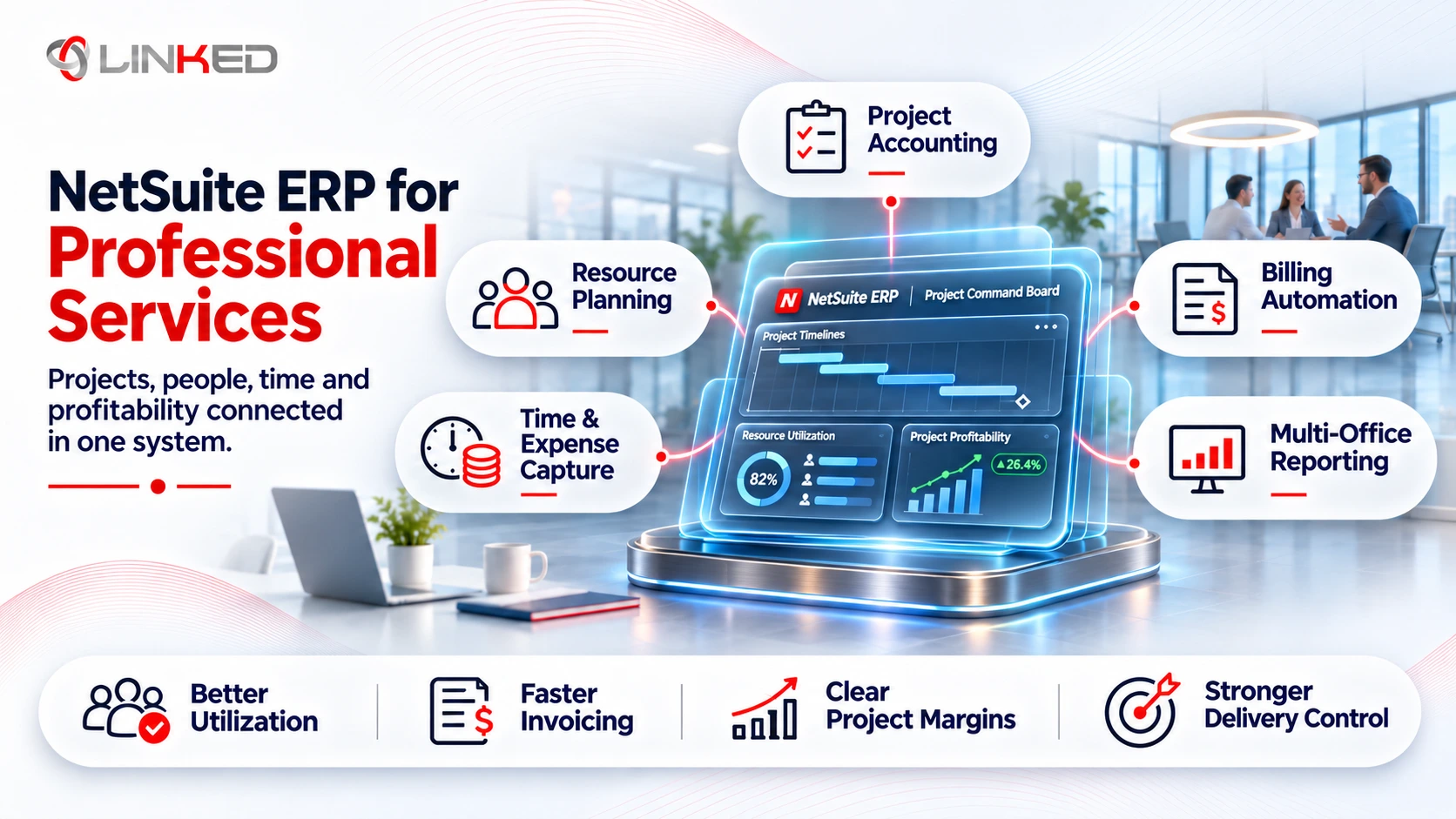
Services firms sell time and expertise, so the key questions are whether projects are profitable, whether staff are fully used and whether billing keeps pace with delivery. NetSuite brings planning, project accounting and billing together.
- Common challenge: Time, expenses and budgets sit in different tools, so project margin is only clear after the project ends and invoices go out late.
How NetSuite ERP solves it:
- SuiteProjects Pro: Planning, staffing, billing and reporting for services firms.
- Project accounting: Budgets versus actuals and project profitability.
- Billing rules: Time and expenses feed invoices automatically.
- Multi-subsidiary structure: Reporting across offices and entities.
- Key benefits: Earlier warning on budget overruns, more accurate invoices from time entries and a clearer view of margin by project and client.
- Ideal fit: Consultancies, agencies and IT services firms that bill for time and projects, including multi-office firms.
- Ideal pricing: SuiteProjects Pro is reported at $25–$50 per user a month, so a 50-user firm would pay roughly $15,000–$30,000 a year, with Advanced Financials and Advanced Revenue Management at about $6,000–$12,000 a year each.
6. Food, Beverage and FMCG: Traceability and Shelf-Life Control
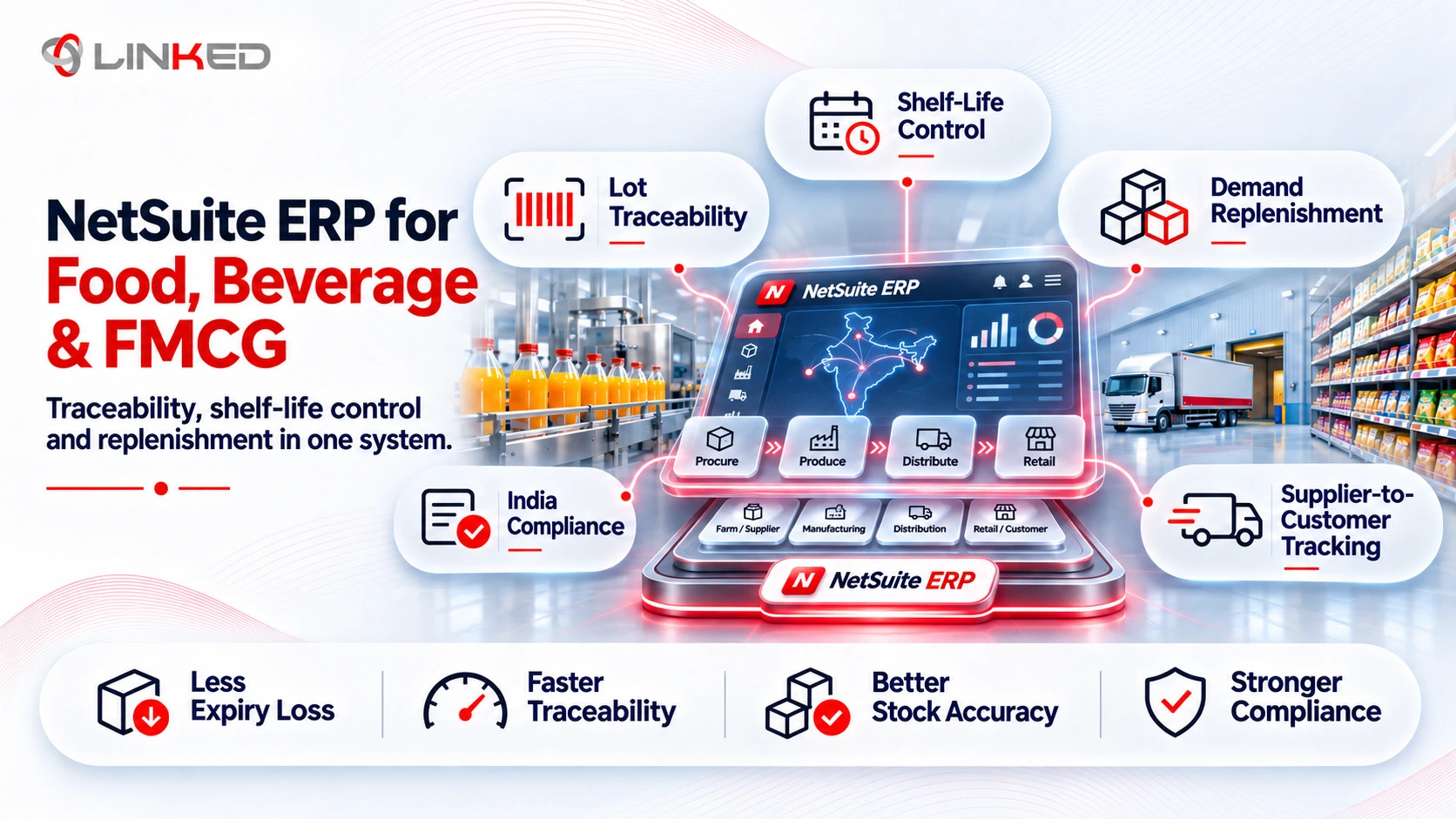
Food and consumer goods businesses must know where each lot came from and where it went, and stock that expires first should leave first. NetSuite's inventory tools are built around lot tracing and expiry-aware stock use.
- Common challenge: Tracing a lot takes hours of manual searching, expired stock is written off and goods-movement paperwork is compiled by hand.
How NetSuite ERP solves it:
- Lot tracing: Trace a lot back to suppliers and forward to customers.
- Expiry-aware stock use: First-expiring, first-out handling for dated goods.
- Demand-based replenishment: Orders that follow sales patterns.
- E-way bill support: Goods-movement compliance in India through the localization.
- Key benefits: Faster traceability when a lot must be located, less expired stock and more accurate stock counts.
- Ideal fit: Food, beverage and FMCG businesses that need traceability, shelf-life control and India goods-movement compliance.
- Ideal pricing: Advanced Inventory plus WMS comes to roughly $18,000–$30,000 a year in partner-reported fees. Producers who add Manufacturing ($7,200–$24,000 a year) land closer to $25,000–$54,000.
A note on pricing. Oracle does not publish module prices. The ranges above are indicative USD estimates from partner and third-party pricing guides in 2026, and they cover module fees only. They sit on top of the base platform (reported from about $999 a month), per-user licenses and implementation, and Indian quotes may differ, so ask for a written quote.
At a Glance: The 6 Industries Compared
|
# |
Industry |
Main Pain |
Key NetSuite Capability |
India Note |
|
1 |
Manufacturing |
Disconnected production, stock and cost |
BOMs, work orders, WIP, lot and serial tracing |
GST and e-invoicing through the India SuiteApp |
|
2 |
Wholesale distribution |
Multi-warehouse stock accuracy |
Demand-based replenishment, WMS, consignment |
E-way bills for goods movement |
|
3 |
Retail and e-commerce |
Channels with different stock views |
Connectors and a unified inventory record |
Fast e-commerce growth raises the stakes |
|
4 |
Software and SaaS |
Subscription billing and recognition |
SuiteBilling and Revenue Management |
GST on services through the India SuiteApp |
|
5 |
Professional services |
Project profitability and utilization |
SuiteProjects Pro and project accounting |
Multi-office and multi-entity reporting |
|
6 |
Food, beverage and FMCG |
Traceability and shelf life |
Lot tracing, first-expiring first-out |
E-way bills for goods movement |
How Does NetSuite ERP India Support Compliance Across These Industries?
NetSuite ERP India deployments need local tax and invoicing built into the transaction flow. Oracle provides an India Localization SuiteTax Engine SuiteApp for this.
According to Oracle's documentation, it calculates GST and TDS and it sends e-invoices through a GST Suvidha Provider to the Invoice Registration Portal. Setup needs SuiteTax enabled and a request to your NetSuite account manager.
For goods-based industries such as manufacturing, distribution and FMCG, this compliance layer matters as much as the operational features. Ask any partner to show it working, not just describe it.
For NetSuite ERP India projects, a sensible starting order is:
- Compliance first - Configure GST, e-invoicing and, for goods businesses, e-way bills.
- Highest-volume process next - Start with the flow that carries the most transactions, such as orders or billing.
- Reporting last - Build dashboards once the underlying data is reliable.
How Do You Know If NetSuite ERP Software Fits Your Industry?
A short self-check helps. The more of these statements apply to you, the stronger the case.
- Your stock or revenue is complex - Multiple locations, lots, subscriptions or contracts.
- You use several disconnected tools - Finance, inventory, billing and CRM live apart.
- You operate more than one entity or currency - Reporting needs consolidation.
- Month-end close is slow - Reconciling data takes days.
- You expect to grow quickly - Today's tools will not scale.
If few of these apply, a simpler system may serve you better for now.
How Do You Choose a NetSuite ERP Solution Provider?
Choosing the right NetSuite ERP solution provider matters as much as choosing NetSuite. There is no single list of the best NetSuite implementation partners, because the best fit depends on your industry, size and compliance needs.
Compare NetSuite ERP implementation partners on the same checklist:
- Industry Experience - Ask for clients in your sector and a reference you can call.
- Partner Status - Verify the designation with NetSuite.
- Named Consultants - Confirm who will do the work and their certifications.
- India Compliance - Ask to see GST and e-invoicing configured.
- Support Terms - Get response times and release handling in writing.
Why Does Industry Experience Matter When You Pick NetSuite ERP Implementation Partners?
Industry experience shortens projects and reduces rework. A partner that has already configured a bill of materials, a subscription billing flow or a lot-tracing process knows where the traps are.
The best NetSuite implementation partners for you are therefore the ones with proven work in your sector, not simply the ones with the longest client list. Generalists can deliver good projects but they often learn your industry's rules on your time and budget.
When you compare NetSuite ERP implementation partners, ask for specifics:
- Similar Clients - How many projects have they delivered in your industry and can you speak to one?
- Sector Workflows - Can they show how they configured production, billing or traceability for a client like you?
- Typical Pitfalls - What do they usually see go wrong in your sector and how do they prevent it?
How Should You Prepare Your Requirements Before Talking to a Partner?
Preparation makes every conversation more useful. Before you contact anyone, spend a few days documenting how your business actually runs.
Write down your three most painful processes, the systems a NetSuite ERP system would need to connect to and any industry rules you must follow. Note how many entities, locations and currencies you operate in and who can approve scope decisions quickly.
It also helps to collect:
- Sample data - Real, messy examples of items, customers or contracts.
- Reports you rely on - The outputs that the new system must reproduce.
- Compliance needs - Tax, traceability and audit requirements for your sector.
- Success measures - For example, stockouts avoided, days to close or hours of billing work removed.
Which Businesses May Not Need NetSuite Yet?
NetSuite is a serious system and it is not necessary for every business. A single-location company with simple inventory, one revenue stream and a small finance team may be well served by lighter tools.
It becomes worth considering when growth, entities, channels or compliance start to strain those tools. Planning ahead is sensible but there is no benefit in buying complexity you do not yet have.
What Mistakes Do Businesses Make When Adopting NetSuite?
Most problems come from process, not software. Businesses often skip process mapping, so the new system copies old habits.
A few more are common:
- Over-Customizing - Heavy custom work raises cost and upgrade effort.
- Underestimating Data Cleanup - Messy item and customer records carry over.
- Ignoring Training - Teams drift back to spreadsheets.
- Choosing on Price Alone - The cheapest quote often leaves out testing or support.
How LinkedERP Approaches NetSuite ERP Solutions
LinkedERP implements NetSuite for Indian businesses and scopes projects around the industry patterns in this guide. Processes are mapped before configuration begins and India compliance is part of the base setup.
- Industry Fit First - Requirements are matched to your sector's real workflows.
- India Compliance - GST and e-invoicing are configured from day one.
- Defined Support - A named contact and response times are agreed upfront.
Conclusion: Is Your Industry on the List of NetSuite ERP Solutions Beneficiaries?
NetSuite ERP solutions benefit manufacturing, wholesale distribution, retail and e-commerce, software and SaaS, professional services and food, beverage and FMCG most, because each has complexity that disconnected tools handle poorly. The common thread is a need for live, shared data across inventory, finance, billing and compliance.
If your business fits one of these patterns, shortlist NetSuite and two or three partners and compare them on industry experience, compliance proof and support. The right NetSuite ERP solution provider will help you use NetSuite ERP software for what your industry actually needs. The best NetSuite implementation partners will welcome that scrutiny.
Wondering
whether NetSuite fits your industry?
Talk to LinkedERP's team for a scoped assessment of your processes, compliance needs and implementation plan.
www.linkederp.com | info@linkederp.com | Book a Free Assessment
Frequently asked questions
Yes. NetSuite ERP is well suited to growing small and mid-sized businesses that need integrated finance, inventory, CRM and reporting without managing multiple disconnected systems.
NetSuite helps manufacturers manage inventory, procurement, production planning, demand, costing and financials in one platform, improving visibility across the supply chain and factory operations.
Yes. NetSuite supports project accounting, resource management, billing, revenue recognition and profitability tracking, making it a strong fit for consulting, IT and other professional services firms.
ROI varies by business, but NetSuite can improve returns by reducing manual work, shortening financial close cycles, improving inventory control and giving management faster access to accurate operational data.
Yes. NetSuite can be configured and extended through workflows, SuiteScript, SuiteApps and integrations to support industry-specific processes, reporting and approval requirements.
NetSuite is a cloud-native ERP that combines finance, inventory, CRM, ecommerce and multi-entity management in one platform, while many traditional ERP systems rely more heavily on separate applications or on-premise infrastructure.