
Quick Summary
For firms operating across multiple subsidiaries, NetSuite professional services automation turns scattered project data, billing rules and entity-level reporting into one consolidated system - and choosing the right NetSuite service providers determines whether that promise actually holds up in production.
Introduction: Can One Platform Really Run Project Delivery Across Multiple Entities?
Multi-entity professional services firms face a problem most single-entity businesses never encounter: the same engagement can touch multiple legal entities, currencies and billing rules before a single invoice goes out. Spreadsheets and disconnected point tools buckle quickly under that complexity. NetSuite professional services automation exists precisely to solve this - connecting project delivery, resourcing and billing directly to the financial ledger across every subsidiary, rather than treating project data and accounting as two separate systems that need reconciling by hand. This guide explains how NetSuite PSA actually works for multi-entity firms, what oracle NetSuite PSA includes out of the box and how to evaluate NetSuite service providers capable of implementing it properly.
|
Market Context: The urgency behind PSA adoption is showing up in the numbers. The global professional services automation market is projected to grow from USD 12.40 billion in 2024 to USD 40.25 billion by 2033, reflecting the accelerating shift toward integrated project-to-financials platforms. The same research notes that professional services firms operating without a proper PSA layer can lose 5 to 10% of potential revenue and productivity to billing delays, resource misutilisation and administrative drag - losses that compound quickly once a firm is running project delivery across several entities at once. Source: Anchor Group, NetSuite SuiteProjects Guide for Services Firms 2026 |
What Is NetSuite Professional Services Automation?
NetSuite professional services automation refers to the set of capabilities - delivered through SuiteProjects (formerly OpenAir) and NetSuite's native Projects module - that manage the full lifecycle of a services engagement: opportunity, resourcing, delivery, time tracking, billing and revenue recognition, all within the same platform that holds the general ledger. Unlike a standalone project management tool bolted onto an accounting system oracle NetSuite PSA keeps project data and financial data in constant sync, so a change in project scope or billing terms flows through to revenue recognition without a manual re-entry step.
For single-entity firms, NetSuite's native Projects module is often sufficient. For firms managing project accounting, skills-based resourcing and capacity planning across multiple business units, the fuller oracle NetSuite PSA capability set - paired with OneWorld for multi-subsidiary management - becomes the more appropriate architecture.
Why Multi-Entity Firms Need NetSuite PSA
Multi-entity operations introduce complications that a single-entity PSA deployment simply doesn't have to solve. A consultant based in one legal entity might deliver work for a client owned by another, which requires accurate intercompany and transfer-pricing entries rather than a simple internal cost allocation. Currency conversion has to happen consistently across every project touching more than one entity and consolidated reporting needs to roll project-level margins up to group-level financials without losing entity-specific detail along the way.
NetSuite PSA, combined with OneWorld, is built to handle exactly this: multiple subsidiaries, multiple currencies and multiple sets of statutory reporting requirements, all visible from a single platform. This is precisely why so many CFOs at multi-entity services firms treat proper NetSuite PSA configuration - not just NetSuite's base financials - as a non-negotiable part of the platform decision.
What a Multi-Entity NetSuite PSA Implementation Typically Involves
Deploying NetSuite professional services automation properly across multiple entities is a meaningfully larger undertaking than a single-entity rollout and it helps to know what the process actually looks like before scoping a project.
Discovery and Entity Mapping
Before any configuration begins, the implementation team needs a clear picture of every legal entity involved, how resources move between them and which billing rules apply where. This step alone often takes longer for multi-entity firms than for single-entity ones, simply because there's more organisational structure to document accurately.
Billing and Revenue Recognition Design
Each entity may have different contractual norms - some clients billed time & materials, others on fixed-fee or retainer terms - and revenue recognition rules need to be configured to match, in line with ASC 606 where applicable. Getting this wrong doesn't just create reporting headaches; it can create real audit exposure.
Intercompany and Consolidation Setup
OneWorld's intercompany accounting needs to be configured to reflect actual transfer-pricing policy, not a generic default and consolidated reporting need to roll up correctly without obscuring entity-level detail that leadership still needs to see.
Testing Across Entity Combinations
Unlike a single-entity deployment, testing needs to cover scenarios where resources, currencies and billing rules interact across entity boundaries - a consultant in one entity billing time to a project owned by another, for example - since these are exactly the cases that break if configuration is incomplete.
Training and Phased Rollout
Larger, multi-entity organisations often benefit from rolling PSA out entity by entity rather than all at once, giving each business unit's finance and delivery teams time to adapt before the next entity goes live.
Because of this added complexity, multi-entity NetSuite PSA projects typically take longer than single-entity implementations - often extending timelines by several weeks to account for the additional discovery, testing and phased rollout work described above. Firms evaluating NetSuite service providers should expect a realistic, entity-aware timeline rather than a generic estimate borrowed from a simpler project.
Core Capabilities of NetSuite PSA for Multi-Entity Operations
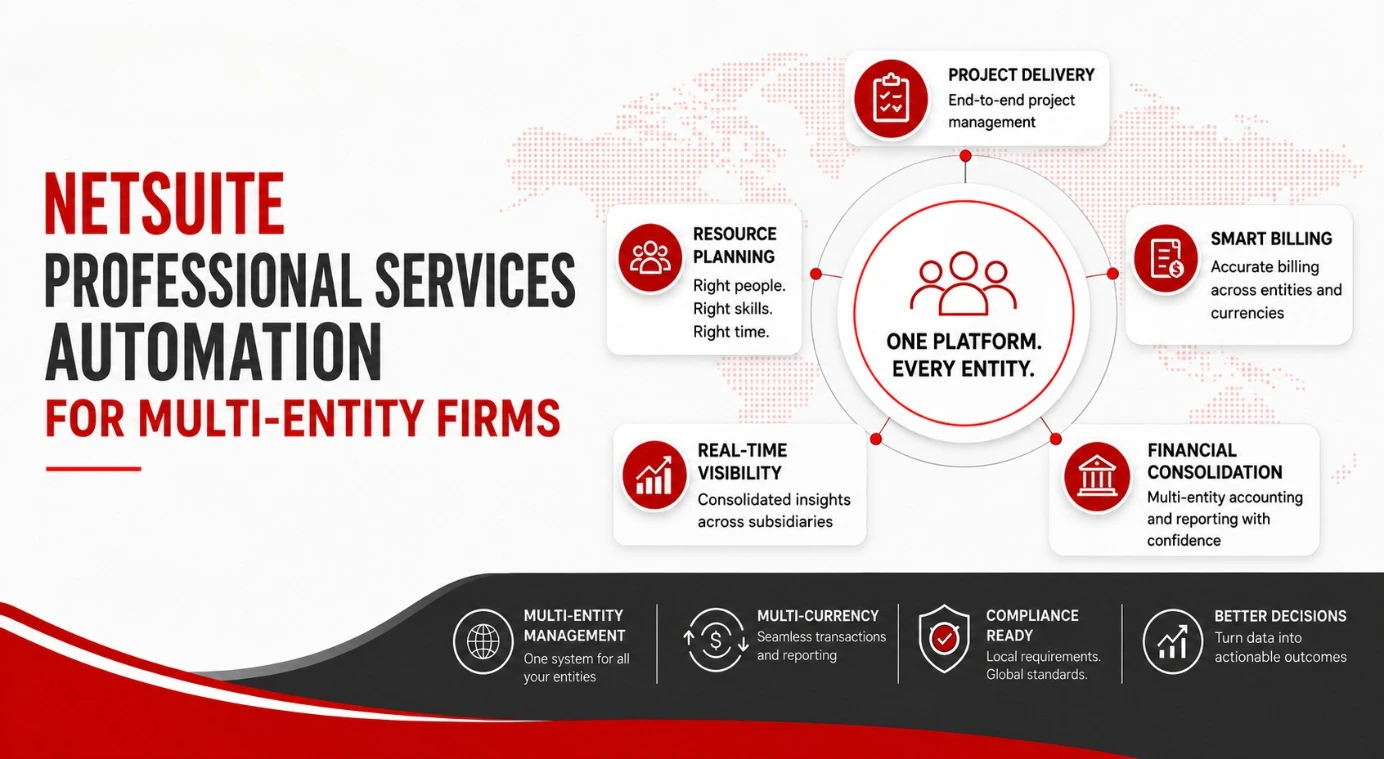
A properly configured NetSuite professional services automation deployment for a multi-entity firm typically covers the following:
|
Capability |
What It Does |
|
Resource Management |
Skills-based staffing, availability tracking and capacity planning across entities |
|
Time & Expense Tracking |
Entity-aware time entry with approval workflows and billable/non-billable classification |
|
Project Billing |
Time & materials, fixed-fee, milestone and retainer billing rules, configurable per entity |
|
ASC 606-aligned recognition - percentage of completion, milestone-based or straight-line |
|
|
Intercompany Accounting |
Automated transfer-pricing and intercompany entries when resources cross entity lines |
|
Multi-Currency Consolidation |
Currency conversion and consolidated reporting across subsidiaries via OneWorld |
|
Project Profitability Reporting |
Real-time margin visibility at the project, client and entity level |
Each of these capabilities exists in NetSuite's base platform to some degree, but the difference between a workable deployment and a genuinely useful one usually comes down to how carefully these pieces are configured to match a firm's actual billing rules and entity structure - which is where implementation quality matters as much as the software itself.
NetSuite PSA vs the Native Projects Module
One decision every multi-entity firm faces early is whether NetSuite's native Projects module is sufficient or whether the fuller SuiteProjects PSA layer is needed. As a general guideline, smaller firms with straightforward billing and a single dominant entity often manage well on the native Projects module alone. Larger, more complex organisations - particularly those needing skills-based resource matching, detailed capacity planning or billing rules that vary meaningfully by entity or region - typically outgrow the native module and move to full NetSuite PSA functionality.
Getting this decision right matters because moving from a lighter configuration to a fuller PSA deployment later is a meaningfully bigger project than scoping it correctly from the outset. It's a conversation worth having explicitly with your implementation partner before configuration begins, rather than assuming the native Projects module will scale indefinitely as headcount and entity count grow.
Where AI Is Changing NetSuite PSA for Multi-Entity Firms
NetSuite's recent AI capabilities are starting to reshape how multi-entity firms manage professional services automation day to day. Built-in AI features can flag anomalies in time entries before they reach an invoice, surface projects trending toward margin erosion earlier than a manual review would catch and assist with the reconciliation work that used to consume a disproportionate share of month-end close for multi-currency, multi-entity consolidations. Because these capabilities are increasingly built into the platform rather than sold as a separate add-on, firms adopting NetSuite PSA today are inheriting AI-assisted monitoring almost by default, provided their implementation partner configures it to actually surface the right signals for their entity structure rather than leaving it running on generic defaults.
This matters specifically for multi-entity operations because the volume of data - time entries, intercompany transactions, currency conversions - scales with every additional subsidiary added to the platform. Manual review of that volume becomes impractical quickly, which is exactly the gap AI-assisted anomaly detection is designed to close.
Common Challenges Multi-Entity Firms Face Without Proper PSA
Firms that delay implementing NetSuite professional services automation properly tend to run into the same set of problems repeatedly. Project profitability becomes visible only after the fact, once a project is already over budget, because time and cost data lives in spreadsheets disconnected from the ledger. Billing delays creep in as approvals and invoice generation are handled manually across entities with different rules. Resource allocation decisions get made on gut feel rather than real utilisation data, leading to over-staffed and under-staffed projects running simultaneously. And month-end close stretches out because intercompany entries and multi-currency consolidation are being reconciled by hand rather than generated automatically by the system.
None of these problems are unique to NetSuite - they show up whenever project delivery and financial systems are disconnected - but they become significantly more expensive to manage manually once a firm is operating across multiple entities and currencies at once. A firm running three subsidiaries with independent spreadsheet-based tracking, for example, isn't just tripling its manual reconciliation effort; the cross-entity dependencies mean errors in one subsidiary's numbers routinely surface as discrepancies in another's consolidated report, turning a single data-entry mistake into a multi-entity investigation.
Choosing the Right NetSuite Service Providers
Not every implementation partner scope’s a multi-entity PSA project the same way and the quality gap between NetSuite service providers shows up most clearly in exactly the areas covered above: intercompany accounting design, revenue recognition configuration and entity-specific billing rules. When evaluating NetSuite service providers, ask specifically about their experience with OneWorld multi-subsidiary structures, not just general NetSuite implementation experience - the two are related but distinct skill sets. It's also worth asking how a prospective partner approaches revenue recognition testing, since ASC 606 compliance issues are far cheaper to catch during configuration than after go-live.
A good NetSuite service provider will also be upfront about whether your firm's complexity genuinely warrants full PSA functionality or whether the native Projects module would serve you well at your current scale - a partner recommending the more complex, more expensive path by default is worth a second opinion.
Why LinkedERP Is a Trusted NetSuite Service Provider for Multi-Entity Firms
LinkedERP delivers NetSuite professional services automation implementations for multi-entity firms operating across subsidiaries, currencies and regional billing requirements, with a contractual commitment that defines what a properly configured oracle NetSuite PSA deployment should actually look like.
What LinkedERP Brings to Every Engagement
- Certified NetSuite Consultants – every engagement is led by consultants with hands-on OneWorld and SuiteProjects configuration experience, named in the proposal before signing and retained through go-live.
- Entity-Aware Scoping – discovery explicitly maps intercompany relationships, transfer-pricing needs and entity-specific billing rules before configuration begins, rather than treating multi-entity complexity as an afterthought.
- Fixed-Fee Proposals – full scope, documented deliverables, no surprise invoices - ever.
- Client-Owned Configuration – all PSA configurations, billing rules and revenue recognition logic transfer to you on completion - no dependency, no lock-in.
- Post-Implementation Managed Services – a named support contact, defined SLAs and proactive support through version upgrades and evolving billing requirements.
LinkedERP's NetSuite PSA Capability Stack
- Project Accounting – configuration of time & materials, fixed-fee, milestone and retainer billing rules across entities.
- Resource Management – skills-based staffing and capacity planning aligned to how your teams actually work across subsidiaries.
- Revenue Recognition – ASC 606-aligned setup covering percentage of completion, milestone and recurring recognition models.
- OneWorld & Multi-Entity Consolidation – intercompany accounting, transfer pricing and multi-currency consolidated reporting.
- Project Profitability Reporting – real-time margin dashboards at the project, client and entity level.
- AI & Automation – AI-assisted anomaly detection across time entries and billing data to catch discrepancies before they reach the close.
- Managed Support – ongoing configuration support and proactive management of NetSuite releases affecting PSA functionality.
Taken together, this is what separates LinkedERP from a typical NetSuite service provider: entity-aware scoping from day one, configuration that mirrors how billing and delivery actually work across your subsidiaries and a capability stack broad enough to carry a multi-entity PSA deployment from initial rollout through years of evolving billing and reporting needs.
Conclusion: Is NetSuite PSA the Right Fit for Your Multi-Entity Firm?
For firms running project delivery across more than one legal entity, NetSuite professional services automation isn't a luxury feature - it's the layer that keeps project profitability, billing and financial consolidation from becoming three disconnected problems instead of one unified view. The platform itself is capable of handling this complexity; the outcome ultimately depends on choosing NetSuite service providers who understand multi-entity structures well enough to configure it properly the first time.
Running
project delivery across multiple entities and considering NetSuite professional
services automation?
Talk to LinkedERP's team for an entity-aware assessment of what a properly scoped oracle NetSuite PSA deployment should look like for your firm.
www.linkederp.com | info@linkederp.com | Book a Free PSA Assessment
Frequently asked questions
It's the combination of SuiteProjects and NetSuite's native Projects module that manages the full services lifecycle - resourcing, time tracking, billing and revenue recognition - connected directly to the financial ledger.
The native Projects module suits simpler, single-entity firms, while full NetSuite PSA functionality adds skills-based resourcing, capacity planning and more complex billing rules suited to larger or multi-entity organisations.
Multi-entity firms need intercompany accounting, transfer pricing and consolidated multi-currency reporting that a single-entity setup doesn't require - capabilities NetSuite PSA delivers when paired with OneWorld.
Oracle NetSuite PSA supports ASC 606-aligned recognition models including percentage of completion, milestone-based and recurring revenue, reducing manual journal entries.
Look for providers with specific OneWorld multi-subsidiary experience, a clear approach to revenue recognition testing and honesty about whether your firm genuinely needs full PSA functionality.
Yes, LinkedERP delivers end-to-end NetSuite professional services automation for multi-entity firms, from entity-aware scoping and OneWorld configuration to post-implementation managed support.