
Quick Summary
Month-end close in multi-entity businesses is slow, error-prone and manual - because consolidation across subsidiaries, currencies and intercompany transactions depends on spreadsheets that break under complexity. This blog explains how NetSuite financial consolidation helps Indian mid-market CFOs automate intercompany eliminations, multi-currency translation and consolidated reporting in one unified platform. It also highlights how LinkedERP configures NetSuite consolidation specifically for Indian group businesses - helping finance leaders close faster, report accurately and meet statutory compliance without the month-end scramble.
Introduction: The Close Problem Every Multi-Entity CFO Recognises
In many Indian group businesses, the subsidiaries are performing, the individual entity books are being maintained and the auditors are - mostly - satisfied. Then the board asks for a consolidated P&L and the real problem surfaces. The finance team spends the next five to seven working days pulling numbers from each entity, eliminating intercompany transactions manually, translating foreign currency balances and reconciling the result in a spreadsheet that everyone hopes is correct.
This is not a people problem. It is a systems problem. And for Indian CFOs managing multiple subsidiaries, branch offices or overseas entities, NetSuite consolidation closes that gap by automating intercompany elimination, multi-currency translation and group-level financial reporting within a single platform. With deep NetSuite configuration expertise and implementation experience across Indian group businesses, LinkedERP helps CFOs identify where the close process breaks down, configure NetSuite financial consolidation at each failure point and deliver a month-end close that takes days - not weeks.
Market Context: NetSuite OneWorld adoption among Indian mid-market group businesses has accelerated significantly in 2025-2026. Month-end close delays and consolidation errors are consistently cited as the primary drivers for evaluation. CFOs who implement consolidation in NetSuite correctly report reducing close time by 60–70% within the first two quarters of go-live. |
Understanding Where Multi-Entity Close Actually Breaks Down
Before evaluating what NetSuite consolidated reporting delivers, CFOs need a precise understanding of where the close process fails. It is not one problem. It is five interconnected problems operating simultaneously across every period end.
The Five Close Breakdown Points in a Multi-Entity Business
Manual intercompany elimination - matching and eliminating intercompany transactions across entities using spreadsheet lookups that miss exceptions and take days to reconcile
Multi-currency translation errors - applying exchange rates manually to foreign currency balances with no systematic revaluation at period end
Inconsistent chart of accounts - each entity using slightly different account structures, making consolidation a mapping exercise before the numbers can even be combined
No real-time group visibility - consolidated P&L only available after close, making mid-month management decisions dependent on incomplete data
Audit trail gaps - manual journal entries made during consolidation that cannot be traced back to originating transactions, creating audit exposure
The Real Cost of Manual Consolidation
For an Indian group business with multiple subsidiaries, the real cost of manual consolidation goes far beyond finance team effort. When consolidation depends on spreadsheets, manual reconciliations and disconnected reporting workflows, finance teams spend significant time compiling group accounts, board reporting gets delayed, intercompany elimination errors become harder to control, currency translation misstatements create reporting risk and audit adjustment costs increase. Over time, these issues create substantial avoidable consolidation overhead - not because of poor financial management, but because of systems gaps that NetSuite financial consolidation is specifically designed to close.
What Is Consolidation in Financial Accounting - and Why NetSuite Does It Differently
What is consolidation in financial accounting? It is the process of combining the financial statements of a parent company and its subsidiaries into a single set of group-level financial statements - eliminating intercompany transactions, translating foreign currency balances and presenting a unified view of group performance as if it were a single economic entity.
Most Indian group businesses do this manually. NetSuite does it automatically - in real time, at every transaction, with a full audit trail.
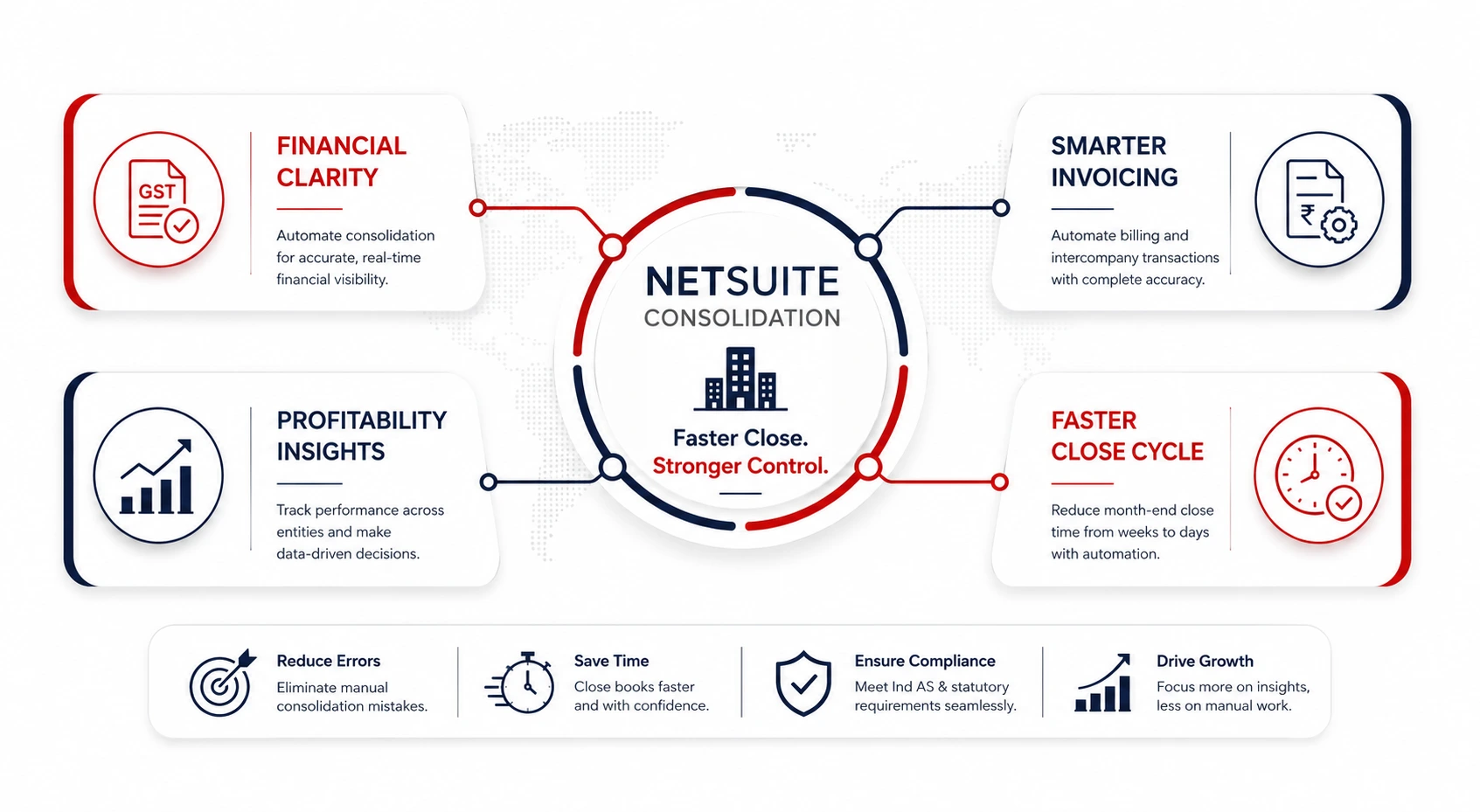
How NetSuite Consolidation Closes Every Breakdown Point
1. Automated Intercompany Elimination
Manual intercompany elimination is the single most time-consuming step in the consolidation close for most Indian group businesses. When Entity A sells to Entity B, that transaction must be eliminated from the consolidated P&L - and finding, matching and eliminating every intercompany transaction across five entities in a spreadsheet is a multi-day exercise at every period end.
What NetSuite Financial Consolidation Delivers
Intercompany Transaction Posted → Mirror Entry Auto-Generated → Elimination Journal Created → Consolidated P&L Updated → Audit Trail Maintained
Configure intercompany relationships in NetSuite → Setup → Subsidiaries with defined intercompany clearing accounts for each entity pair
Enable automatic mirror-image journal entry generation - when Entity A posts an intercompany sale, NetSuite automatically posts the corresponding purchase in Entity B's books
Set elimination rules under NetSuite → Consolidation → Elimination Rules to automatically reverse intercompany balances at the consolidated reporting level
Generate intercompany reconciliation reports by entity pair to confirm all transactions are matched before period close - no manual lookup required
LinkedERP clients using NetSuite consolidation to automate intercompany elimination report reducing this single step from 3–4 days of manual work to a same-day automated process - with zero reconciliation exceptions in the first month of go-live.
2. Multi-Currency Translation and Revaluation
Indian group businesses with overseas subsidiaries - billing in USD, GBP, EUR or SGD - face a currency translation problem at every period end. Applying the correct exchange rate to foreign currency balances, translating P&L at average rates and balance sheet at closing rates and posting the resulting currency translation adjustment to equity - done manually, this is both time-consuming and error-prone.
What NetSuite Financial Consolidation Delivers
Foreign Currency Balance Identified → Translation Rate Applied → P&L Translated at Average Rate → Balance Sheet Translated at Closing Rate → CTA Posted to Equity → Consolidated Report Updated
Configure currency exchange rates in NetSuite → Lists → Currencies with automated rate feeds or manual rate updates at defined periods
Enable period-end revaluation to automatically recalculate foreign currency balance sheet positions at the closing rate - posting the revaluation adjustment to the defined exchange gain/loss account
Apply average rate translation to P&L accounts and closing rate translation to balance sheet accounts in a single automated consolidation run - no manual rate application required
Generate multi-currency consolidated financial statements in INR with subsidiary-level foreign currency detail available for drill-down
NetSuite consolidated reporting with multi-currency translation eliminates the most complex and error-prone step in the close process for Indian businesses with overseas entities - replacing a manual calculation that takes days with an automated run that takes minutes.
3: Unified Chart of Accounts and Reporting Structure
For Indian group businesses where each subsidiary was set up independently - often on different accounting systems with different account structures - consolidation requires a mapping exercise before the numbers can even be combined. That mapping exercise is manual, error-prone and different every month when someone in a subsidiary adds a new account.
What NetSuite Consolidation Delivers
Subsidiary Account Created → Global Chart of Account Mapped → Consolidation Hierarchy Applied → Group Report Generated → Entity Drill-Down Available
Define a global chart of accounts in NetSuite that serves as the consolidation framework - each subsidiary uses the global structure, with local additions mapped to the nearest global equivalent
Configure reporting hierarchies in NetSuite → Financial Reports → Report Builder to aggregate subsidiary accounts into group-level line items automatically
Enable segment reporting by subsidiary, business unit or region - allowing the consolidated P&L to be sliced by any organisational dimension without separate report preparation
Set account mapping rules for subsidiaries with legacy account structures to automatically translate local accounts to global equivalents at consolidation - no manual remapping at period end
4: Real-Time Consolidated Reporting and CFO Dashboards
The final and most strategically valuable capability in NetSuite financial consolidation is real-time group visibility - the ability for a CFO to see consolidated revenue, margin, cash position and entity-level performance at any point in the month without waiting for the close process to complete.
What NetSuite Consolidated Reporting Delivers
Transaction Posted in Any Entity → Consolidated Report Updated in Real Time → CFO Dashboard Refreshed → Variance Alert Triggered → Board Pack Data Available
Configure real-time consolidated financial dashboards in NetSuite → Reports → Financial Statements with group-level P&L, Balance Sheet and Cash Flow visible at any time
Set budget versus actual variance alerts to notify the CFO when any entity or the consolidated group deviates from the monthly plan by more than the defined threshold
Enable one-click drill-down from consolidated group numbers to entity-level detail and individual transactions - giving auditors and management the audit trail they need without separate report requests
Schedule automated board pack delivery - consolidated financials, entity summaries and KPI dashboards - delivered to defined recipients at period close without manual compilation
Finance teams using NetSuite consolidated reporting reclaim 15–20 person-hours per month previously spent on manual report preparation - and CFOs report making better commercial decisions because group financial data is available in real time rather than two weeks after the fact.
The Honest Capability Comparison
Factor | Spreadsheet Consolidation | NetSuite Financial Consolidation |
|---|---|---|
Intercompany elimination | Manual - days of reconciliation | Automated - same-day systematic elimination |
Multi-currency translation | Manual rate application - error-prone | Automated translation at correct rates by account type |
Chart of accounts consistency | Manual mapping exercise each period | Global structure with automatic subsidiary mapping |
Real-time group visibility | Not available - close dependent | Live at any point in the month |
Audit trail | Manual journals - difficult to trace | Full transaction-level audit trail |
Board pack preparation | Manual compilation - 2–3 days | Automated scheduled delivery |
Close timeline | 8–15 working days | 2–4 working days |
Consolidation error rate | High - human-dependent | Near-zero - system-driven |
The Five Consolidation Scenarios Where NetSuite Expertise Is Non-Negotiable
Scenario 1: Indian Holding Company with Multiple Subsidiaries
For Indian group businesses with holding company structures and multiple operating subsidiaries, intercompany elimination and statutory consolidated reporting under Ind AS require both technical precision and audit trail discipline. NetSuite financial consolidation handles both - with elimination rules, minority interest calculations and consolidated statement generation built into the platform.
Scenario 2: Overseas Subsidiaries with Multi-Currency Reporting
Indian businesses with subsidiaries billing in foreign currencies need correct translation at average and closing rates, currency translation adjustment posting and INR-equivalent consolidated reporting. NetSuite's multi-currency consolidation handles all of this natively - with RBI-aligned rate management and automated revaluation.
Scenario 3: Rapid Group Expansion
For Indian businesses acquiring new entities or launching new subsidiaries, integrating each new entity into the consolidation framework quickly is operationally critical. NetSuite's subsidiary architecture allows new entities to be added to the consolidation structure in days - not the months that a new standalone accounting system would require.
Scenario 4: Audit-Ready Consolidated Reporting
Statutory auditors reviewing consolidated financial statements under Ind AS 110 need a clear, traceable audit trail from consolidated numbers to individual entity transactions. NetSuite consolidated reporting provides this drill-down natively - eliminating the audit preparation exercise that manual consolidation requires.
Scenario 5: Group Businesses Migrating from Multiple Legacy Systems
Group businesses where each subsidiary runs a different accounting system - Tally in one entity, SAP in another, a custom system in a third - face both a consolidation problem and a data integrity problem. LinkedERP's migration methodology brings all entities onto a single NetSuite instance with a unified chart of accounts, replacing the multi-system consolidation exercise permanently.
Why LinkedERP Is India's Trusted NetSuite Consolidation Implementation Partner
LinkedERP delivers NetSuite consolidation for Indian group businesses with deep platform expertise, Ind AS compliance knowledge and a contractual commitment that defines what professional NetSuite implementation should look like.
What LinkedERP Brings to Every Consolidation Engagement
Oracle-Certified NetSuite OneWorld Consultants: Every LinkedERP consolidation implementation is led by Oracle-certified consultants with individual OneWorld and multi-entity credentials - named in the proposal before signing, retained through go-live
India-First Consolidation Architecture: Intercompany elimination rules, multi-currency translation and Ind AS 110 consolidation requirements configured as core system behaviour from day one
Fixed-Fee Implementation Proposals: Full scope, documented deliverables, no surprise invoices - ever
Client-Owned Configuration: All NetSuite configurations, consolidation rules and reporting structures transfer to you on completion - no dependency, no lock-in
Post-Implementation Managed Services: Named support contact, defined SLAs and proactive management of NetSuite bi-annual upgrade testing for all consolidation configurations
LinkedERP's NetSuite Consolidation Capability Stack
Intercompany: Automated elimination rules, mirror-image journal generation, intercompany reconciliation reporting
Multi-currency: Exchange rate management, P&L and balance sheet translation, CTA posting, period-end revaluation
Reporting: Real-time consolidated P&L, Balance Sheet, Cash Flow, entity drill-down, segment reporting
Chart of accounts: Global account structure design, subsidiary mapping, reporting hierarchy configuration
Compliance: Ind AS 110 consolidation support, minority interest calculation, statutory report generation
Migration: Multi-system legacy consolidation to single NetSuite instance with data integrity validation
Conclusion: Is NetSuite Consolidation Right for Your Business?
Stay with current tools when the group has fewer than three entities, all entities operate in INR, intercompany transactions are minimal and consolidated reporting is not a board or audit requirement.
Implement NetSuite consolidation when month-end close consistently takes more than five working days, intercompany reconciliation is a manual multi-day exercise, overseas subsidiaries require currency translation, consolidated board reporting is delayed by the close process and audit trail gaps create statutory risk. For most growing Indian group businesses, NetSuite financial consolidation becomes the clearly stronger choice as entity count, transaction complexity and reporting demands increase - preventing the manual overhead that spreadsheet-based consolidation makes inevitable at scale.
Start
Your NetSuite Consolidation Implementation with LinkedERP
Book a free consolidation assessment with LinkedERP. Share your current entity structure, close timeline and reporting requirements. We will evaluate your consolidation complexity honestly, recommend the right NetSuite architecture, and provide a fixed-fee proposal with named consultants and committed delivery dates.
www.linkederp.com | info@linkederp.com | Book a Free Consolidation Assessment
Frequently asked questions
What is consolidation in financial accounting? It is the process of combining the financial statements of a parent company and its subsidiaries into a single group-level view - eliminating intercompany transactions, translating foreign currencies and presenting unified financial statements. NetSuite consolidation automates this entire process within a single platform, replacing the manual spreadsheet exercise with a real-time, audit-ready system.
Consolidation in NetSuite uses pre-configured elimination rules to automatically reverse intercompany transactions at the group reporting level. When Entity A sells to Entity B, NetSuite posts the mirror-image entry in Entity B and eliminates both sides from the consolidated P&L - without manual journal entries.
Yes. NetSuite financial consolidation supports multi-currency consolidation with automated translation at average rates for P&L accounts and closing rates for balance sheet accounts. Currency translation adjustments are posted automatically to equity - with RBI-aligned exchange rate management built in.
A standard NetSuite consolidated reporting implementation covering intercompany elimination, multi-currency translation and group financial reporting typically takes 10-14 weeks with LinkedERP, depending on the number of entities, legacy system complexity and data migration requirements.
Yes. LinkedERP configures NetSuite financial consolidation to support Ind AS 110 requirements - including subsidiary identification, intercompany elimination, minority interest calculation and consolidated statement presentation - as core system behaviour from go-live.
A single NetSuite consolidation instance with multiple subsidiaries gives you shared master data, automated intercompany processing, real-time consolidated reporting and a single support surface. Separate instances create data silos, manual consolidation overhead and integration complexity that grows with every entity added - making the single-instance architecture the correct choice for any group business with consolidation requirements.