
Quick Summary
Odoo project management is one of the most capable tools available to Indian mid-market businesses - but most implementations barely scratch the surface of what the module can do. Missed deadlines, invisible bottlenecks, disconnected billing and poor resource visibility are not Odoo problems. They are configuration problems. This blog identifies the seven most common reasons Odoo project management underperforms, explains what correct configuration looks like at each failure point and shows how LinkedERP helps businesses turn the Odoo project management module into a delivery engine that connects tasks, timesheets, billing and real-time reporting in one platform.
Introduction: The Project Management Problem Every Odoo User Recognises
Odoo implementation may be complete and the project management module may be live, but projects can still run late when tasks, timesheets, billing, updates and approvals are not configured around real workflows. If teams continue relying on WhatsApp, email threads, manual invoices and incomplete timesheets, the issue is usually not Odoo itself - it is poor configuration.
When configured correctly, Odoo project management connects task management, resource allocation, time tracking, client billing and financial reporting in one unified system. At LinkedERP, we have rebuilt underperforming Odoo project management setups across Indian consulting, IT services, construction and professional services firms - and the same seven configuration failures appear repeatedly, each one fixable with the right implementation approach.
For teams assessing the odoo project management tool, it works best when configuration mirrors real delivery workflows, approval paths and reporting needs.
Industry Context: Studies consistently show that fewer than 35% of projects are delivered on time and within budget across Indian mid-market businesses. In most cases, the project management tool is not the problem - the configuration, adoption and workflow design are. Odoo project management features can eliminate every one of these failure modes when set up correctly. |
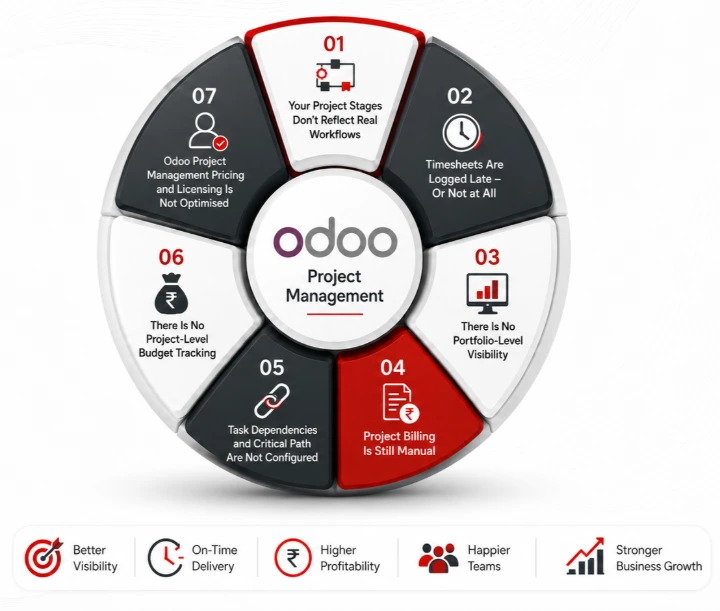
Reason 1: Your Project Stages Don’t Reflect Real Workflows
Default Odoo project stages - New, In Progress, Done - do not show where work actually stands. If stages do not match real delivery gates and handoffs, your project board becomes unreliable.
What the problem looks like: Tasks pile up in “In Progress” with no clarity on what is blocked, under review or moving forward. Project managers cannot see what needs attention and leadership cannot assess delivery confidence.
What correct configuration looks like:
• Define project stages that reflect actual delivery gates - Scoping, In Development, Client Review, Awaiting Approval, Complete, Billed
• Configure stage-specific required fields - a task cannot move to Client Review without an attached deliverable or to Billed without a linked timesheet
• Set automated alerts when tasks stay in the same stage beyond the defined limit
• Use Odoo’s colour-coding and kanban rules to identify on-track, at-risk and blocked tasks
Reason 2: Timesheets Are Logged Late - Or Not at All
The Odoo project management module has strong timesheet integration, but delayed logging weakens accuracy. When teams submit timesheets from memory, billable hours are often missed and non-billable hours increase.
What the problem looks like: Timesheet completion is below 80%. Approved hours are lower than estimates and project managers cannot track budget overruns in real time.
What correct configuration looks like:
• Enable the timesheet timer directly on task cards
• Configure automated daily timesheet reminders using Odoo’s scheduled actions
• Make timesheet completion mandatory before task closure
• Connect approved timesheets directly to the project billing queue
Reason 3: There Is No Portfolio-Level Visibility
Individual project boards show one project, but delivery heads need a cross-project view of timelines, risks, resources, milestones and budget consumption.
What the problem looks like: Delivery leaders depend on manual updates. RAG status is tracked in spreadsheets and resource conflicts appear only after they delay delivery.
What correct configuration looks like:
• Configure the Odoo project management portfolio view with planned vs. actual hours, task completion and milestone status
• Enable project health indicators based on task completion, overdue tasks and timesheet variance
• Set up cross-project resource allocation views to detect over-allocation early
• Use Odoo’s pivot and graph views for weekly reports on burn rate, milestones and at-risk projects
Reason 4: Project Billing Is Still Manual
One of the most useful Odoo project management features is the link between approved timesheets and invoicing. Without this setup, billing depends on manual compilation, finance review and invoice creation.
What the problem looks like: Invoices are sent 10–15 days after billing closure. Billable hours are missed, expenses are skipped and milestone invoices are delayed.
What correct configuration looks like:
• Configure billing rules in Odoo Project → Configuration → Billing for time-and-materials, fixed-price milestones and retainers
• Connect approved timesheets to invoicing so billable hours flow into invoice drafts automatically
• Set milestone triggers to generate fixed-price invoices when phases are completed
• Route draft invoices to project managers for one-click review before dispatch
Reason 5: Task Dependencies and Critical Path Are Not Configured
In project management, task sequence matters. Without dependencies, every task appears equally available and project managers cannot see what is blocking delivery.
What the problem looks like: Development starts before design approval. Testing begins before development is complete. One delayed task creates a chain of missed deadlines that nobody saw coming.
What correct configuration looks like:
• Enable task dependencies in Odoo Project → Configuration → Settings → Task Dependencies
• Configure automatic blocking of dependent tasks until prerequisite tasks are complete
• Use Odoo’s Gantt view to map dependencies and identify critical path risks
• Set automated alerts when blocking tasks are overdue
Reason 6: There Is No Project-Level Budget Tracking
Knowing a project is late is useful. Knowing it is over budget before margin is lost is more valuable. The Odoo project management module supports budget tracking through analytic accounting, but many implementations skip this setup.
What the problem looks like: Project managers know delivery status but not cost position. Finance discovers budget overruns only at month-end, when the margin is already affected.
What correct configuration looks like:
• Enable analytic accounts for each project in Odoo Project → Configuration → Settings → Analytic Accounting
• Configure project budgets with planned hours and cost estimates
• Set budget variance alerts when actual costs cross defined thresholds
• Generate project profitability reports showing planned vs. actual hours, cost vs. revenue and estimated-at-completion margin
Reason 7: Odoo Project Management Pricing and Licensing Is Not Optimised
Wrong licence allocation affects both cost and adoption. Some users lack access to required Odoo project management features, while others are assigned full licences they do not need.
What the problem looks like: Contractors cannot log timesheets. Project managers and finance users sit on the same licence structure. The Odoo project management pricing conversation was never aligned with actual user roles.
What correct configuration looks like:
• Map user types to the correct Odoo licence tier - full users for project managers and consultants, portal users for clients, light users for contractors
• Configure portal access for clients to view progress, approve milestones and download deliverables
• Use Odoo’s timesheet app for mobile-only users
• Review Odoo project management pricing annually to match licence structure with current team composition
The Honest Capability Comparison
Factor | Misconfigured Odoo Setup | Correctly Configured Odoo Project Management |
|---|---|---|
Project stage visibility | Default stages - no delivery logic | Custom stages mapped to real delivery gates |
Timesheet accuracy | Weekly memory-based submission | Real-time task-level logging with automated reminders |
Portfolio visibility | Individual project boards only | Cross-portfolio dashboard with health indicators |
Project billing | Manual - 12–15 day invoice cycle | Automated - draft invoice in under 3 days |
Task dependencies | Not configured - no critical path view | Dependency-mapped with Gantt and blocking rules |
Budget tracking | Invisible until month-end | Real-time analytic accounting with variance alerts |
Licence optimisation | One-size-fits-all licence structure | Role-based licence tiers reducing total cost by 20–30% |
Why LinkedERP Is India's Trusted Odoo Project Management Implementation Partner
LinkedERP delivers Odoo project management implementations for Indian professional services, IT services and project-based businesses with deep platform expertise, delivery workflow knowledge and a contractual commitment that defines what professional Odoo implementation should look like.
What LinkedERP Brings to Every Project Management Engagement
Certified Odoo Project Consultants - every implementation led by certified Odoo consultants with individual project management module credentials - named in the proposal before signing, retained through go-live
Delivery-First Configuration - our implementations are built around your actual delivery process, not Odoo's default feature set. Stage design, billing rules, timesheet workflows and portfolio dashboards are configured around how your team actually works
Fixed-Fee Proposals - full scope, documented deliverables, no surprise invoices - ever
Client-Owned Configuration - all Odoo configurations, custom workflows and reporting structures transfer to you on completion - no dependency, no lock-in
Post-Implementation Managed Services - named support contact, defined SLAs and proactive management of Odoo version upgrades for all project management configurations
LinkedERP's Odoo Project Management Capability Stack
Task and stage management: Custom delivery stage design, kanban rules, automated blocking, colour-coded health indicators
Timesheet automation: Real-time task-level logging, automated reminders, mandatory timesheet-to-task-close rules
Portfolio visibility: Cross-project dashboards, resource allocation views, milestone tracking, RAG status automation
Project billing: T&M and fixed-price billing rules, automated invoice generation, milestone payment triggers
Budget tracking: Analytic accounting integration, budget vs. actual reporting, variance alerts, project P&L
Dependency management: Task dependency configuration, Gantt view, critical path visibility, blocking rule automation
Licence optimisation: Role-based licence structure, portal user configuration, mobile timesheet access
Conclusion: Is Your Odoo Project Management Setup Fixable?
A full reimplementation may not be necessary when the team uses Odoo consistently, data quality is reasonable and issues are limited to specific workflows such as billing automation or portfolio visibility. In such cases, a targeted configuration review by Linked can resolve most Odoo project management failure points in 3–4 weeks without disrupting live projects.
A structured reconfiguration becomes important when timesheet completion rates are below 70%, project invoices go out more than 7 days after period close, project managers maintain separate spreadsheets alongside Odoo, the project board is not trusted as a source of truth, budget overruns are discovered only at close or the licence structure has not been reviewed since go-live. For most Indian project-based businesses, the gap between a misconfigured Odoo project management setup and a correctly configured one is not a new implementation, but a structured configuration review by a partner who knows where the failure points are and how to close them.
Start Your Odoo Project Management Review with LinkedERP
Book a free project management configuration assessment. Share your current Odoo setup, delivery workflows, and the problems your team is experiencing. We will identify every configuration gap, recommend the right fixes and provide a proposal with named consultants and committed delivery dates.
www.linkederp.com | info@linkederp.com | Book a Free Project Management Assessment
Frequently asked questions
The most underused Odoo project management features are task dependencies, analytic accounting for budget tracking, automated billing rules connected to approved timesheets, cross-portfolio dashboard views and portal access for client-facing milestone approval. Most standard implementations configure basic task management and stop there - leaving the highest-value capabilities untouched.
The Odoo project management module integrates natively with Odoo's invoicing engine. When billing rules are configured at the project level, approved timesheets automatically populate invoice drafts at the defined billing frequency - eliminating the manual translation step that causes invoice delays and billing leakage in most professional services firms.
For T&M businesses, project management in Odoo should connect task-level timesheet logging to billable hour classification, route approved hours to invoice drafts automatically and provide the project manager with a real-time view of billed vs. unbilled hours across every active engagement - all without manual data transfer between systems.
Odoo project management pricing is user-based and modular. Full users require a standard Odoo licence and can access all project management, timesheet and billing features. Portal users - for clients - and light users - for contractors logging timesheets only - are available at significantly lower cost or free, depending on the Odoo edition. Linked reviews licence structure as part of every implementation to ensure the pricing model matches the team composition.
A targeted reconfiguration addressing the seven failure points covered in this guide typically takes 3–5 weeks with LinkedERP, depending on the number of active projects, billing model complexity and the extent of analytic accounting integration required. A full implementation for a new Odoo customer typically takes 6–10 weeks.
Yes. The Odoo project management module supports concurrent billing rule configurations - fixed-price milestone billing and time-and-materials hourly billing can run simultaneously across different projects within the same Odoo instance, with each project assigned the billing model matching its contractual structure.