
Quick Summary
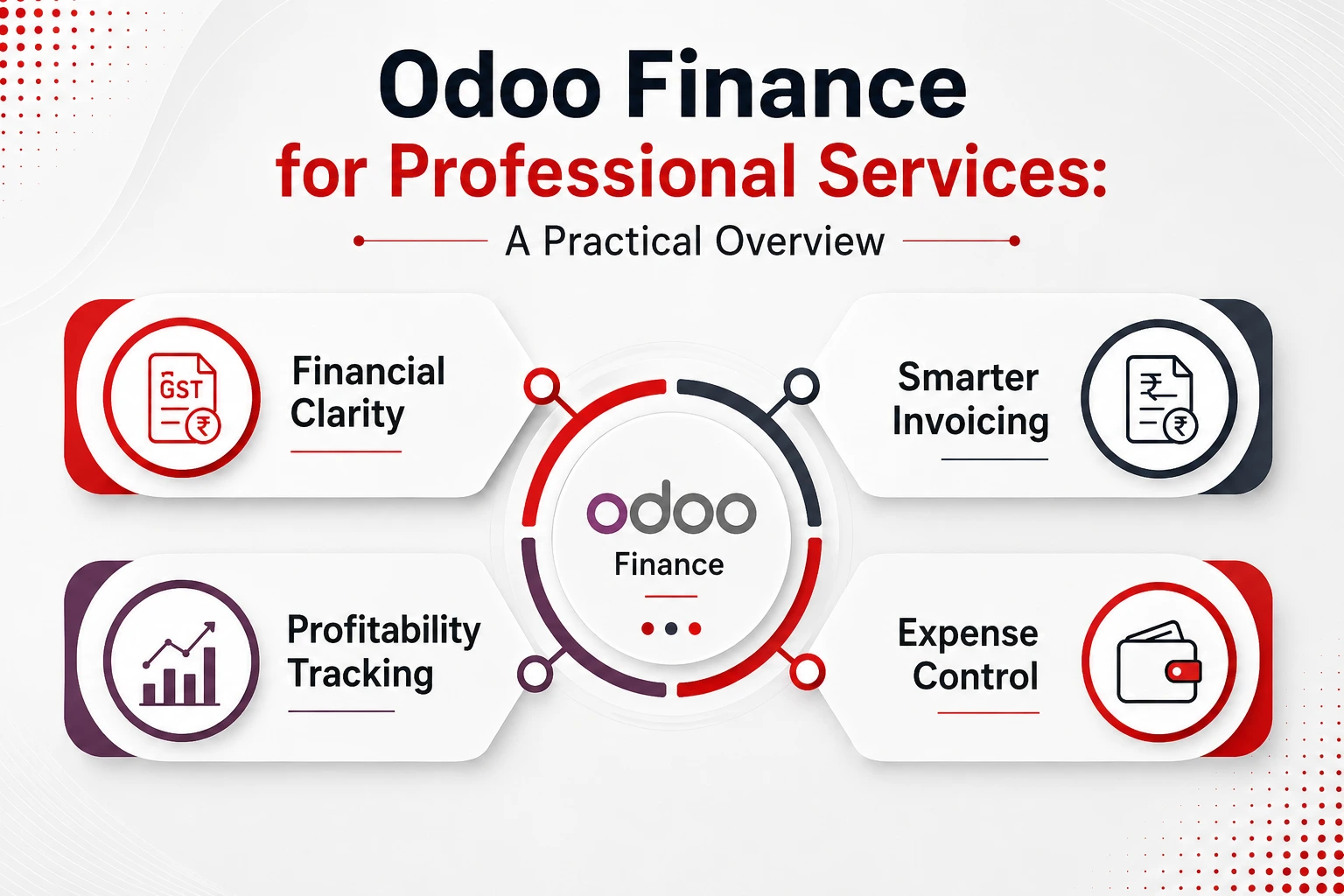
Financial leakage in professional services happens when billing is delayed, GST is miscalculated, TDS lives in spreadsheets and project profitability is only visible after close. This blog explains how the Odoo finance module helps consulting, IT services and project-based firms connect project accounting, tax compliance, automated billing and real-time financial reporting in one platform. It also highlights how LinkedERP configures Odoo financial accounting specifically for India's regulatory environment - helping professional services leaders protect margins, close faster and stay compliant.
Introduction: The Finance Problem Every Professional Services Firm Recognises
In many professional services businesses in India, consultants are billing hours, projects are delivering and clients appear satisfied - until the CFO reviews the monthly numbers. Cash flow is tighter than expected, GST returns require a week of manual reconciliation, TDS deductions are tracked in a separate spreadsheet and month-end close consistently bleeds into the second week of the following month. The missing value is difficult to trace because the problem is not delivery - it is systems.
Odoo finance helps India's mid-market consulting, IT services and managed services firms close this gap by connecting automated GST compliance, TDS management, project-linked billing, analytic accounting and real-time MIS reporting in one platform. With deep Odoo configuration expertise, strong understanding of India's regulatory environment and implementation experience across professional services engagements, LinkedERP helps firms identify where financial leakage occurs, configure the Odoo finance module at each breakdown point and stop revenue loss permanently.
Market Context: Odoo adoption among Indian professional services firms has accelerated significantly in 2025-2026. GST compliance complexity, TDS management overhead and project margin erosion are consistently cited as the primary drivers for evaluation. Firms that implement Odoo financial accounting correctly report reducing month-end close time by 60% and near-eliminating GST filing errors within the first two quarters of go-live. |
Understanding Where Professional Services Finance Actually Breaks Down
Before evaluating what Odoo finance and accounting delivers, professional services leaders need a precise understanding of where the breakdown happens. It is not one problem. It is five interconnected problems operating simultaneously across every engagement.
The Five Financial Breakdown Points in a Professional Services Business
Disconnected project and billing data - approved hours that never automatically reach an invoice, creating 12–18 day gaps between work completion and invoice dispatch
Manual GST application - wrong tax codes applied at the invoice level, creating GSTR mismatches, ITC disputes and reconciliation effort at every return period
TDS tracked outside the accounting system - spreadsheet-based records with no audit trail, threshold monitoring or automatic journal entries
No real-time project profitability - margin only visible after project close, making mid-engagement correction impossible
Manual MIS compilation - finance teams spending 20–25 person-hours per month preparing reports that should be generated automatically
For a professional services firm with 40 consultants, the cost of disconnected finance is not just operational inconvenience - it becomes measurable financial leakage. When billing, GST, e-invoicing, TDS, collections, reporting, consolidation and project profitability are managed through spreadsheets or disconnected tools, finance teams often depend on delayed inputs, manual reconciliations and estimate-based decisions. Over time, these gaps reduce visibility, slow down billing cycles, increase compliance effort and make it harder to identify where margins are being lost.
Compared to spreadsheets and standalone systems, the Odoo Finance module gives professional services firms a more automated, controlled and real-time finance operating model. By connecting accounting, invoicing, tax compliance, collections, reporting and profitability tracking in one platform, Odoo for accounting helps reduce avoidable leakage that can exceed ₹2.8 crore annually - not because of poor delivery or client dissatisfaction, but because of system gaps that better financial automation is designed to close.
How Odoo Finance Closes Every Breakdown Point
Workflow 1: End-to-End GST Compliance Automation
Without automation, GST management in professional services becomes a return-period exercise - chasing invoices, correcting tax codes, reconciling GSTR-2A against the purchase register and hoping the ITC numbers match. Odoo finance formalises every step of GST compliance into a system-driven workflow from invoice creation to return data extraction.
What Odoo Finance Delivers
Invoice Created → HSN/SAC Mapped → GST Slab Applied → CGST/SGST/IGST Split → E-Invoice Generated → GSTR Data Populated → ITC Reconciled
Configure HSN/SAC codes at product level under Inventory → Products → Accounting Tab with mapped tax rates for each applicable GST slab
Set fiscal positions in Accounting → Configuration → Fiscal Positions to automatically switch between intra-state and inter-state tax treatment based on client location
Enable GSTN e-invoicing API integration for IRN generation, QR code stamping and e-Way Bill creation on eligible transactions - no third-party tool required
Extract GSTR-1 and GSTR-3B data in portal-ready formats directly from Accounting → Reporting → Tax Reports
LinkedERP clients using Odoo for accounting to automate GST workflows report a 70–80% reduction in manual data entry at return filing time - and near-zero GSTR mismatches compared to their previous manual process.
Workflow 2: TDS Automation Across All Applicable Sections
Professional services firms make frequent payments to contractors, consultants, landlords and service providers - each with a different TDS section, different rate and different threshold. Managing this manually across a growing vendor base means errors, missed deductions and eventual notices from the Income Tax Department.
What Odoo Finance Delivers
Vendor Bill Created → TDS Section Identified → Cumulative Threshold Checked → Deduction Calculated → Payable Entry Posted → Deposit Due Date Tracked → Return Data Exported
Configure TDS tax groups under Accounting → Configuration → Taxes with section code, applicable rate and statutory threshold for each section
Tag each vendor with the relevant TDS section in the vendor master under the Accounting Tab - driving automatic deduction on every bill without manual intervention
Enable automatic TDS payable journal entry creation at bill validation - eliminating manual journal posting entirely
Use Odoo's activity scheduler to track TDS deposit due dates and trigger alerts before the 7th of each month - zero late deposits, zero interest liability
LinkedERP clients using the Odoo finance module for TDS automation report eliminating an average of 12–15 manual journal entries per month and zero late-deposit penalties in the twelve months following implementation.
Workflow 3: Project-Linked Billing and Accounts Receivable Automation
For professional services firms, the gap between work completion and invoice dispatch is where cash flow leaks most visibly. When project delivery systems and finance systems are separate, the translation from approved hours to invoice line items depends on manual effort - and manual effort creates delay, error and missed billings.
What Odoo Finance Delivers
Timesheet Approved → Billing Rule Applied → Invoice Draft Generated → Approval Routed → Invoice Dispatched → Payment Reminder Triggered → Receipt Reconciled
Configure project billing rules in Odoo Project → Configuration → Billing to automatically stage approved timesheets for invoicing at the defined billing frequency
Connect Odoo's timesheet module to the invoicing engine - so every approved billable hour flows to an invoice draft without manual data transfer
Enable automated payment reminders using Odoo's follow-up module - triggered by invoice age, outstanding amount and client segment - reducing average collection time by 8 days
Auto-reconcile received payments against open invoices using Odoo's bank reconciliation engine - eliminating the daily manual matching exercise from your finance team's routine
Odoo financial accounting clients at LinkedERP reduce average invoice dispatch time from 12–18 days to under 3 days after implementing automated project billing workflows - recovering weeks of working capital per billing cycle.
Workflow 4: Real-Time Project Profitability and MIS Reporting
The most undervalued capability in Odoo finance and accounting for professional services is not tax compliance or billing automation - it is the ability to see project profitability in real time, at any stage of delivery, without waiting for month-end close. For firms managing multiple concurrent engagements across different billing models, this visibility changes the commercial decisions leaders make.
What Odoo Finance Delivers
Cost Posted → Revenue Recognised → Margin Calculated → Project P&L Updated → MIS Pack Scheduled → CFO Dashboard Refreshed → Variance Alert Triggered
Use Odoo's analytic accounting to track revenue and cost at project level - giving engagement managers their own P&L without a separate accounting system
Configure scheduled MIS delivery in Odoo to auto-generate and email the full financial pack - P&L, Balance Sheet, AR Aging and GST summary - to defined recipients at period close
Set budget variance alerts to notify engagement managers when project costs deviate from estimate by more than the defined threshold - enabling mid-engagement correction rather than post-close discovery
Generate consolidated practice area P&L reports across all engagements by service line - giving leadership the profitability view needed to make investment and pricing decisions
Finance teams that automate MIS reporting through the Odoo finance module reclaim 20–25 person-hours per month previously spent on manual report compilation - redirecting that capacity toward financial analysis and business partnering.
The Honest Capability Comparison
Factor | Spreadsheets and Disconnected Tools | Odoo Finance Module |
|---|---|---|
GST multi-slab automation | Manual configuration per invoice | Automated at product and service master level |
E-invoicing / IRN generation | External add-on or manual portal | Built-in GSTN API integration |
TDS section-wise automation | Spreadsheet-tracked manually | Automated deduction and journal posting |
Project-to-invoice cycle | 12–18 days manual process | Under 3 days automated draft generation |
Real-time project profitability | Available only at month-end | Live at any project stage via analytic accounting |
MIS reporting | Manual compilation on request | Scheduled automated delivery |
AP/AR collections automation | Manual follow-up by finance team | Workflow-based dunning and auto-reconciliation |
Multi-company consolidation | Manual Excel process | Native multi-entity with auto-elimination |
True cost of financial leakage | Unknown - estimated | Quantified - tracked and reported in real time |
The Five Professional Services Scenarios Where Odoo Finance Is Non-Negotiable
Scenario 1: High-Volume Client Invoicing Across Multiple Engagements
For consulting and IT services firms managing dozens of concurrent client engagements - each with different billing frequencies, rates and models - manual invoice preparation is not scalable. Odoo financial accounting handles high-volume billing across time-and-materials, fixed-price and retainer engagements simultaneously, with automated draft generation and one-click review before dispatch.
Scenario 2: E-Invoicing Mandate Compliance
Professional services firms above the prescribed turnover threshold must generate IRN-stamped e-invoices for every B2B transaction. Managing this through a manual process or standalone tool introduces compliance risk on every invoice raised. Odoo's built-in GSTN integration, configured by LinkedERP, makes this entirely automatic.
Scenario 3: Multi-State Client Billing with State-Specific GST
Professional services firms with clients across multiple Indian states need correct intra-state and inter-state GST treatment on every invoice - with state-wise GSTR reporting for each registration. Odoo's fiscal position framework handles this automatically, eliminating the manual tax code selection that creates GSTR mismatches.
Scenario 4: Practice Area Profitability Analysis
For firms with multiple service lines - each with different billing rates, delivery costs and margin profiles - understanding which practices are genuinely profitable requires engagement-level cost and revenue data that spreadsheets cannot reliably deliver. Odoo finance and accounting provides practice-level P&L in real time through analytic accounting, enabling leadership to make evidence-based decisions.
Scenario 5: Migration from Tally or Legacy Accounting Systems
Professional services firms transitioning from Tally, Busy or custom accounting systems need to migrate open invoices, vendor balances, TDS records and GST transaction history without breaking compliance continuity. LinkedERP's structured migration methodology maintains the full audit trail through transition - so your Odoo finance system opens with complete, compliant historical data.
Why LinkedERP Is India's Trusted Odoo Finance Implementation Partner
LinkedERP delivers Odoo finance implementations for Indian professional services firms with deep platform expertise, India compliance knowledge and a contractual commitment that defines what professional Odoo implementation should look like.
What LinkedERP Brings to Every Finance Engagement
India-First Configuration: GST multi-slab setup, TDS section mapping, e-invoicing integration and TCS handling configured as core system behaviour from day one - not retrofitted after go-live
Certified Odoo Finance Consultants: Every implementation led by certified Odoo consultants with individual finance module credentials and India-specific compliance experience - named in the proposal before signing
Fixed-Fee Implementation Proposals: Full scope, clear deliverables, no surprise invoices - ever
Client-Owned Configuration: All Odoo configurations, custom reports and automation workflows transfer to you on completion - no dependency, no lock-in
Post-Implementation Managed Services: Named support contact, defined SLAs and proactive compliance update management including GSTN API changes and CBIC notifications
LinkedERP's Odoo Finance Capability Stack for Professional Services
GST: Multi-slab configuration, e-invoicing, GSTR data extraction, ITC reconciliation
TDS/TCS: Section-wise automation, threshold tracking, challan management, return data
Project billing: Timesheet-to-invoice automation, fixed-price milestones, retainer schedules
AP/AR: Dunning workflows, payment reconciliation, vendor payment runs, aging analysis
Analytic accounting: Project P&L, practice area reporting, budget vs. actual tracking
MIS: Scheduled report delivery, CFO dashboards, variance alerts
Migration: Tally, Busy and legacy system to Odoo with full compliance continuity
Conclusion: Is Odoo Finance Right for Your Professional Services Firm?
Stay with current tools when the firm has fewer than 10 billable staff, operates single-entity with straightforward GST, has low invoice volumes and compliance complexity has not yet created a management overhead.
Implement Odoo finance when GST filing consistently requires manual correction, TDS is tracked outside your accounting system, the project-to-invoice cycle exceeds 7 days, project profitability is only visible at close and MIS reports are compiled manually on request. For most growing Indian professional services firms, the Odoo finance module becomes the stronger choice as billing complexity, tax compliance demands and reporting requirements increase - preventing the financial leakage that spreadsheet-driven processes make inevitable at scale.
Start
Your Odoo Finance Implementation with LinkedERP
Book a free finance configuration assessment with LinkedERP. Share your current accounting setup, compliance requirements, and billing models. We will evaluate your situation honestly, recommend the right Odoo financial accounting architecture and provide a fixed-fee proposal with named consultants and committed delivery dates.
www.linkederp.com | info@linkederp.com | Book a Free Finance Assessment
Frequently asked questions
The Odoo finance module covers the complete financial management stack for professional services - GST automation, TDS/TCS compliance, e-invoicing with GSTN integration, project-linked billing, accounts payable and receivable, bank reconciliation, analytic project accounting and MIS reporting. With LinkedERP's India localization, every component is configured to meet the specific requirements of Indian tax law and professional services billing models.
Odoo financial accounting manages multi-state GST through fiscal positions that automatically switch between CGST/SGST for intra-state and IGST for inter-state billing based on the client's registered state. HSN/SAC code mapping at the service master level ensures the correct rate is applied on every invoice without manual selection.
Yes. The Odoo finance and accounting module supports concurrent TDS configuration across all applicable sections - 194C for contractors, 194J for professional fees, 194I for rent - with individual threshold tracking at the vendor level. Deductions trigger automatically when the statutory threshold is crossed, with no manual intervention required.
Odoo for accounting integrates natively with Odoo's Project and Timesheet modules. Approved billable hours are automatically staged for invoicing at the defined billing frequency - weekly, fortnightly or monthly - generating a draft invoice for one-click review without any manual data transfer between systems.
A standard Odoo financial accounting implementation covering GST, TDS, project billing, AP/AR automation and MIS reporting typically takes 6–10 weeks with LinkedERP, depending on the number of entities, billing model complexity and data migration requirements from legacy systems.
Odoo finance is a fully integrated financial management system that connects accounting with project management, CRM, timesheets and HR on a single platform. Tally handles bookkeeping and basic GST compliance but requires manual data transfer from project and delivery systems - creating the billing gaps, reconciliation overhead and delayed MIS that the Odoo finance module is specifically designed to eliminate.