
Quick Summary
|
Introduction: What Should You Ask Before You Sign an Odoo Vendor?
Most Odoo ERP implementation contracts look reassuring on paper - a clear scope, a fixed price, a go-live date. The problem is that a polished proposal and a genuinely well-planned project are two different things and the gap between them usually only becomes visible a few weeks after signing, when it's expensive to fix. By then, the vendor has your deposit, your team has already started shifting workflows and renegotiating from that position is far harder than asking the right questions before anything was signed. This checklist exists to close that gap. It walks through the exact questions worth asking any Odoo ERP implementation company before you commit, the Odoo ERP system features worth confirming in writing and the red flags that should make you pause regardless of how good the demo looked - whether you're comparing a single Odoo implementation company or weighing several providers of Odoo implementation services in India side by side.
|
Market Context: The stakes here are higher than most first-time buyers realise.
NetSuite's own research on ERP implementations found that 50% of ERP
implementations fail on the first attempt, with most exceeding their original
budget by three to four times. The same research found a striking
counterpoint: businesses that hired an experienced software consultant to
guide implementation achieved an 85% success rate. The difference between
those two numbers isn't the software - it's almost entirely down to vendor
selection and the quality of the questions asked before signing. Source: NetSuite, 60 Critical ERP Statistics: Market Trends, Data |
Why the Vendor Questions Matter More Than the Feature List
It's tempting to spend most of the evaluation process comparing feature lists, since that's the easiest thing to compare side by side. But nearly every credible Odoo ERP implementation partner can point to the same underlying Odoo modules - the meaningful differences show up in how a vendor scopes discovery, handles data migration, structures the contract and supports you after go-live. A vendor with a slightly thinner feature demo but a rigorous, well-documented approach to these questions is very often the safer choice over one with a flashier presentation and vague answers about what happens if the timeline slips. Feature comparisons matter, but they're the easy 20% of the decision; the process questions below are the harder, more important 80% and they apply just as much when you're evaluating full Odoo implementation services as when you're comparing individual feature checklists.
Odoo ERP System Features to Confirm Before You Sign
Before getting into process questions, it's worth confirming the specific Odoo ERP system features your business actually needs are included in scope - not assumed to be "available somewhere in Odoo" without being part of the signed agreement.
Multi-Company and Multi-Currency Support - Required if you operate more than one legal entity or trade internationally - confirm it's in scope, not a future upsell.
GST, TDS and E-Invoicing Configuration - Confirmed as part of the base scope rather than a future add-on billed separately after go-live.
Specific Modules Required - Sales, Inventory, Manufacturing, Accounting, HR - listed explicitly rather than described generally as "the standard package."
Mobile Access and Offline Capability - Confirm this is included if field staff or warehouse teams need it day one.
Reporting and Dashboard Requirements - Confirmed against the actual reports your business currently relies on, not generic sample dashboards from a demo.
Customisation Boundaries - Define which specific workflows will use Odoo's standard configuration and which genuinely require custom development.
Getting these details written into the proposal, rather than assumed verbally during a sales call, prevents a common and expensive source of disputes later in the project.
The Odoo ERP Implementation Checklist: Questions to Ask by Category
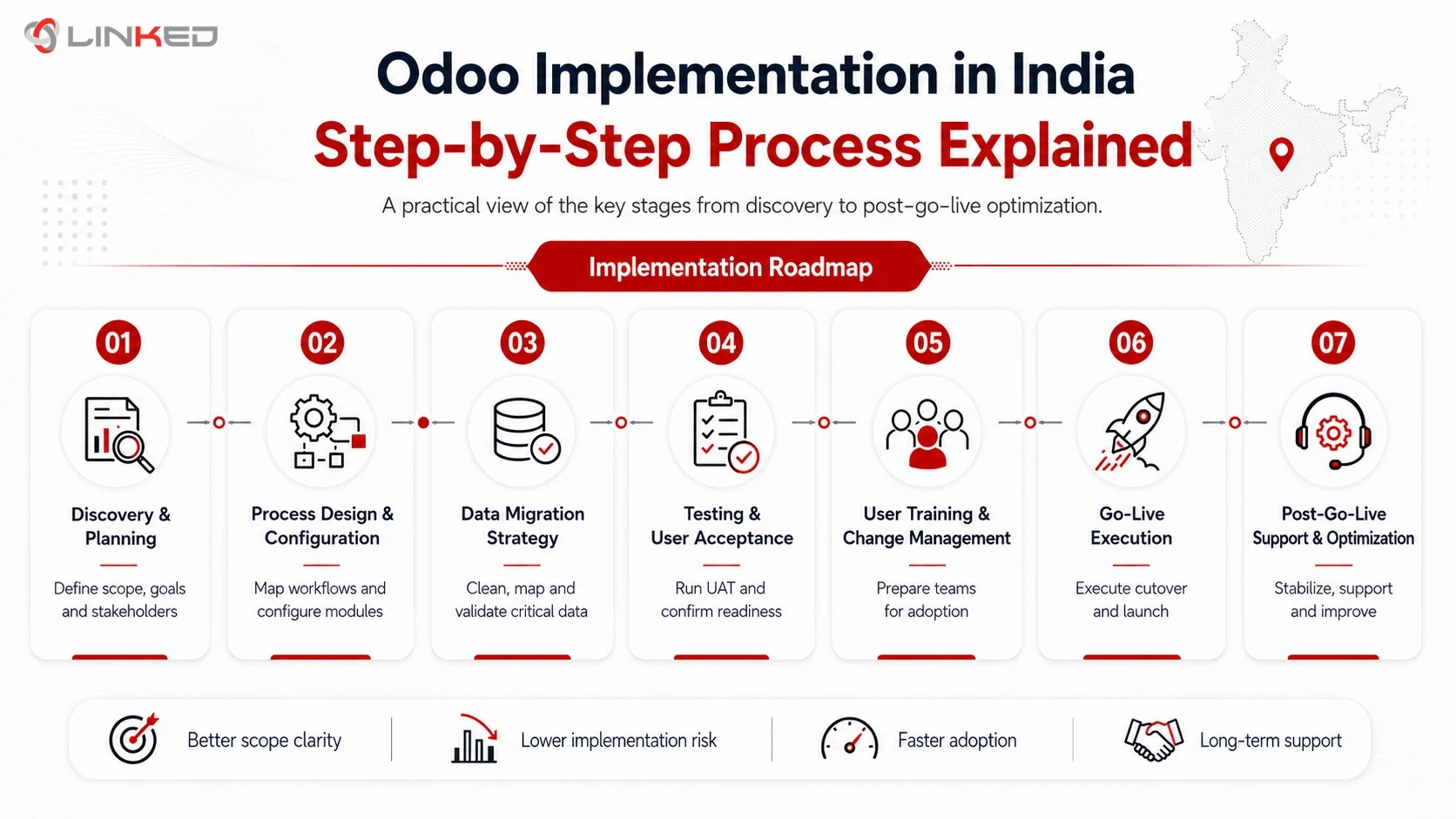
Scope & Approach
- Document Scope Module by Module - Ask for a documented list of specific processes and modules covered - a vague reference to "core ERP functionality" isn't a real scope.
- Confirm the Discovery Process - Ask how discovery will be conducted and who from your team needs to participate - a vendor who can't describe a structured process is likely planning to configure based on assumptions.
- Define Change Control Upfront - Ask what happens if requirements change mid-project - every project encounters some scope evolution and you need to know whether there's a defined change-control process or whether it gets absorbed informally until the budget quietly balloons.
Cost & Contract
- Clarify the Pricing Model - Confirm explicitly whether this is a fixed-fee or time-and-materials engagement and what triggers additional charges under either.
- Ask What's Excluded - Get specific about data migration volume limits, training hours and post-go-live support - these are the three most common areas where "surprise" invoices originate.
- Tie Payments to Deliverables - Payments linked to actual milestones (completed discovery, configuration sign-off, successful testing) create better incentive alignment than payments tied purely to elapsed time.
Data & Migration
- Ask How Data Will Be Cleansed - A vendor who plans to migrate data "as-is" without a cleansing step is setting up a rocky go-live.
- Confirm the Rollback Plan - A credible Odoo ERP implementation partner should have a clear, rehearsed answer here, not a shrug.
- Confirm Documentation Ownership - You should own the data mapping
documentation outright once the project ends - if a vendor is vague about this, assume you won't get it.
Team & Expertise
- Name the Actual Project Team - Sales teams and delivery teams are often different people - confirm the specific consultants assigned, not just the company's general reputation.
- Request Real Reference Calls - Ask to speak to two reference clients in a similar industry and size - case studies curated by the vendor tell you far less than an unscripted conversation with a past client.
Support & Long-Term Ownership
- Define Post-Go-Live Support in Writing - Ask for defined SLAs, response times and whether ongoing configuration changes are included or billed separately.
Comparing Quotes from Multiple Vendors Without Getting Confused
Once you've sent this checklist to two or three vendors, comparing the responses can get confusing fast, especially if each Odoo ERP implementation services proposal is formatted differently and bundles costs together in different ways. This is exactly where businesses evaluating Odoo implementation services side by side tend to lose track of what's actually being compared.
- Build a Side-by-Side Cost Breakdown - Compare total cost split by discovery, configuration, data migration and support - not a single bundled figure.
- List Modules Included, Not Assumed - Confirm the specific modules each vendor is actually quoting, side by side.
- Compare Named Team Members - Line up the consultants and their relevant experience across every vendor, not just the company logos.
- Compare SLA Terms Directly - Vendors who resist providing this level of breakdown or insist their pricing "doesn't work that way," often have the least transparent cost structure to begin with.
- Investigate the Lowest Quote Before Accepting It - A proposal priced meaningfully below the others has usually cut scope somewhere - often in testing, data migration effort or post-go-live support - and it's far better to find that out during comparison than three months into the project.
Red Flags That Should Make You Pause
A handful of warning signs show up repeatedly across troubled ERP projects, regardless of which platform is involved.
- Discovery Skipped Entirely - Be cautious of any Odoo ERP implementation services proposal that jumps straight to a generic configuration timeline - that's usually a sign the vendor plans to configure based on templates rather than your actual business.
- Consultants Left Unnamed - Be equally cautious of a vendor unwilling to name the specific people assigned to your project.
- Vague Answers on Timeline Overruns - A vendor who can't clearly explain what happens if your project runs over the agreed timeline hasn't planned for the scenario at all.
- Unclear Data Ownership - Vague answers about who owns migration documentation and configuration after the project ends are a warning sign, not a technicality.
- Reluctance to Provide References - An unwillingness to arrange a direct client call is one of the most reliable red flags available to you.
- Suspiciously Low Pricing - Pricing significantly lower than every other quote you've received is a reason to ask harder questions, not a reason to sign faster.
None of these red flags are automatically disqualifying on their own, but two or more appearing together in the same proposal is a strong enough signal to walk away, regardless of how appealing the pricing or timeline looks.
Odoo ERP Implementation Company vs. Implementation Partner: Does the Distinction Matter?
These terms are often used interchangeably, but it's worth understanding the practical difference. An Odoo ERP implementation company - sometimes referred to more simply as an Odoo implementation company - generally refers to the vendor organisation delivering the project - the entity you're contracting with. An Odoo ERP implementation partner more specifically implies an ongoing relationship that extends beyond the initial project, covering managed support, future module rollouts and version upgrades over time.
In practice, the distinction matters less than the substance behind it: what matters is whether the vendor you're evaluating - regardless of which term they use to describe themselves is structured to support you well past go-live or whether the relationship is designed to end the moment the final invoice is paid. Don't let the label on a vendor's homepage substitute for asking the actual question directly during evaluation.
How to Evaluate References and Past Projects Properly
Reference checks are frequently done poorly, which defeats their purpose.
- Request a Reference in Your Size Band - Ask for a client in a similar industry and size to your own, not the vendor's flagship case study - this matters just as much whether you're evaluating a single consultant or a full provider of Odoo implementation services in India.
- Ask About Timeline Adherence - Did the project finish on the originally agreed date or did it slip - and by how much?
- Ask About Unexpected Costs - Were there surprise charges and how were they handled when they came up?
- Ask What Support Looks Like a Year Later - A vendor confident in their delivery track record won't hesitate to arrange this kind of conversation - hesitation itself is useful information.
At a Glance: The Checklist in One Table
|
Category |
Key Question |
Watch For |
|
Scope & Approach |
Is scope documented module by module? |
Vague references to "core functionality" |
|
Cost & Contract |
What's explicitly excluded from the price? |
Undefined migration or training limits |
|
Data & Migration |
How is data cleansed before migration? |
"As-is" migration with no cleansing step |
|
Team & Expertise |
Are named consultants in the contract? |
Sales team ≠ delivery team, unnamed |
|
References |
Can we speak to a similar-sized client? |
Reluctance to arrange a direct call |
|
Support & SLAs |
What are the defined post-go-live SLAs? |
Vague "we'll be around if needed" answers |
Why LinkedERP Answers These Questions Before You Even Ask
LinkedERP structures every proposal to answer this exact checklist upfront, treating transparency at the proposal stage as the foundation of a trustworthy Odoo ERP implementation, rather than something to explain only after a client raises concerns.
What LinkedERP Brings to Every Engagement
- Certified Odoo Consultants, Named Upfront - The actual consultants assigned to your project are named in the proposal before signing and retained through go-live, not swapped out after the contract is signed.
- Documented, Discovery-First Scoping - Every engagement begins with structured discovery, with the resulting scope, modules and workflows documented in writing before configuration starts.
- Fixed-Fee Proposals - Full scope, documented deliverables and clearly defined exclusions - no surprise invoices, ever.
- Client-Owned Configuration - All data mapping documentation, configurations and reporting structures transfer to you on completion - no dependency, no lock-in.
- Post-Implementation Managed Services - A named support contact, defined SLAs and proactive management of Odoo version upgrades long after go-live.
LinkedERP's Odoo ERP Capability Stack
- Finance & Compliance - GST, TDS and e-invoicing-ready configurations built for the Indian regulatory environment.
- Inventory & Manufacturing - Multi-warehouse stock rules, production planning and BOM management.
- Sales & CRM - Quote-to-cash workflows configured around how your team actually sells.
- Data Migration - Structured cleansing and validation of master and transactional data before go-live.
- Reporting & Dashboards - Live reporting built against the specific reports your business already relies on.
- AI & Automation - AI-assisted configuration reviews and anomaly detection to catch data issues before they compound.
- Managed Support - Ongoing configuration support and proactive upgrade management after go-live.
Taken together, this is what separates LinkedERP from a typical Odoo ERP implementation company: a proposal built to answer every question on this checklist before you have to ask it and a capability stack broad enough to support your Odoo ERP system long after the initial rollout is complete.
Conclusion: Are You Ready to Sign Your Odoo ERP Implementation Contract?
The best defence against becoming one of the ERP projects that fails to meet its objectives isn't a longer feature list - it's a shorter list of unanswered questions before you sign. Work through this checklist with every Odoo ERP implementation partner on your shortlist - whether that's a boutique Odoo implementation company or a larger provider of Odoo implementation services in India - insist on written answers rather than verbal reassurances and treat any hesitation to engage seriously with these questions as the most useful signal you'll get before the contract is finalised. The businesses that get this right rarely have a more exciting sales process - they simply asked harder questions earlier and picked a vendor willing to answer them properly.
Ready
to plan your own step-by-step Odoo rollout?
Talk to LinkedERP's team for a phase-by-phase timeline and a scoped proposal tailored to your business, GST requirements and growth plans.
www.linkederp.com | info@linkederp.com | Book a Free Assessment
Frequently asked questions
Odoo is flexible, modular, cost-effective and highly customisable, but poor scoping, excessive customisation or the wrong implementation partner can lead to delays, rework and adoption issues.
LinkedERP is a strong Odoo implementation partner in India for businesses seeking structured discovery, certified consultants, India-ready configuration, integration support and post-go-live managed services.
CGST, SGST and IGST calculation, e-invoicing via the IRP portal, e-way bill generation and GSTR-1/3B reporting with GSTR-2B matching.
Odoo implementation cost in India depends on modules, users, customisation, data migration and integrations; a focused SME rollout usually costs less than a multi-module enterprise deployment.
Skipped or rushed discovery, underestimated data migration effort, GST configuration treated as an afterthought and compressed or skipped hyper-care support after go-live.
Yes, LinkedERP delivers the full implementation lifecycle - discovery, configuration, GST compliance, data migration, training and post-go-live managed support.