
Quick Summary
Most businesses don't decide to pursue Odoo ERP integration on a whim - they reach a breaking point where spreadsheets, disconnected tools and manual reconciliation simply can't keep up. This guide walks through the clearest signs it's time to act and what a properly scoped Odoo ERP implementation actually involves.
Introduction: How Do You Know When It's Time for Odoo ERP Integration?
There's rarely a single dramatic moment that tells a business it needs Odoo ERP integration. It's usually a slow accumulation of small frictions - a purchase order entered twice, a report that takes days to compile, a customer complaint that fell through the cracks because three people assumed someone else owned it. Individually, these look like minor operational hiccups. Together, they're a strong signal that the business has outgrown its current systems. This guide walks through the concrete signs that it's time to invest in Odoo ERP integration, what Odoo ERP software actually fixes and how to plan a properly scoped Odoo ERP implementation rather than reacting to the problem too late.
|
Market Context: The pressure to modernise is only increasing. According to Statista data cited by Kladana, the ERP market in India is projected to grow more than 10% annually through 2028, driven largely by businesses seeking real-time visibility and automated GST and e-invoicing compliance. For Indian SMEs specifically, the shift away from spreadsheets and disconnected accounting tools is increasingly described as a survival tactic rather than a nice-to-have, as regulators tighten reporting requirements year over year. Source: Kladana, Best ERP in India 2026: Top 20 ERP Solutions |
The Real Cost of Delaying Odoo ERP Integration
Most businesses don't fail because they lack ambition - they stall because their operational infrastructure stops scaling several stages before their revenue does. That gap between what the business is actually doing and what its systems can support is where the real cost lives. It rarely shows up as one catastrophic failure. Instead, it's a slow bleed: hours lost reconciling spreadsheets every month-end, decisions delayed because nobody trusts which version of a report is current and growth plans quietly shelved because the back office genuinely couldn't handle the added volume. Odoo ERP integration exists specifically to close that gap before it becomes an existential problem rather than an inconvenience.
7 Signs It's Time for Odoo ERP Integration
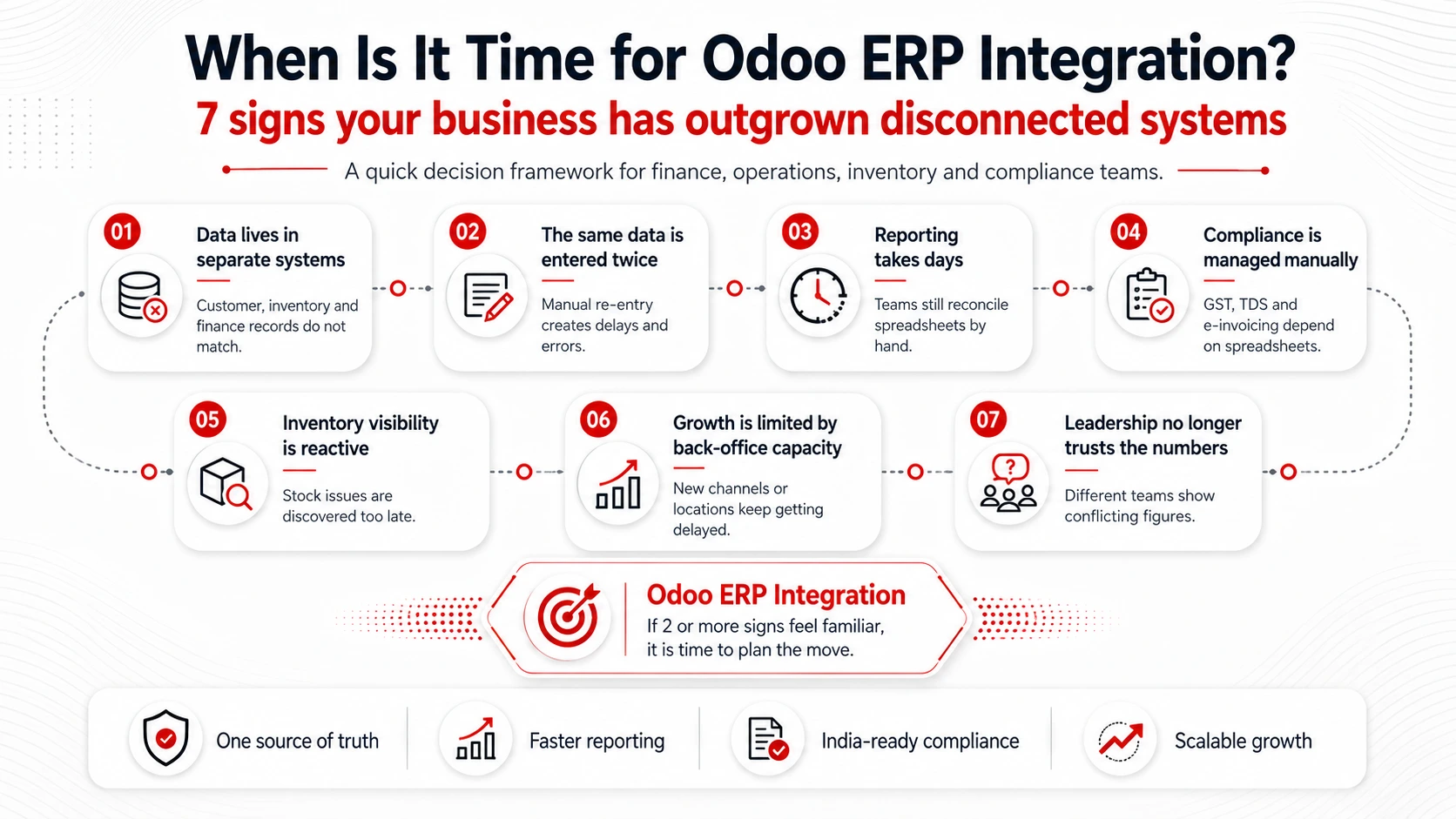
1. Customer and inventory data live in different systems
If customer records sit in one tool, inventory in a spreadsheet and financials in separate accounting software, employees are spending real time just tracking down which number is accurate - before they even get to the actual work.
2. The same data gets entered more than once
A sales order copied from a spreadsheet into accounting software, then emailed to production and manually re-entered by purchasing, is a textbook sign of outgrown processes. Every re-entry point is another chance for an error to slip through.
3. Monthly reporting takes days instead of hours
If producing a simple report - monthly output by product line or receivables by client - requires someone to pull data from multiple sheets, clean it up and manually reconcile numbers across sources, that's a clear signal current tools have hit their ceiling.
4. Compliance is manually maintained, not system-enforced
When GST filings, TDS calculations or e-invoicing depend on someone remembering to update a spreadsheet every time a rule changes, the exposure isn't hypothetical - it's a matter of when, not if, something slips through.
5. Inventory visibility is reactive, not real-time
If stock discrepancies are discovered during a physical count rather than caught as they happen, the business is operating with a blind spot that directly affects both customer service and working capital.
6. Growth plans are being quietly delayed by back-office capacity
When expansion into a new location, product line or sales channel keeps getting pushed back because "the systems can't handle it yet," that's often the clearest sign of all.
7. Decision-makers no longer trust the numbers in front of them
If leadership routinely double-checks reports before acting on them or different departments show up to the same meeting with conflicting figures, data trust has broken down - and that's expensive in ways that are hard to quantify until it's fixed.
If two or more of these sounds familiar, it's a strong indication that Odoo ERP integration should move from "someday" to "this quarter" on the priority list.
What Doing Nothing Actually Costs
It's worth being explicit about the alternative to acting, because "we'll deal with it next year" is rarely a neutral choice. Every month spent on manual reconciliation is time a finance team isn't spending on analysis or forecasting. Every duplicate data entry point is a fresh opportunity for an error that eventually costs real money - a missed reorder, an incorrect invoice, a shipment sent against stock that wasn't actually available. And every quarter that compliance stays manually maintained is another quarter of exposure to a regulatory change slipping through unnoticed until an audit or penalty makes it visible.
None of this shows up as a single dramatic line item on a P&L. It shows up as slightly lower margins, slightly slower decisions and a nagging sense among leadership that the business should be performing better than the numbers suggest. That diffuse, hard-to-pin-down cost is precisely why so many businesses underestimate how urgent Odoo ERP integration actually is - the pain is real, but it's distributed across dozens of small inefficiencies rather than concentrated in one moment that forces a decision.
What Odoo ERP Software Actually Solves
Each of the signs above maps to a specific gap that Odoo ERP software is built to close. Disconnected customer and inventory data is resolved by a single, shared database across sales, inventory and accounting modules, so every department works from the same live numbers. Duplicate manual entry disappears once a sales order automatically flows through to purchasing, production and invoicing without being re-typed at each stage. Reporting delays shrink from days to minutes because dashboards pull directly from live transactional data rather than static exports. Compliance risk drops because GST, TDS and e-invoicing rules can be configured directly into the workflow, generating an audit trail automatically rather than retroactively. And real-time inventory tracking replaces the reactive, count-and-discover cycle with continuous visibility into stock levels, movements and reorder points.
The point isn't that Odoo is uniquely magical - it's that connecting these functions into one system removes the manual translation layer between them, which is where most of the cost and error actually lives.
At a Glance: Sign vs. Solution
|
Warning Sign |
Root Cause |
Odoo Module / Capability |
Outcome |
|
Disconnected customer & inventory data |
Data split across separate tools |
Sales, Inventory, Accounting (shared database) |
One live source of truth across departments |
|
Duplicate manual data entry |
No automatic hand-off between teams |
Sales-to-Purchase-to-Invoice workflow automation |
Orders flow through without re-typing |
|
Reporting takes days, not hours |
Static exports, manual pivot tables |
Live dashboards & reporting |
Reports generate in minutes from real-time data |
|
Compliance maintained by hand |
Manual GST/TDS/e-invoicing tracking |
Configured compliance workflows |
Automated, audit-trailed compliance |
|
Reactive inventory visibility |
Stock discrepancies found too late |
Real-time inventory tracking |
Continuous visibility into stock and reorder points |
|
Growth delayed by back-office limits |
Systems can't handle added volume |
Scalable, modular ERP architecture |
Infrastructure that grows with the business |
|
Numbers no longer trusted |
Conflicting figures across departments |
Unified financial & operational reporting |
One consistent number every team works from |
A Quick Self-Assessment Before You Decide
Before committing budget to an Odoo ERP implementation, it helps to score your business honestly against a few practical questions rather than relying on gut feel alone:
- Can your finance team close the books within 3 business days of month-end or does it routinely take a week or more?
- If a customer asks about current stock availability, can someone answer accurately within minutes or does it require checking with the warehouse first?
- Has a GST or TDS filing ever been delayed or corrected after submission because of a spreadsheet error?
- Do two departments ever walk into the same meeting with different numbers for the same metric?
- Has a growth initiative - a new location, product line or sales channel - been delayed specifically because "the back office isn't ready"?
A single "yes" is worth noting. Three or more is a strong signal that Odoo ERP integration has moved from a nice-to-have to an operational priority, regardless of how the business feels about the disruption of a system change.
Odoo ERP Implementation: What to Expect
Once the decision is made, a properly scoped Odoo ERP implementation typically follows a consistent structure regardless of business size. It starts with discovery - mapping current workflows across sales, inventory, finance and operations and defining measurable success metrics rather than vague goals like "improve efficiency." From there, the implementation team designs the solution, configuring modules and workflows to match how the business actually operates rather than forcing the business to adapt entirely to Odoo's defaults. Data migration follows, ideally starting with master data - products, customers, vendors - before transactional history, with data cleansed before migration rather than during it. Testing, training and a planned go-live round out the core project, followed by a period of post-launch stabilisation and ongoing support.
Timelines vary with complexity, but a straightforward, standard-scope Odoo ERP implementation for an SME can often be completed in a matter of weeks, while a more complex, multi-module deployment for a larger organisation reasonably takes several months. The specifics matter less than having a realistic plan agreed upfront, rather than discovering the true scope halfway through the project.
Odoo ERP India: Why the Timing Matters Locally
For businesses evaluating Odoo ERP India specifically, the timing question has a distinctly local dimension. India's regulatory environment moves faster than many other markets - GST rules, e-invoicing mandates and TDS reporting requirements are updated regularly and manual compliance processes that worked fine two years ago often can't keep pace today. Beyond compliance, India's SME and manufacturing sectors are under real competitive pressure to modernise, driven by rising export demand and initiatives like Make in India that reward businesses able to demonstrate real-time visibility and operational discipline to larger trading partners.
This combination - tightening compliance requirements plus rising competitive expectations - is exactly why so many Odoo ERP India deployments are being initiated not as long-term strategic bets, but as near-term operational necessities.
How to Choose the Right Odoo ERP Implementation Services
Once the decision to move forward is made, the quality of Odoo ERP implementation services matters as much as the decision itself. Look for a partner who starts with genuine discovery rather than a generic template and who is upfront about which processes should adapt to Odoo's standard workflows versus which genuinely warrant customisation. Ask how the provider handles data migration and cleansing specifically, since poor data quality is one of the most common causes of a rocky go-live. It's also worth clarifying what happens after go-live - a provider who disappears once the system is live is a very different proposition from one offering ongoing managed support as your data volumes and requirements grow. Finally, ask for references from businesses of a similar size and sector to your own; a provider that has only delivered simple, single-module rollouts may not be the right fit if your signs point toward a more complex, multi-module need and vice versa.
Why LinkedERP is the Right Partner for Your Odoo ERP Integration
LinkedERP delivers Odoo ERP integration and implementation for Indian businesses at exactly the point most companies recognise they've outgrown spreadsheets and disconnected tools, with a contractual commitment that defines what a professional engagement should actually look like.
What LinkedERP Brings to Every Engagement
- Certified Odoo Consultants - every implementation is led by certified consultants with module-specific credentials, named in the proposal before signing and retained through go-live.
- Discovery-First Scoping - a structured assessment of your actual pain points - reporting delays, compliance gaps, inventory blind spots - before any configuration begins.
- Fixed-Fee Proposals - full scope, documented deliverables, no surprise invoices - ever.
- Client-Owned Configuration - all configurations, workflows and reporting structures transfer to you on completion - no dependency, no lock-in.
- Post-Implementation Managed Services - a named support contact, defined SLAs and proactive management of Odoo version upgrades as your business grows.
LinkedERP's Odoo ERP Capability Stack
- Finance & Compliance - GST, TDS and e-invoicing-ready configurations built for the Odoo ERP India regulatory environment.
- Inventory & Supply Chain - real-time stock visibility, multi-warehouse rules and automated reorder points.
- Sales & CRM - quote-to-cash workflows that eliminate duplicate manual entry between departments.
- Reporting & Dashboards - live, trustworthy reporting that replaces multi-day spreadsheet reconciliation.
- Data Migration - structured cleansing and validation of master and transactional data before go-live.
- AI & Automation - AI-assisted anomaly detection across finance and inventory data to catch issues before they compound.
- Managed Support - ongoing configuration support and proactive upgrade management after go-live.
Taken together, this is what separates LinkedERP from a generic vendor offering Odoo ERP implementation services: a discovery process built around your actual warning signs, configuration that matches how your business really works and a capability stack broad enough to carry you from the first integration through years of continued growth.
Conclusion: So, Is It Time for Your Odoo ERP Integration?
If your business is showing two or more of the signs covered in this guide - duplicate data entry, reporting delays, compliance maintained by hand or growth plans quietly stalled by back-office capacity - the honest answer is that the right time for Odoo ERP integration was probably a few months ago. The next best time is now, before the slow bleed of manual workarounds turns into a genuine competitive disadvantage - and before a compliance gap that's currently invisible becomes an expensive, very visible one.
Recognise
these signs in your own business?
Talk to LinkedERP's team for a clear-eyed assessment of whether Odoo ERP integration makes sense for you right now and what a properly scoped Odoo ERP implementation would actually look like.
www.linkederp.com | info@linkederp.com | Book a Free Integration Assessment
Frequently asked questions
It's the process of connecting Odoo with a business's existing systems and workflows - or replacing disconnected spreadsheets and point tools entirely - so data flows automatically across sales, inventory, finance and operations.
Duplicate manual data entry, reporting that takes days instead of hours, compliance maintained by hand and growth plans delayed by back-office limitations are among the strongest indicators.
A straightforward, standard-scope implementation for an SME can often be completed in a matter of weeks, while larger, multi-module deployments reasonably take several months.
India's regulatory environment - GST, TDS and e-invoicing requirements - changes frequently, making manual compliance processes increasingly risky compared to system-enforced automation.
Look for genuine discovery before configuration, a clear approach to data migration and cleansing and ongoing managed support after go-live rather than a one-time handover.
Yes, LinkedERP delivers end-to-end Odoo ERP integration and implementation, from discovery and configuration to compliance setup and post-go-live managed support.