
Quick Summary
South African distributors lose margin due to excess dead stock, stockouts and lack of real-time inventory analytics South Africa businesses need for smarter decisions. This blog explains how inventory analytics software powered by NetSuite helps optimise reorder logic, strengthen demand-driven supply chains and how LinkedERP, a trusted NetSuite implementation partner, configures inventory management software, South Africa businesses can rely on from go-live.
Introduction: The Inventory Problem Every South African Distributor Recognises
South African distributors often face a costly contradiction: warehouses remain full, working capital stays locked in stock, yet sales teams still handle stockout complaints for critical SKUs. At the same time, finance teams write down slow-moving inventory sitting untouched for months. This is not a purchasing problem - it is a visibility problem and it is exactly where inventory analytics South Africa distributors adopt through NetSuite can create measurable control.
A properly configured NetSuite environment gives buyers, warehouse managers, CFOs and sales directors a real-time, data-driven view of stock performance that spreadsheets and disconnected inventory management software South Africa businesses rely on cannot match. At LinkedERP, NetSuite’s inventory analytics software is configured for FMCG, industrial supply, pharmaceutical and technology distributors to identify preventable waste patterns, improve margins and build an inventory and analysis framework that reduces stock waste from the ground up.
|
Market Context: South African distributors face complex inventory challenges in 2026 - rand-dollar volatility, extended supplier lead times, load-shedding impacts and multi-location stock management. Features like demand-based reorder logic, multi-warehouse visibility, landed cost tracking and slow-moving stock analysis are now operational necessities for SA distributors managing meaningful SKU volumes. |
The Five Inventory Analytics Workflows That Cut Waste for SA Distributors
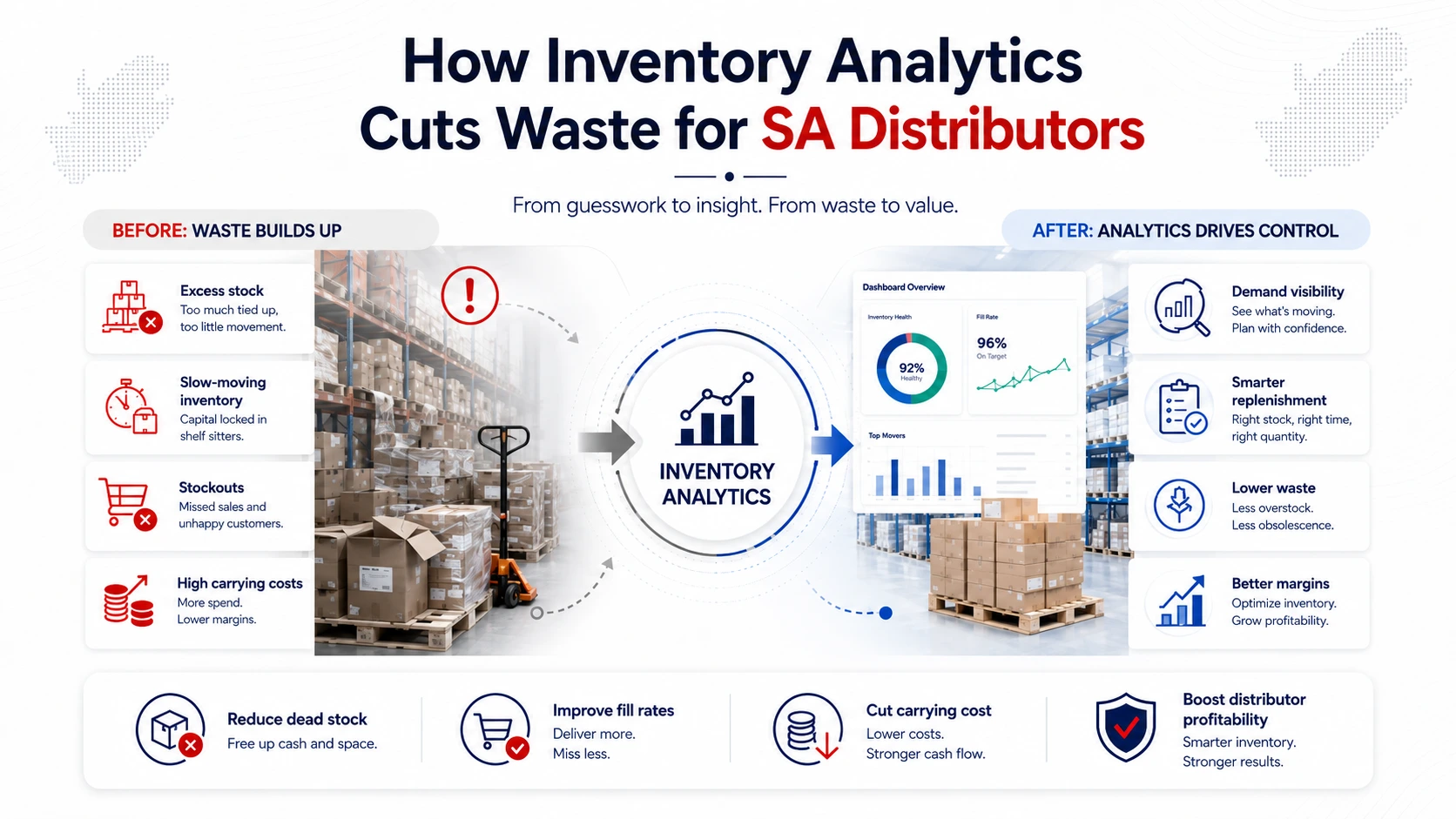
Workflow 01 - Real-Time Multi-Warehouse Inventory Visibility
The Problem
South African distributors managing stock across Johannesburg, Cape Town, Durban and regional warehouses often lack real-time visibility. Manual transfers and outdated stock data create overstock in one location and stockout in another for the same SKU.
What Inventory Analytics Software Delivers
Stock Received → Bin Location Assigned → Real-Time Availability Updated Across All Locations → Transfer Opportunity Identified → Transfer Order Raised → Allocation Confirmed → Replenishment Decision Informed
NetSuite’s inventory analytics software updates every receipt, transfer, sales allocation, adjustment and return in real time across all warehouse locations. Buyers and warehouse teams access the same live data, while transfer opportunities are surfaced before new purchase orders are raised.
- Configure bin-level inventory tracking across all warehouse locations in NetSuite → Inventory → Locations for exact SKU, bin, lot and serial visibility
- Enable real-time available-to-promise calculations using purchase orders, sales orders and in-transit stock
- Set automated transfer order recommendations when stock imbalances exceed defined thresholds
- Generate location-level inventory valuation reports for working capital, VAT compliance and profitability analysis
SA distributors using real-time multi-warehouse visibility through NetSuite’s inventory analytics South Africa configuration report a 35–45% reduction in emergency transfers and better first-attempt order fulfilment.
Workflow 02 - Demand-Based Reorder and Replenishment Automation
The Problem
Many South African distributors rely on static reorder points that ignore demand velocity, seasonality, supplier lead time changes, rand volatility and global supply chain disruption.
What Inventory Analytics Software Delivers
Sales Velocity Calculated → Lead Time Variability Assessed → Safety Stock Determined → Reorder Point Set → Stock Falls Below Reorder Point → Purchase Order Recommended → Supplier Order Raised → Receipt Confirmed → Reorder Logic Updated
NetSuite’s inventory analytics software calculates reorder points dynamically using SKU/location sales velocity, supplier lead time history, variability and service level targets. Purchase order recommendations are grouped by supplier, weighted by economic order quantity and ready for buyer approval.
- Configure demand-based reorder logic in NetSuite → Inventory → Replenishment using sales velocity, lead time data and service levels
- Track supplier lead time at vendor-SKU level to calculate realistic safety stock
- Enable economic order quantity calculations to balance order frequency and carrying cost
- Generate weekly replenishment reports ranking SKUs by stockout risk and days of cover
SA distributors using NetSuite demand-based replenishment within their inventory analytics South Africa framework report 50–65% lower stockout frequency and 12–18% lower average inventory value.
Workflow 03 - Slow-Moving and Dead Stock Identification
The Problem
Slow-moving SKUs tie up working capital, occupy valuable bin space and eventually become write-downs. These issues often stay hidden until they hit the P&L.
What Inventory Analytics Software Delivers
Stock Age Calculated → Velocity Classification Applied → Slow-Moving SKUs Flagged → Days of Cover Projected → Clearance Action Recommended → Write-Down Risk Quantified → CFO Alert Triggered
NetSuite’s inventory and analysis framework classifies SKUs by stock age, sales velocity and days of cover, identifying slow-moving and at-risk stock before obsolescence. Buyers get alerts, while finance receives monthly write-down risk reports by category.
- Configure stock age analysis in NetSuite → Reports → Inventory Aging across 0–30, 31–60, 61–90 and 90+ day brackets
- Set slow-moving stock alerts when days of cover exceed defined thresholds
- Enable write-down risk reporting by category, supplier and location
- Generate supplier return analysis reports to recover working capital before write-downs
LinkedERP clients using NetSuite slow-moving stock analytics within inventory analytics South Africa report recovering R800,000 to R1.5 million in working capital within six months.
Workflow 04 - Landed Cost Tracking and True Margin Analysis
The Problem
South African import distributors face complex landed costs including freight, insurance, port handling, customs duties, VAT on importation, clearing fees and rand-dollar volatility. Without accurate landed cost tracking in inventory management software South Africa, margin reports overstate profitability.
What Inventory Analytics Software Delivers
Purchase Order Raised → Freight Cost Estimated → Customs Duty Calculated → Clearing Fees Captured → Rand-Dollar Rate Applied → Landed Cost Finalised → Inventory Valued at True Cost → Margin Report Updated
NetSuite’s inventory analytics software tracks landed costs at shipment level and allocates freight, duties, insurance, clearing fees and currency conversion costs to individual SKUs by value, weight or volume. Inventory valuation and margin reports reflect true landed cost.
- Configure landed cost templates in NetSuite → Inventory → Landed Costs by import route, cost component and apportionment method
- Enable multi-currency purchase order management with rand-dollar rate capture at goods receipt
- Set landed cost variance alerts when actual costs exceed estimates
- Generate true-cost margin reports by SKU, category and supplier
SA distributors using NetSuite’s inventory and analysis framework often discover true margins on imported categories are 8–15% lower than invoice-cost reports suggested, helping them reprice, renegotiate or substitute products early.
Workflow 05 - Inventory Performance Reporting and CFO Dashboard
The Problem
Many South African distributor CFOs rely on outdated, manually compiled inventory reports that show only total stock value and basic turnover. Critical inventory and analysis data like SKU margin, category stock turn, supplier fill rate and working capital efficiency is hard to access.
What Inventory Analytics Software Delivers
Transactions Posted → KPIs Calculated in Real Time → CFO Dashboard Updated → Variance Alerts Triggered → Board Report Scheduled → Supplier Performance Ranked → Category Review Initiated
NetSuite’s inventory analytics South Africa reporting framework calculates inventory KPIs in real time, including stock turn by category, days of inventory outstanding, supplier fill rate, SKU margin contribution and working capital efficiency by location. Dashboards update automatically as transactions are posted.
- Configure the CFO inventory dashboard in NetSuite → Reports → KPI Dashboard with total inventory value, stock turn, DIO, slow-moving stock percentage and working capital metrics
- Build supplier performance scorecards for fill rate, lead time accuracy and quality returns
- Schedule automated inventory performance reports weekly for operations and monthly for CFO/board review
- Enable drill-down from summary KPIs to SKU-level detail and individual transactions
SA distributors using real-time inventory reporting through NetSuite’s inventory analytics South Africa framework improve CFO and commercial decision-making speed by making inventory data available on demand, not weeks later.
The Honest Capability Comparison
|
Factor |
Spreadsheets and Disconnected Tools |
NetSuite Inventory Analytics Software |
|
Multi-warehouse stock visibility |
End-of-day batch updates - location blind spots |
Real-time bin-level visibility across all locations |
|
Reorder logic |
Static minimum levels - set and forgotten |
Dynamic demand-based reorder with lead time variability |
|
Slow-moving stock identification |
Month-end manual analysis - write-downs arrive as surprises |
Automated age classification with proactive alerts |
|
Landed cost tracking |
Invoice cost only - true margin unknown |
Full landed cost capture with rand-dollar rate management |
|
Supplier performance data |
Anecdotal - no systematic measurement |
Fill rate, lead time accuracy and quality return rate by supplier |
|
CFO inventory dashboard |
Manual compilation - 1–2 days per report |
Real-time KPIs updated automatically from live transactions |
|
Stockout prevention |
Reactive - discovered when customer complains |
Proactive - days of cover alert before stockout occurs |
|
Working capital visibility |
Total stock value only |
Working capital efficiency by SKU, category and location |
|
Inventory write-down risk |
Unknown until write-down is posted |
Quantified in real time - provisioning decisions made on current data |
Five Inventory Scenarios Where NetSuite Expertise Is Non-Negotiable for SA Distributors
Scenario 1: Multi-Location Distributor With Regional Warehouses
South African distributors managing stock across Gauteng, Western Cape, KwaZulu-Natal and regional warehouses need inventory analytics South Africa for real-time location visibility, transfer order automation, location-level reorder logic and CFO-ready consolidated reporting. NetSuite’s multi-location inventory architecture, configured by LinkedERP, delivers this from day one.
Scenario 2: Import-Dependent Distributor With Rand Volatility Exposure
Import-dependent distributors face margin pressure from rand-dollar volatility between order date and goods receipt. NetSuite’s inventory and analysis framework captures actual exchange rates, allocates landed costs at shipment level and automatically updates margin reports for accurate pricing decisions.
Scenario 3: High-SKU Distributor With Significant Slow-Moving Stock Exposure
High-SKU distributors often accumulate slow-moving stock across seasonal, technology and imported product lines. NetSuite’s inventory analytics software identifies slow-moving exposure in real time, quantifies write-down risk and highlights return-to-supplier or clearance opportunities before full obsolescence.
Scenario 4: Distributor Preparing for PE Investment or Growth Financing
Distributors preparing for PE investment or growth financing need investor-grade inventory reporting, accurate stock valuations, auditable landed cost records, working capital analysis and inventory turn benchmarks. Inventory management software South Africa businesses implement through NetSuite provides this framework natively.
Scenario 5: Distributor Migrating From Pastel, Sage or Legacy Inventory Systems
SA distributors moving from Pastel, Sage or legacy inventory systems need a migration partner who protects inventory accuracy during transition. LinkedERP’s methodology ensures the first NetSuite stock position matches the final legacy system record, with a full audit trail from day one.
Why LinkedERP Is South Africa's Trusted NetSuite Inventory Analytics Partner
LinkedERP delivers inventory analytics South Africa implementations for SA distributors with deep NetSuite platform expertise, South Africa supply chain knowledge and a contractual commitment that defines what professional inventory management software South Africa implementation should look like.
What LinkedERP Brings to Every Inventory Analytics Engagement
- South Africa-First Inventory Configuration
LinkedERP builds inventory implementations around South Africa’s distribution realities - rand volatility, landed cost management, multi-location reorder logic, import-led supplier delays and load-shedding resilience. These are core NetSuite configuration decisions from day one, not post-implementation customisations.
- Oracle-Certified NetSuite Inventory Consultants
Every LinkedERP inventory analytics implementation is led by named Oracle-certified NetSuite consultants with inventory management and supply chain credentials, committed from proposal to go-live.
- Fixed-Fee Implementation Proposals
Every LinkedERP engagement comes with fixed-fee pricing, documented scope, clear deliverables and committed go-live dates - with no time-and-materials risk or surprise invoices.
- Client-Owned Configuration - Without Exception
All NetSuite configurations, custom reports, reorder logic frameworks and inventory analytics software workflows transfer to the client after completion, with no proprietary middleware, no dependency and no lock-in.
- Post-Implementation Managed Services
LinkedERP managed services include a named support contact, defined SLA response times, proactive NetSuite upgrade testing and bi-annual inventory analytics health reviews to keep inventory management software features performing as SKUs, suppliers and warehouses evolve.
Conclusion: Is NetSuite Inventory Analytics Right for Your SA Distribution Business?
It may not be required yet if the business manages fewer than 200 active SKUs, operates from a single warehouse, imports from one supplier geography and can still manage inventory decisions through basic stock tracking and monthly reporting.
It becomes necessary when stockouts and overstock happen together, multiple warehouses lack real-time transfer visibility, slow-moving stock appears as month-end surprises, margins are based on supplier invoice cost instead of true landed cost, reorder points are outdated, CFO decisions depend on delayed reports or the business is preparing for PE investment or growth financing. For South African distributors beyond the early stage, multi-location complexity, import-led supply chains, rand volatility and high-SKU catalogue management make inventory analytics South Africa through NetSuite the stronger choice. With Linked, distributors can move beyond spreadsheet-based inventory control through NetSuite-led inventory analytics, real-time visibility, landed cost tracking, warehouse reporting and scalable decision support - giving finance and operations teams the clarity to reduce waste, protect margins and support growth with investor-grade reporting.
Start
Your NetSuite Inventory Analytics Implementation with LinkedERP
Book a free inventory analytics assessment with LinkedERP. Share your current inventory management setup, warehouse structure, supplier mix and the inventory challenges costing your business the most. We will quantify your estimated inventory waste, recommend the right NetSuite inventory analytics software architecture and provide a fixed-fee proposal with named consultants and committed delivery dates.
www.linkederp.com | info@linkederp.com | Book a Free Inventory Assessment
Frequently asked questions
Inventory analytics South Africa distributors use through NetSuite helps track real-time stock, SKU demand, supplier lead times, landed cost and working capital efficiency. It matters because inventory is often the largest balance-sheet asset and poor visibility leads to overbuying, stockouts, margin loss and costly purchase decisions.
SA distributors should prioritise real-time multi-location visibility, bin-level tracking, dynamic reorder points, slow-moving stock alerts, landed cost tracking, supplier performance reporting and CFO dashboards. NetSuite covers these features natively, while LinkedERP configures them for South Africa’s distribution environment.
NetSuite captures freight, insurance, duties, port charges, clearing fees and VAT at shipment level, then allocates them to SKUs. It also manages rand-dollar exchange rates so inventory valuation and margins reflect true landed cost, not just supplier invoice cost.
A standard NetSuite inventory management software South Africa implementation with LinkedERP typically takes 10–14 weeks, depending on warehouses, SKU complexity, supplier integrations and data migration scope, with milestones and go-live dates agreed upfront.
Yes. NetSuite inventory analytics software integrates with 3PLs, clearing agents and warehouse systems through connectors, EDI or APIs. This keeps stock updates real time and feeds clearing cost data into landed cost tracking.
LinkedERP first assesses source data quality, cost inconsistencies and historical requirements, then migrates SKU masters, stock positions, open POs, supplier records and demand history. A pre-go-live reconciliation confirms NetSuite stock matches legacy records.
LinkedERP stands out through South Africa-first inventory configuration, Oracle-certified NetSuite consultants, fixed-fee proposals, client-owned configuration, no lock-in dependency and post-go-live managed services with SLA-backed support and upgrade testing.