
Quick Summary
Most NetSuite ERP implementations fail due to poor scoping, weak NetSuite ERP integration architecture or partners lacking industry and compliance depth. These mistakes lead to budget overruns, delayed go-lives, broken integrations and manual workarounds - this blog highlights the 10 costliest risks and how LinkedERP, a trusted NetSuite ERP implementation partner, helps prevent them.
Introduction: Why NetSuite ERP Implementation Mistakes Are More Common Than You Think
NetSuite is the world’s leading cloud-native ERP platform, built to transform how mid-market businesses manage finance, inventory, supply chain and operations. The platform is not the problem - the real risk lies in whether the NetSuite ERP implementation is executed with precision, strong architecture discipline and post-go-live accountability.
Many NetSuite ERP implementations underperform due to budget overruns, delayed go-lives, broken NetSuite ERP integration workflows and poor user adoption. As one of India’s leading NetSuite ERP implementation services providers, LinkedERP has rebuilt underperforming NetSuite environments across manufacturing, distribution, professional services and retail. This guide highlights the ten common mistakes made by NetSuite ERP implementation partners, their cost and how to avoid them so your NetSuite investment delivers value from day one.
The Real Cost of Getting NetSuite Wrong
Before the ten mistakes, one number worth anchoring to:
The average cost of a failed or significantly underperforming NetSuite ERP implementation for an Indian mid-market business - including remediation spend, extended parallel running costs, delayed operational benefits and finance team bandwidth consumed by managing two systems simultaneously - runs between ₹25 lakhs and ₹1.2 crore.
That is not the cost of a bad ERP platform. It is the cost of a bad implementation partner making avoidable mistakes at every stage of the project.
Here are the ten mistakes that drive that number and exactly how to avoid them:
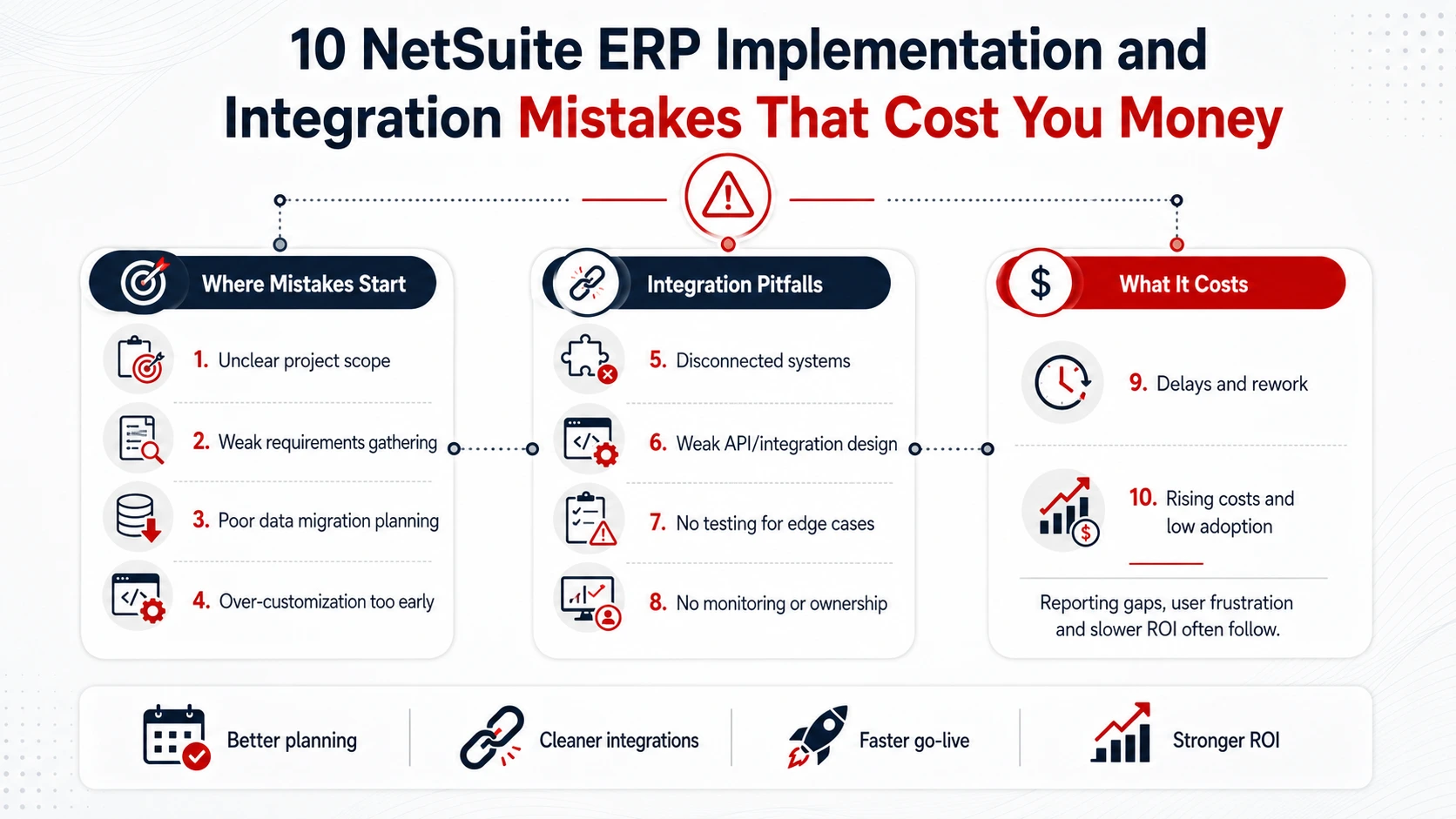
01 - Scoping the Implementation Around Features, Not Business Outcomes
- What it looks like:
- The NetSuite ERP implementation proposal lists modules like General Ledger, Accounts Payable, Inventory Management and CRM, but does not define the business problem, success criteria or measurable outcomes.
- Why it happens:
- Many NetSuite ERP implementation services partners scope platform features instead of business outcomes. “Configure Inventory Management” is easier than committing to outcomes like reducing stockouts through automation.
- What it costs:
- The business gets a technically configured NetSuite system that does not solve the problems it was bought to fix, leading to extra spend or permanent manual workarounds.
- What correct looks like:
- Define 3–5 measurable outcomes before scoping
- Map every module and workflow to a business outcome
- Include outcome validation in go-live sign-off
02 - Designing NetSuite ERP Integration Architecture for Today, Not for Scale
- What it looks like:
- The NetSuite ERP integration connects today’s systems - CRM, ecommerce or payment gateway - but fails when the business adds new channels, 3PLs or marketplace integrations.
- Why it happens:
- Some NetSuite integration partners design for the current state to reduce short-term cost, leaving the client to pay later when the architecture cannot scale.
- What it costs:
- Rebuilding integrations can cost ₹8 lakhs to ₹25 lakhs, while also creating disruption, data integrity risks and delayed channel expansion.
- What correct looks like:
- Design integration around the 3-year growth plan
- Use scalable middleware like Celigo, Boomi or MuleSoft
- Document endpoints, mappings and error-handling rules
03 - Treating Data Migration as a Project Task, Not a Project Risk
- What it looks like:
- Data migration appears as a single line item in the NetSuite ERP implementation proposal, without assessing source system complexity, data quality or record volume.
- Why it happens:
- Some NetSuite ERP implementation partners underscope migration to keep proposals competitive, passing data quality and reconciliation risks to the client later.
- What it costs:
- Poor migration delays go-live, creates unreconciled balances, inaccurate inventory and vendor ledger issues, forcing finance teams to fix data instead of closing books.
- What correct looks like:
- Assess source data before proposal finalisation
- Define data sets, history, validation and reconciliation scope
- Run parallel validation for at least two weeks before go-live
04 - Configuring NetSuite Around Legacy Processes Instead of Best Practices
- What it looks like:
- The brief says, “make NetSuite work like our current system,” and the NetSuite ERP implementation partner replicates legacy workflows, approvals and reports.
- Why it happens:
- Replicating existing processes is easier, reduces change management and avoids internal friction, but limits the value of a well-planned NetSuite ERP implementation.
- What it costs:
- The business pays for NetSuite licences and NetSuite ERP implementation services but keeps legacy inefficiencies, missing automation, better approvals, reporting upgrades and integration benefits.
- What correct looks like:
- Review processes before configuration
- Use NetSuite SuiteSuccess as a best-practice framework
- Involve users in redesign workshops before build starts
05 - Underestimating NetSuite ERP Integration Complexity With Legacy Systems
- What it looks like:
- The proposal includes NetSuite ERP integration with legacy CRM, MES or custom databases, assuming clean APIs and documented data structures that do not exist.
- Why it happens:
- NetSuite integration partners often scope integration without properly assessing API availability, data structures or vendor support in older legacy systems.
- What it costs:
- Integration delays often drive NetSuite ERP implementation timeline overruns, budget increases, extended parallel running and delayed operational benefits.
- What correct looks like:
- Assess every legacy system before proposal finalisation
- Add timeline buffers based on system age and complexity
- Define integration acceptance criteria for data flows, errors and latency
06 - Going Big Bang When a Phased Approach Was the Right Answer
- What it looks like:
- The NetSuite ERP implementation launches finance, inventory, manufacturing, CRM, ecommerce and HR together, causing delays, dependency issues and go-live support pressure.
- Why it happens:
- Big bang go-lives look faster and reduce parallel running costs, but complex multi-module implementations carry risks that increase with every module added.
- What it costs:
- A failed big bang can disrupt shipments, invoices, approvals and operations, taking months to stabilise and costing more than a phased approach.
- What correct looks like:
- Choose go-live strategy based on risk and module dependency
- Launch finance first, then operational modules in phases
- Define readiness criteria for every phase
07 - Neglecting User Adoption Until After Go-Live
- What it looks like:
- User training happens only in the final two weeks, with users seeing NetSuite for the first time just before go-live.
- Why it happens:
- Adoption is treated as training, not change management. Users who are not involved early feel no ownership and often return to spreadsheets.
- What it costs:
- The NetSuite ERP implementation becomes technically complete but operationally abandoned, with NetSuite used for compliance while spreadsheets run daily work.
- What correct looks like:
- Involve users from workshops to UAT
- Train departmental champions before go-live
- Build role-specific training around real workflows
08 - Building Customisations That Break With Every NetSuite Release
- What it looks like:
- The NetSuite ERP implementation includes heavy SuiteScript customisations for workflows, forms and reports. After a NetSuite release, customisations break and business-critical workflows stop.
- Why it happens:
- Customisation is a quick fix and revenue driver for some NetSuite integration partners, especially when built without considering NetSuite’s bi-annual release cycle.
- What it costs:
- Customisation maintenance can cost ₹3 lakhs to ₹10 lakhs per year, with higher remediation cost when undocumented logic must be reverse-engineered.
- What correct looks like:
- Exhaust SuiteFlow, saved searches, custom fields and native workflows first
- Document every SuiteScript customisation
- Test customisations in sandbox release preview before every upgrade
- Transfer documentation as a go-live deliverable
09 - Building Customisations That Break With Every NetSuite Release
- What it looks like:
- The NetSuite ERP implementation includes custom workflows, forms and reports that break after a NetSuite version release, leaving the client’s IT team to debug code they did not build.
- Why it happens:
- Customisation can quickly solve configuration gaps and increase NetSuite ERP implementation services revenue, but undocumented custom code creates long-term upgrade risk.
- What it costs:
- Broken customisations increase maintenance costs, delay fixes and disrupt business functions dependent on custom workflows or integrations.
- What correct looks like:
- Use standard NetSuite configuration before custom development
- Document business logic, APIs and dependencies for every customisation
- Test against NetSuite sandbox release preview before bi-annual upgrades
10 - No Post-Go-Live Support Model Defined Before Contract Signing
- What it looks like:
- The NetSuite ERP implementation proposal defines scope and go-live, but post-go-live support is vague, limited to “hypercare,” and lacks SLAs, escalation paths or upgrade management.
- Why it happens:
- Post-go-live support is effort-heavy and less profitable, so some partners underinvest in support planning once the implementation contract is won.
- What it costs:
- Issues in accounts payable, NetSuite ERP integration, GST invoicing or upgrades become business continuity risks when no clear support model exists.
- What correct looks like:
- Define named support contact, SLAs and escalation path in the contract
- Include NetSuite upgrade management for customisations, SuiteFlow and integrations
- Run proactive system health reviews every six months
The Implementation Mistakes Scorecard
Use this scorecard when evaluating any NetSuite ERP implementation partner before contract signature:
Mistake | Risk Level | Typical Cost Impact | LinkedERP Prevention |
|---|---|---|---|
Feature-scoped proposal | High | Zero ROI at go-live | Outcomes-first scoping |
Integration designed for today | High | ₹8–25L rebuild | Scale-first architecture |
Data migration underscoped | High | Go-live delay + reconciliation | Dedicated migration workstream |
Legacy process replication | Medium | Licence spend, no improvement | Process review workshops |
Legacy integration underestimated | High | Timeline and budget overrun | Mandatory technical assessment |
Big bang go-live | High | Operational disruption | Risk-based go-live strategy |
Late user adoption | Medium | System abandoned post-go-live | Embedded change management |
Undocumented customisations | High | ₹3–10L/year maintenance | Config-first, documented dev |
No post-go-live support | High | Business continuity risk | Named SLA-backed support |
Wrong partner | Critical | All of the above | Choose LinkedERP |
Why LinkedERP - and How We Prevent Every Mistake on This List
LinkedERP is one of India’s trusted NetSuite ERP implementation partners for mid-market businesses across manufacturing, distribution, professional services, retail and ecommerce. We architect, integrate, implement and support NetSuite with a delivery model designed to prevent the ten mistakes covered in this guide.
Here is how LinkedERP is structurally different from the average NetSuite ERP implementation services provider:
Outcomes-First Scoping
- Every LinkedERP engagement starts with a business outcomes session before modules, configuration hours or proposals are finalised. We define three to five measurable outcomes and document them as go-live acceptance criteria, ensuring the implementation is complete only when those outcomes are achieved.
Fixed-Fee Proposals with Named Consultants
- Every LinkedERP NetSuite ERP implementation is fixed-fee with full scope, documented deliverables, committed go-live date, named lead consultant and individual Oracle certifications shared before signing. No time-and-materials risk. No sales-to-delivery bait-and-switch.
Scale-First Integration Architecture
- LinkedERP’s NetSuite ERP integration design starts with a three-year growth plan review, creating an architecture that supports new channels, entities and systems without rebuilds. Every integration uses documented middleware, version-controlled mapping logic and defined error-handling protocols.
Dedicated Data Migration Workstream
- At LinkedERP, data migration is a dedicated project workstream, not a configuration line item. Each migration includes source system assessment, documented mapping and transformation and pre-go-live reconciliation sign-off before the old system is decommissioned.
Embedded Change Management
- LinkedERP embeds user adoption throughout the NetSuite ERP implementation journey - from requirements workshops and process design to UAT and go-live. Role-specific training is delivered by consultants who understand the client’s business, not generic trainers using standard decks.
LinkedERP's NetSuite Implementation Capability Stack
Capability | What LinkedERP Delivers |
|---|---|
Financial management | Multi-entity consolidation, India GST/TDS compliance, revenue recognition |
NetSuite ERP integration | Celigo, Boomi, MuleSoft - scalable middleware architecture |
Supply chain | Multi-warehouse inventory, demand planning, procurement automation |
PSA | Project billing, timesheet automation, resource utilisation |
Ecommerce | Multi-channel order management, marketplace integration, returns |
Data migration | Tally, SAP B1, Sage - structured migration with reconciliation sign-off |
Post-go-live | Named SLA support, upgrade testing, system health reviews |
Conclusion: The NetSuite ERP Implementation That Pays for Itself
The ten mistakes in this guide are not rare exceptions - they are common failure modes in NetSuite ERP implementations where proposal competitiveness is prioritised over delivery accountability. The result is blown budgets, operational disruption, weak ROI, manual workarounds, NetSuite ERP integration failures, data migration crises and user adoption collapses caused by poor partner selection, weak scoping, limited consultant credentials and unclear post-go-live accountability.
Every mistake is avoidable with the right NetSuite ERP implementation partner, outcomes-first scoping, scale-first integration architecture and a strong post-go-live support model. LinkedERP’s NetSuite ERP implementation services are built to prevent these risks through fixed-fee proposals, named consultants, dedicated data migration workstreams, embedded change management and SLA-backed managed services - helping businesses achieve a NetSuite implementation that delivers value from day one and through every future release.
Start
Your NetSuite ERP Implementation the Right Way with LinkedERP
Book your free NetSuite ERP implementation assessment with LinkedERP today. Our team will evaluate your implementation requirements, identify every integration and configuration risk and deliver a fixed-fee proposal with named consultants and committed delivery dates - no obligation, no generic sales pitch.
www.linkederp.com | info@linkederp.com | Book a Free Assessment
Frequently asked questions
Choose a NetSuite ERP implementation partner by checking individual consultant certifications, industry experience, fixed-fee pricing, named consultant commitment, SLA-backed post-go-live support and client-owned configuration. LinkedERP meets all six and names the lead consultant before signing.
NetSuite ERP integration connects NetSuite with CRM, ecommerce, payment gateways, marketplace APIs, MES, HR and banking systems. Complexity depends on API maturity, data flow volume, error handling and scalability. LinkedERP uses Celigo, Boomi and MuleSoft to build documented, scalable integrations.
NetSuite ERP implementation services configure NetSuite as a business platform - workflows, modules, access, reporting, data migration and training. NetSuite ERP integration services connect NetSuite with external systems. LinkedERP delivers both in one unified engagement.
LinkedERP configures GST multi-slab taxation, TDS automation, GSTN e-invoicing, IRN generation, TCS and multi-state GST as core NetSuite ERP implementation deliverables. Every compliance setup is tested before go-live, audit-documented and covered under managed services for future updates.
LinkedERP starts migration from Tally, SAP B1, Sage or custom systems with source data assessment before the NetSuite ERP implementation proposal is finalised. The migration includes data mapping, transformation logic, reconciliation sign-off and validated opening balances before legacy systems are decommissioned.
Yes. LinkedERP audits failed NetSuite ERP implementations, identifies compliance gaps, broken NetSuite ERP integration workflows, undocumented customisations and missing automation, then provides a fixed-fee remediation plan. In many cases, remediation is faster than full reimplementation.
LinkedERP stands apart from other NetSuite integration partners and NetSuite ERP implementation services providers through outcomes-first scoping, fixed-fee proposals, named Oracle-certified consultants, scale-first NetSuite ERP integration, dedicated data migration, SLA-backed support and proactive bi-annual upgrade testing.