
Quick Summary
Indian ecommerce businesses scaling across marketplaces, managing multi-warehouse inventory and navigating GST compliance need more than a basic ERP. They need NetSuite solutions for ecommerce that connect order management, inventory, finance and fulfilment in one real-time platform. This blog breaks down the five NetSuite solutions that deliver the highest impact for Indian ecommerce businesses - from multi-channel order automation to GST-compliant invoicing - and explains how LinkedERP, one of India's most trusted NetSuite partners, configures each solution to turn operational complexity into competitive advantage.
Introduction: The Ecommerce Scaling Problem Every Indian Business Recognises
Ecommerce businesses entering the next growth stage often face the same operational strain: orders flowing in from Shopify, Amazon and Flipkart, inventory split across multiple warehouses, GST varying by product category and state and finance teams still reconciling marketplace settlements manually. The tools that supported growth to ₹10 crore may not scale to ₹100 crore when order management, inventory reconciliation and financial reporting remain disconnected.
NetSuite solutions for ecommerce help solve this inflection point by connecting order management, inventory, fulfilment, finance and compliance in one unified cloud-native ERP system. At LinkedERP, one of India’s leading NetSuite partners, we configure NetSuite for Indian ecommerce businesses across fashion, electronics, FMCG, health and wellness and D2C brands - helping them scale revenue, channels, warehouses and SKUs without increasing operational complexity at the same pace.
Market Context: Acc. To Deloitte & BCG - India's ecommerce market is projected to reach $350 billion by 2030, with D2C brands, marketplace sellers and omnichannel retailers all scaling rapidly. NetSuite partners in India with ecommerce-specific implementation experience report that inventory accuracy, GST compliance and multi-channel order automation are the three most common pain points driving ERP evaluation among Indian ecommerce businesses in 2025-2026. |
What Makes NetSuite the Right ERP for Indian Ecommerce Businesses
Before evaluating the five solutions, it is worth understanding why NetSuite solutions for ecommerce are particularly well-suited to India's operating environment:
Real-time multi-channel order visibility - every order from every channel in one system, updated in real time without manual data entry
India-native GST compliance - automated GST calculation, e-invoicing and GSTR data extraction built into every transaction
Multi-warehouse inventory management - bin-level stock visibility across all fulfilment locations with real-time allocation logic
Marketplace settlement reconciliation - automated matching of Amazon, Flipkart and Meesho settlements against orders and returns
Scalable without ERP replacement - NetSuite grows with the business, adding modules and users without a platform migration
Solution 1: Multi-Channel Order Management Automation
The Problem It Solves
Managing orders from Shopify, Amazon, Flipkart and your own website in separate systems - or worse, consolidating them manually in a spreadsheet - creates fulfillment delays, inventory overselling and customer experience failures. When a product sells out on one channel and the update does not reach the others in time, you are either cancelling orders or overselling stock you do not have.
What NetSuite Delivers
Order Received on Any Channel → Centralised in NetSuite → Inventory Allocated → Fulfilment Triggered → Tracking Updated → GST Invoice Raised → Revenue Recognised
Connect all sales channels - Shopify, Amazon, Flipkart, WooCommerce, your own website - to NetSuite through native connectors or Celigo integration, centralising every order in a single order management view
Configure real-time inventory allocation rules so stock is reserved at the moment of order confirmation - preventing overselling across channels when the same SKU is listed on multiple platforms
Set automated fulfilment routing rules to direct each order to the most appropriate warehouse based on customer location, stock availability and shipping cost - without manual allocation decisions
Enable order status synchronisation back to each marketplace - so tracking numbers, delivery confirmations and return acknowledgements update automatically without your operations team touching each order
LinkedERP ecommerce clients who implement centralised order management through NetSuite solutions for ecommerce report eliminating 85–90% of manual order processing tasks within the first quarter - and reducing order cancellation rates due to stockouts by over 60%.
Solution 2: Real-Time Multi-Warehouse Inventory Management
The Problem It Solves
Indian ecommerce businesses with stock across multiple fulfilment centres, third-party logistics providers and their own warehouses consistently face the same problem: nobody knows exactly how much stock is where in real time. Replenishment decisions are made on yesterday's numbers. Stockouts happen on fast-moving SKUs while slow-moving stock ties up working capital in the wrong location.
What NetSuite Delivers
Stock Received → Bin Location Assigned → Real-Time Availability Updated → Reorder Point Checked → Purchase Order Triggered → Transfer Order Raised → Allocation Confirmed
Configure bin-level inventory tracking across all warehouse locations - giving your operations team exact stock position by SKU, location and lot or serial number at any moment without a physical count
Set reorder points and preferred stock levels by SKU and location - so NetSuite automatically generates purchase order recommendations when stock falls below the defined threshold before a stockout occurs
Enable transfer order automation to move stock between warehouses when demand signals indicate an imbalance - without manual intervention from the inventory planning team
Generate real-time inventory valuation reports by warehouse, category and supplier - giving your finance team accurate stock values for GST compliance, working capital management and profitability analysis
Oracle NetSuite partners in India with ecommerce implementation experience consistently report that real-time inventory visibility is the single capability that delivers the fastest measurable ROI - typically within 60 days of go-live, as stockout costs and excess inventory carrying costs both fall simultaneously.
Solution 3: GST-Compliant Invoicing and Marketplace Settlement Reconciliation
The Problem It Solves
For Indian ecommerce businesses, GST compliance is not optional - and it is not simple. Different product categories attract different GST rates. Sales across state borders require IGST treatment. Marketplace commissions carry their own GST implications. And the settlement files that Amazon and Flipkart send every two weeks bear only a passing resemblance to your actual order and return data. Reconciling them manually is a full-time finance function.
What NetSuite Delivers
Order Confirmed → GST Rate Applied → E-Invoice Generated → IRN Stamped → Settlement File Received → Auto-Matched Against Orders → Variance Flagged → GSTR Data Extracted
Configure product-level HSN code mapping and GST rate assignment - so every invoice raised through NetSuite carries the correct tax treatment automatically, regardless of the channel or customer location
Enable GSTN e-invoicing integration for IRN generation and QR code stamping on every B2B transaction above the mandatory threshold - with no manual portal submission required
Build marketplace settlement reconciliation workflows that automatically match Amazon, Flipkart and Meesho settlement line items against NetSuite order and return records - flagging variances for finance review rather than requiring line-by-line manual matching
Extract GSTR-1 and GSTR-3B data in portal-ready formats directly from NetSuite - eliminating the data compilation step that consumes finance team bandwidth at every return period
LinkedERP clients using NetSuite solutions for ecommerce for GST automation and settlement reconciliation report reducing finance team effort on marketplace reconciliation from 3–4 days per settlement cycle to under 4 hours - and achieving near-zero GSTR mismatches compared to their previous manual process.
Solution 4: Returns Management and Reverse Logistics Automation
The Problem It Solves
Returns are a fact of ecommerce life in India - and in many categories, return rates run between 15% and 30% of gross orders. Managing returns manually - processing refunds, updating inventory, raising credit notes and reconciling returns against marketplace settlement deductions - is one of the highest-overhead operational processes in any ecommerce business. When returns are handled manually, refund delays damage customer experience, inventory records become inaccurate and the financial impact of returns is never fully visible.
What NetSuite Delivers
Return Initiated → RMA Raised → Item Received → Condition Assessed → Inventory Updated → Credit Note Raised → Refund Processed → GST Adjusted → Margin Impact Reported
Configure return merchandise authorisation workflows in NetSuite to manage the full returns cycle - from customer return initiation through inspection, inventory restock or write-off and financial credit - in a single automated process
Set condition-based return routing rules - saleable returns go back to available inventory, damaged returns are quarantined for write-off or vendor claim and refurbishment candidates are routed to a separate bin location for processing
Enable automated credit note generation linked to the original sales order - ensuring GST treatment on the credit note matches the original invoice and GSTR data is adjusted correctly
Generate returns analytics by SKU, category, channel and reason code - giving your product and buying team the data they need to address return rate drivers at the source
Solution 5: Ecommerce Financial Reporting and Profitability Analytics
The Problem It Solves
Most Indian ecommerce businesses know their gross revenue. Far fewer know their true unit economics - the actual contribution margin per order after marketplace commissions, fulfilment costs, return rates, payment gateway fees and advertising spend are accounted for. Without this visibility, scaling decisions are made on revenue metrics that mask the profitability reality.
What NetSuite Delivers
Revenue Recognised → COGS Allocated → Fulfilment Cost Captured → Commission Deducted → Return Cost Applied → Contribution Margin Calculated → Channel P&L Reported → CFO Dashboard Updated
Configure NetSuite's analytic accounting to track revenue, COGS, fulfilment costs, marketplace commissions and return costs at order level - giving finance and leadership a true contribution margin view by channel, category and SKU
Build channel-level P&L reports showing gross revenue, net revenue after returns, direct costs, marketplace fees and contribution margin - enabling evidence-based decisions about which channels and categories to invest in and which to rationalise
Enable cash flow forecasting that accounts for marketplace settlement timing - so your treasury function knows exactly when Amazon, Flipkart and Meesho settlement proceeds will hit your bank account and can plan working capital accordingly
Schedule automated delivery of the weekly trading report - revenue orders, returns and margin by channel - to leadership and investors without any manual compilation by the finance team
LinkedERP ecommerce clients who implement profitability analytics through NetSuite solutions for ecommerce consistently identify 2–3 product categories or channels that are consuming marketing and fulfilment investment while delivering negative contribution margins - and redirecting that investment to profitable growth channels within the first quarter.
The Honest Capability Comparison
Factor | Disconnected Tools | NetSuite Solutions for Ecommerce |
|---|---|---|
Multi-channel order management | Manual consolidation - channel by channel | Real-time unified order view across all channels |
Inventory visibility | End-of-day batch updates - overselling risk | Real-time bin-level allocation - zero overselling |
GST compliance | Manual rate selection - GSTR mismatch risk | Automated HSN mapping and e-invoicing |
Settlement reconciliation | 3–4 days manual per cycle | Under 4 hours automated matching |
Returns management | Manual RMA - credit note delays | Automated cycle from return to credit note |
Channel profitability | Unknown - revenue metrics only | Real-time contribution margin by channel and SKU |
Working capital visibility | Cash flow surprises at settlement time | Settlement-timing-aware cash flow forecasting |
Scale without headcount | Operations team grows with order volume | Automation absorbs volume growth |
Five Ecommerce Scenarios Where NetSuite Expertise Is Non-Negotiable
Scenario 1: Multi-Marketplace D2C Scaling D2C brands selling across their own website, Amazon, Flipkart and emerging quick-commerce platforms need a single order management system that treats every channel consistently - with unified inventory, unified invoicing and unified profitability reporting. NetSuite solutions for ecommerce provide this architecture natively, with LinkedERP-built channel integrations connecting every marketplace from go-live.
Scenario 2: High-SKU Fashion and Lifestyle Ecommerce Fashion and lifestyle ecommerce businesses managing thousands of SKUs across multiple size and colour variants need bin-level inventory tracking, variant-level return analytics and category-level margin reporting that generic accounting tools cannot deliver. NetSuite's inventory architecture handles variant complexity at any scale.
Scenario 3: Marketplace Seller Moving to Omnichannel Marketplace-first sellers expanding into their own website, offline retail or wholesale need a single ERP that handles all channels with consistent inventory, pricing and financial reporting - without a separate system for each channel. NetSuite's omnichannel architecture is built for exactly this transition.
Scenario 4: Ecommerce Business Approaching GST Audit Indian ecommerce businesses approaching a GST audit need an auditable trail from every sales transaction to the GST return data - including marketplace settlement reconciliation, return adjustments and TCS deductions. Oracle NetSuite partners in India with ecommerce experience configure this audit trail as core system behaviour, not a post-audit remediation.
Scenario 5: Ecommerce Business Preparing for PE Investment or IPO Investors and underwriters evaluating Indian ecommerce businesses need investor-grade financial reporting - audited consolidated statements, unit economics by channel and category and working capital visibility. NetSuite's financial reporting architecture delivers this without a separate finance transformation project.
Why LinkedERP Is India's Trusted NetSuite Ecommerce Partner
LinkedERP is one of India's leading NetSuite partners, delivering ecommerce ERP implementations with deep platform expertise, India compliance knowledge and a contractual commitment that defines what professional NetSuite partner engagement should look like.
What LinkedERP Brings to Every Ecommerce Implementation
Oracle-Certified NetSuite Consultants - named before you sign, retained through go-live - with individual ecommerce module and SuiteCommerce credentials
India-First Ecommerce Architecture - GST, e-invoicing, marketplace settlement reconciliation and TCS compliance configured as core system behaviour from day one
Channel Integration Expertise - Shopify, Amazon, Flipkart, WooCommerce, Meesho and payment gateway integrations built and tested as go-live deliverables
Fixed-Fee Proposals - full scope, documented deliverables, no surprise invoices - ever
Client-Owned Configuration - all NetSuite configurations, integrations and custom workflows transfer to you on completion - no lock-in
Post-Implementation Managed Services - named support contact, defined SLAs, proactive management of marketplace API changes and GSTN integration updates
LinkedERP's NetSuite Ecommerce Capability Stack
Capability | What LinkedERP Delivers |
|---|---|
Order management | Multi-channel centralisation, allocation rules, fulfilment routing |
Inventory | Bin-level tracking, reorder automation, transfer order management |
GST compliance | HSN mapping, e-invoicing, GSTR extraction, TCS handling |
Settlement reconciliation | Amazon, Flipkart, Meesho auto-matching with variance reporting |
Returns management | RMA workflows, condition routing, credit note automation |
Profitability analytics | Channel P&L, unit economics, cash flow forecasting |
Integrations | Shopify, Amazon, Flipkart, Razorpay, Delhivery, Shiprocket |
Conclusion: Is NetSuite the Right Solution for Your Ecommerce Business?
It may not be required yet when the business operates on a single channel, manages fewer than 500 orders per month, has a simple single-warehouse inventory structure and GST compliance remains straightforward with low transaction volumes.
It becomes necessary when selling across three or more channels with separate order management processes, inventory overselling or stockouts are affecting orders and customer relationships, marketplace settlement reconciliation takes more than one day of finance team time per cycle, real-time visibility into contribution margin by channel or category is missing, GST compliance is manual, return-period reconciliation becomes a scramble or the business is preparing for Series A, PE investment or an IPO and needs investor-grade financial reporting.
Start
Your NetSuite Ecommerce Implementation with LinkedERP
Book a free ecommerce ERP assessment. Share your current channel mix, order volumes, inventory structure, and compliance requirements. We will evaluate your situation honestly, recommend the right NetSuite architecture, and provide a fixed-fee proposal with named consultants and committed delivery dates.
www.linkederp.com | info@linkederp.com | Book a Free Ecommerce Assessment
Frequently asked questions
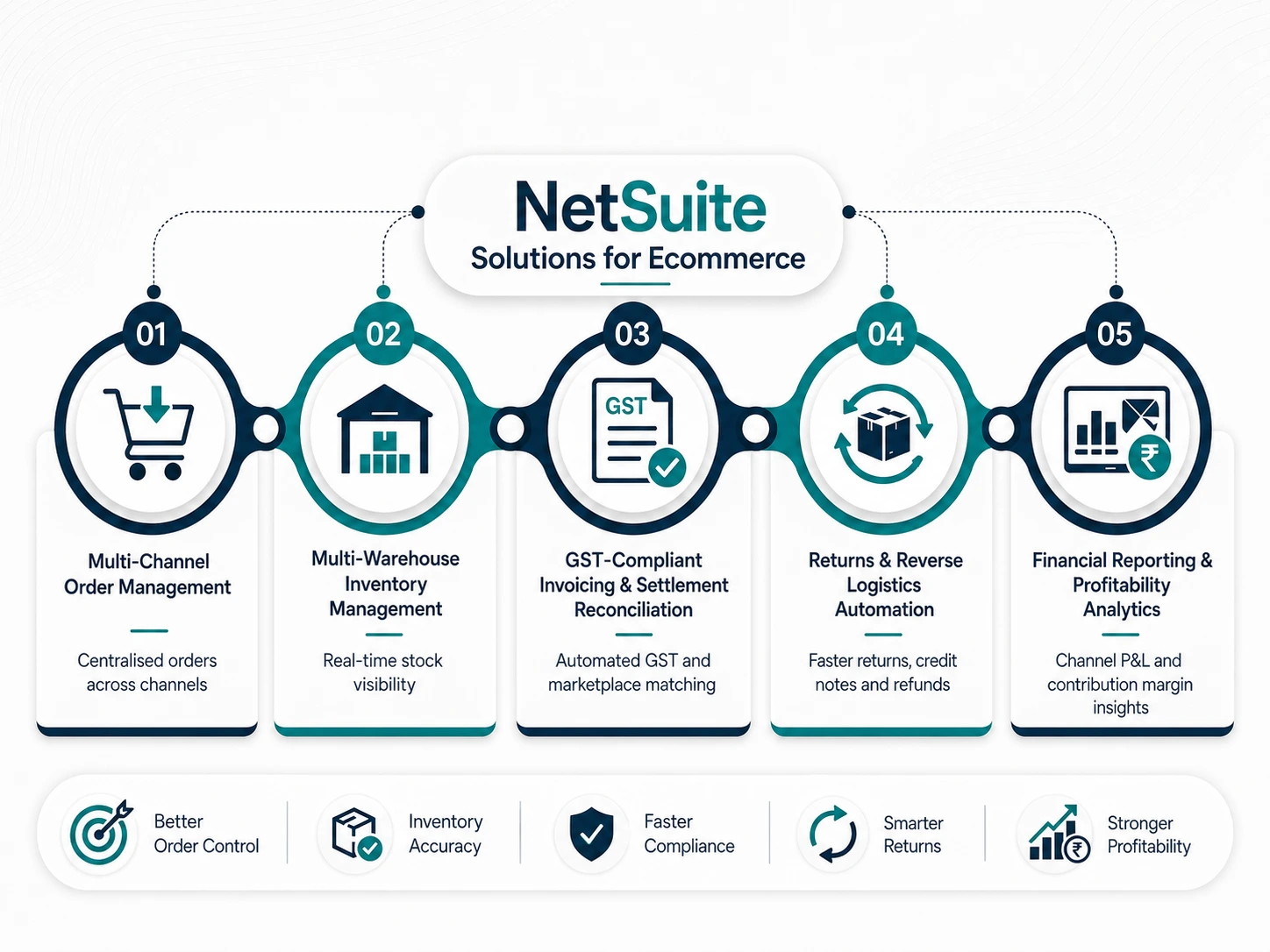
The top NetSuite solutions for ecommerce for Indian businesses are multi-channel order management automation, real-time multi-warehouse inventory management, GST-compliant invoicing and marketplace settlement reconciliation, returns management and reverse logistics automation, and ecommerce financial reporting and profitability analytics. LinkedERP configures all five as integrated components of a single NetSuite implementation.
NetSuite solutions for ecommerce connect to Amazon and Flipkart through native connectors or Celigo integration - centralising orders, synchronising inventory levels, automating fulfilment updates and matching settlement files against order and return records. LinkedERP builds and tests these integrations as core go-live deliverables.
Experienced NetSuite partners in India configure product-level HSN code mapping, automated GST rate application, GSTN e-invoicing integration for IRN generation and GSTR-1 and GSTR-3B data extraction - so every ecommerce transaction is GST-compliant from the moment it is processed in NetSuite.
When reviewing a list of NetSuite partners for ecommerce implementation, prioritise partners with Oracle certification, proven ecommerce channel integration experience, India GST compliance expertise, fixed-fee proposals and post-go-live managed services. LinkedERP meets all of these criteria with dedicated ecommerce implementation experience across Indian D2C, marketplace and omnichannel businesses.
A standard NetSuite ecommerce implementation covering order management, inventory, GST compliance, marketplace integrations and financial reporting typically takes 10–14 weeks with LinkedERP, depending on the number of channels, warehouse complexity and data migration requirements from legacy systems.
Top NetSuite implementation partners for Indian ecommerce differ in their India compliance depth, channel integration capability and post-go-live support model. LinkedERP differentiates through ecommerce-specific configuration experience, India-first GST and settlement reconciliation setup and Oracle-certified consultants named before contract signing.