
Quick Summary
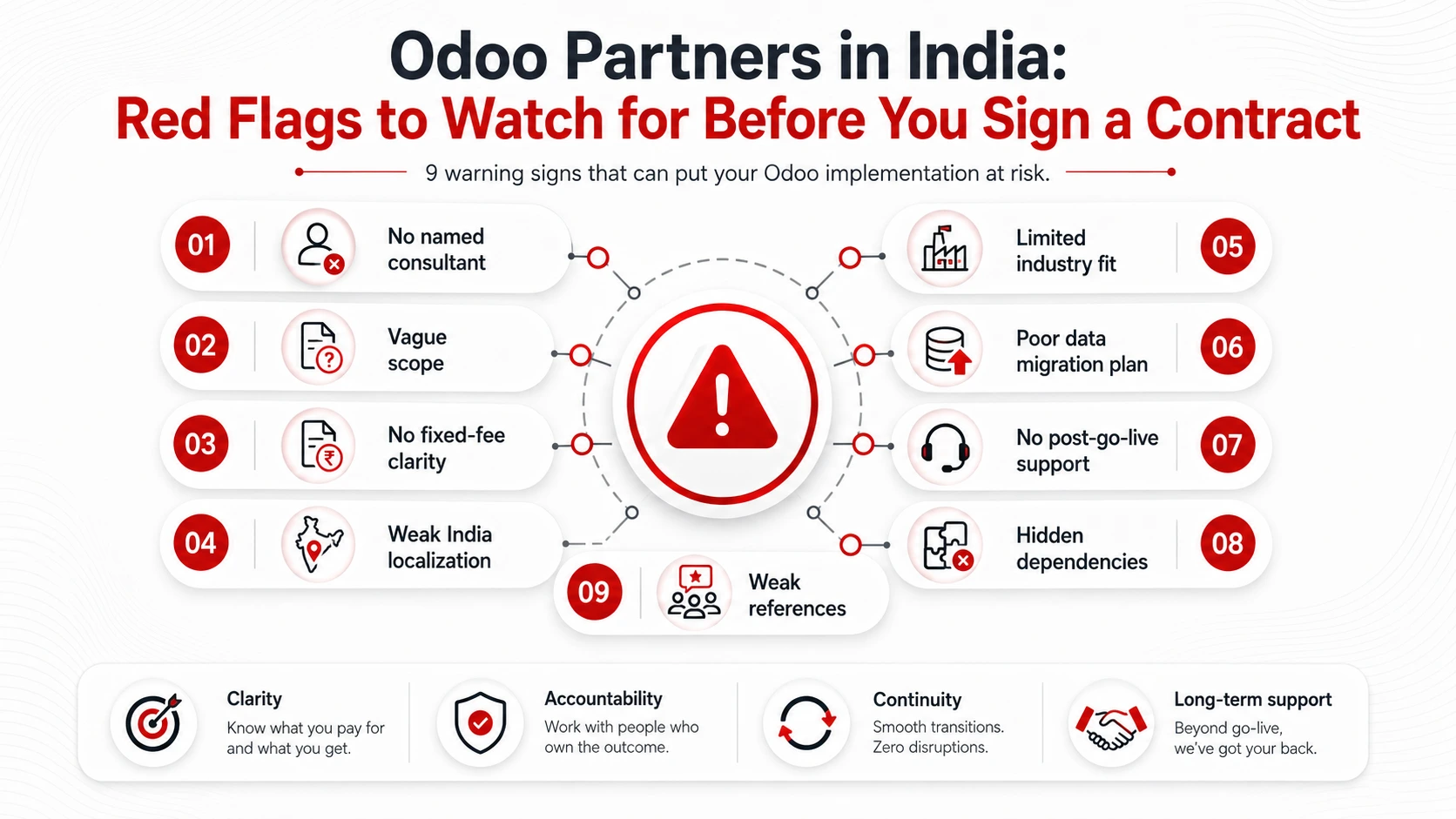
Choosing the right Odoo partners India can decide whether your ERP implementation succeeds or becomes expensive rework. This blog highlights 9 red flags to watch for before signing with an Odoo implementation partner in India - from overpromising and unclear scope to weak post-go-live support - and explains how LinkedERP brings accountability, clarity and structured delivery.
Introduction: The Odoo Partner Problem Every Indian Business Needs to Understand
Odoo is one of the most capable ERP platforms for Indian mid-market businesses, connecting finance, inventory, sales, CRM, manufacturing, HR and project management in one unified system with India-specific localisation for GST, TDS, e-invoicing and multi-entity accounting.
However, Odoo’s open-source model and easy partner certification have created an uneven partner landscape in India. The difference between the strongest Odoo partners India and the weakest can decide whether ERP transforms the business or creates delays, budget pressure, disruption and long-term workarounds. This guide highlights nine red flags to help businesses choose the right Odoo ERP implementation partner, reliable Odoo implementation services in India and accountable Odoo ERP implementation services before signing.
|
Industry Context: Odoo has over 100 certified partners in India, ranging from boutique consultancies to large system integrators. Certification level - Official, Ready or Silver/Gold - reflects a baseline of platform competency but does not guarantee implementation quality, industry expertise or post-go-live accountability. The businesses that get the most from Odoo are the ones that evaluated partners rigorously - not the ones that signed with the lowest bidder or the most persuasive sales team. |
Red Flag 1: They Cannot Name the Consultant Leading Your Implementation
The most damaging bait-and-switch in Odoo ERP implementation happens when a senior consultant handles the sales process, but a junior resource leads the actual project.
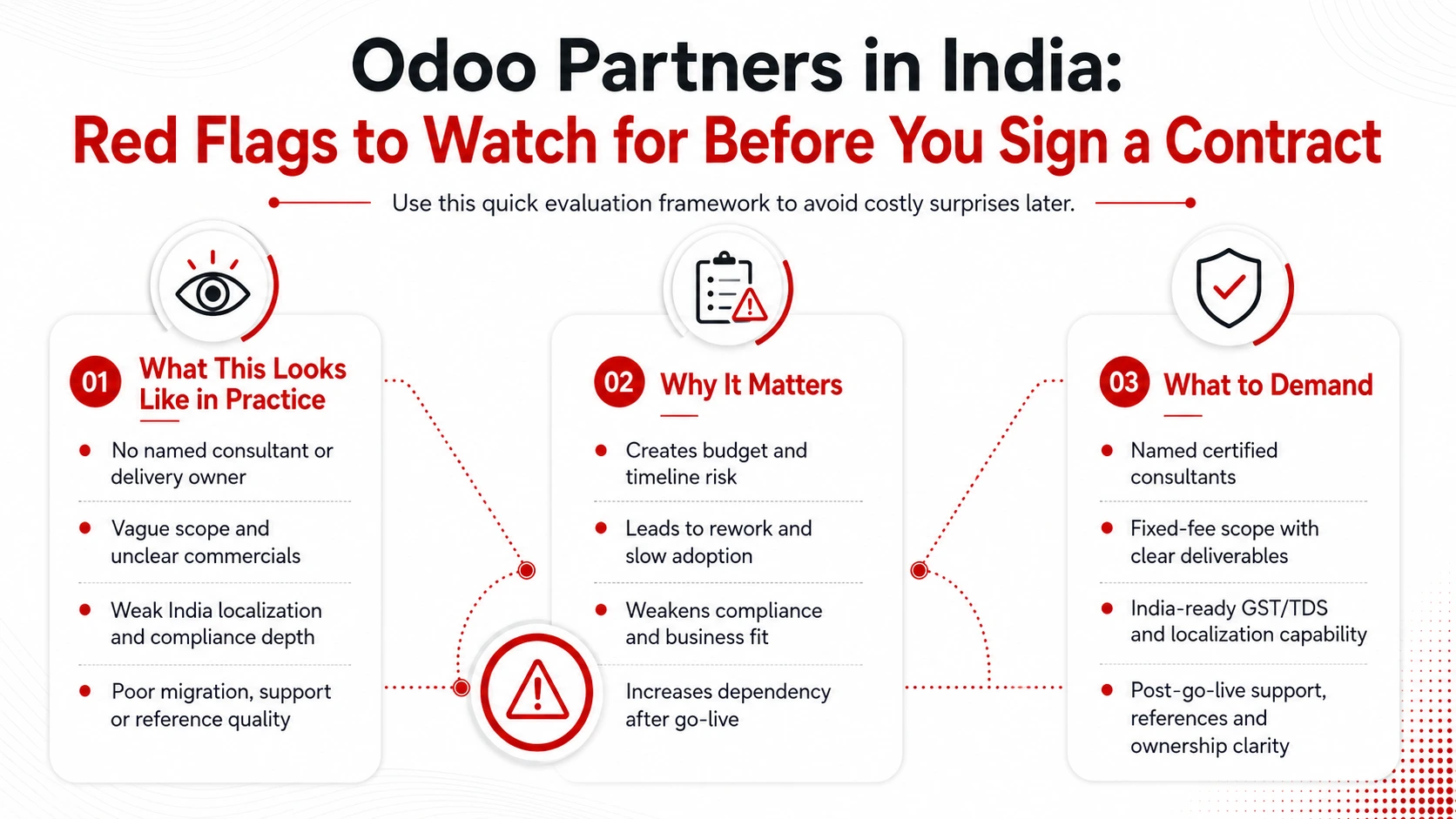
What this looks like in practice: The sales team sounds polished, but when asked who will lead the implementation, the answer is vague - “our team of certified consultants” - instead of a name, CV and certification record.
Why it matters: Odoo implementation quality depends on the consultant’s industry experience, configuration depth and ability to translate business requirements into a working system. A junior consultant on a complex multi-module project increases risk.
What to demand: Ask for the lead consultant’s name, individual Odoo certifications and confirmation that they will stay from kickoff to go-live. Anything vague should be treated as a red flag.
Red Flag 2: The Proposal Is Time-and-Materials With No Fixed Scope
A time-and-materials proposal shifts implementation risk to your business. If the partner underscopes, misunderstands requirements or underestimates complexity, you pay the extra cost.
What this looks like in practice: The proposal lists hourly or daily rates with an estimated total, vague scope and no committed go-live date.
Why it matters: Poorly scoped Odoo ERP implementation costs can rise sharply mid-project, leaving your business with little negotiating power once operations depend on completion. This is why businesses should choose Odoo ERP implementation services that include fixed scope, documented deliverables, milestones and a committed go-live date.
What to demand: Ask for a fixed-fee proposal with documented modules, workflows, integrations, data migration deliverables, milestones and a committed go-live date.
Red Flag 3: They Have No India-Specific Compliance Experience
Odoo is global, but India compliance needs specific localisation expertise across GST, TDS, e-invoicing with GSTN integration, TCS and multi-state GST registration.
What this looks like in practice: The partner explains standard Odoo features but gives vague answers on GSTR-2A reconciliation, IRN generation or TDS threshold configuration.
Why it matters: Incorrect GST configuration can create GSTR mismatches, ITC disputes and penalties from the first invoice. Retrofitting compliance later is expensive and disruptive.
What to demand: Ask how they configure HSN/SAC mapping, fiscal positions, TDS section assignment and GSTN e-invoicing integration. Generic answers indicate weak India compliance depth.
Red Flag 4: Their References Are All From Different Industries
Broad Odoo exposure is not the same as industry depth. Strong implementation partners should show repeated experience in your sector.
What this looks like in practice: Case studies cover many unrelated industries, but the partner struggles to share references from businesses similar to yours.
Why it matters: Manufacturing, professional services, retail and trading businesses need different workflows, approvals, reporting and compliance logic. Generic Odoo experience may not fit your requirements.
What to demand: Ask for two or three references from your industry. Check whether the partner understood requirements, delivered on time and stayed within budget.
Red Flag 5: The Demo Uses Only Default Odoo Data
A demo using standard Odoo sample data may look impressive, but it does not prove the partner can configure Odoo for your business.
What this looks like in practice: The partner shows scripted default workflows. When asked to demonstrate your approval hierarchy, GST configuration or project billing model, they defer it to implementation.
Why it matters: A partner unable to demonstrate your requirements before signing may lack the configuration depth to build them correctly later.
What to demand: Ask for a proof of concept using your data, workflows and compliance needs. Strong Odoo implementation services in India partners should welcome this.
Red Flag 6: Post-Go-Live Support Is Vague or Entirely Absent
Go-live is not the end of an Odoo ERP implementation. The first 30–90 days are the most sensitive period as users adapt and live issues surface.
What this looks like in practice: The proposal mentions hypercare but does not define response times, support channels, named contacts or escalation paths.
Why it matters: Issues in GST invoicing, accounts payable or inventory rules after go-live can become business continuity risks if support is slow or generic.
What to demand: Ask for a written support model with named contacts, severity-wise SLAs, escalation paths and Odoo version upgrade support.
Red Flag 7: They Propose Heavy Customisation Before Understanding Your Processes
Odoo customisation should be the last resort, not the first recommendation. Heavy custom code before process discovery signals weak platform knowledge or budget padding.
What this looks like in practice: The proposal includes custom development for workflows that standard Odoo modules can handle, with vague justification like “to match your current process.”
Why it matters: Custom code creates technical debt, upgrade risk and maintenance dependency. Poorly documented customisation becomes difficult to support over time.
What to demand: Ask the partner to justify every customisation, explain why standard Odoo cannot meet the need and document all custom code before go-live.
Red Flag 8: Data Migration Is Not Scoped in the Proposal
Historical data is the foundation of your new Odoo system. Treating data migration as an afterthought creates serious go-live risk.
What this looks like in practice: The proposal says “migration of master data as agreed” without listing data sets, formats, validation criteria or timelines.
Why it matters: Migration from Tally, Busy, SAP B1 or custom systems needs proper mapping, validation and reconciliation. Poor migration can cause incorrect balances, vendor ledger issues and GST traceability gaps.
What to demand: Ask for a defined data migration scope covering source systems, data sets, validation rules, reconciliation process and go-live readiness checks.
Red Flag 9: They Cannot Explain Their Odoo Version Upgrade Process
Odoo releases a new version annually and each update can affect custom modules, APIs, workflows and integrations.
What this looks like in practice: The partner gives vague answers such as “Odoo handles updates automatically” or says upgrades are assessed case by case.
Why it matters: Odoo version upgrades require structured testing of custom modules, integrations and automated workflows before production updates. Without this, every release becomes a system risk.
What to demand: Ask for their version upgrade process, testing protocol, release-to-upgrade timeline and SLA for resolving upgrade-related issues. A partner without this process is not protecting long-term system health.
Conclusion: The Right Odoo Partner Makes the Difference Between Transformation and Disruption
Odoo is a powerful ERP platform for Indian mid-market businesses in 2026, but its success depends on the quality of the Odoo ERP implementation behind it. The nine red flags in this guide show where failed implementations usually begin - weak partner evaluation, poor India compliance depth, unclear accountability, limited industry expertise and no structured post-go-live support. The real gap is not in Odoo’s capability, but in partner quality.
For businesses evaluating Odoo partners India, the right Odoo ERP implementation partner should name the lead consultant, offer fixed-fee scoping, prove India compliance expertise, provide relevant references and commit to SLA-backed support. With LinkedERP’s structured Odoo implementation services in India and accountable Odoo ERP implementation services, businesses get a clear assessment, the right Odoo architecture, named consultants, fixed-fee accountability and a stronger foundation for long-term ERP success.
Book
your free Odoo implementation assessment with LinkedERP today.
Our India team will evaluate your requirements, identify every compliance and configuration risk and deliver a fixed-fee proposal with named consultants and committed delivery dates - no obligation, no generic sales pitch.
www.linkederp.com | info@linkederp.com | Book a Free Assessment
Frequently asked questions
Trustworthy Odoo partners India should name the lead consultant before signing, offer fixed-fee proposals, show India compliance expertise, provide industry references, define SLA-backed post-go-live support and transfer configuration IP after completion. Odoo partner tiers are useful filters, but implementation accountability matters more than certification or marketing presence.
A standard Odoo implementation covering finance, inventory and sales usually takes 6–10 weeks with LinkedERP. Multi-module projects involving manufacturing, HR, project management, e-invoicing, integrations and complex data migration may take 10–16 weeks, with milestones and go-live dates agreed upfront.
Odoo implementation services in India should cover GST multi-slab configuration, HSN/SAC mapping, intra-state and inter-state fiscal positions, GSTN e-invoicing, GSTR-1 and GSTR-3B extraction, TDS, TCS and multi-state GST registration. A strong Odoo implementation partner must explain these configurations in technical terms.
Odoo partner tiers - Authorized, Ready, Silver and Gold - reflect licences sold, certified consultants and implementation volume. However, tier alone does not guarantee implementation quality, industry expertise or support capability. Choose an Odoo ERP implementation partner based on references, consultant credentials, proposal quality and accountability.
A complete Odoo ERP implementation proposal should include named consultants, individual certifications, fixed-fee pricing, full scope documentation, modules, workflows, integrations, data migration deliverables, go-live milestones, support SLAs and configuration IP ownership. Missing fixed-fee pricing, named consultants or post-go-live support is a red flag.
Yes. LinkedERP fixes failed Odoo ERP implementation projects through a configuration audit, compliance gap review, workflow assessment and prioritised remediation plan with fixed-fee pricing. In many cases, structured remediation is faster and less disruptive than a full reimplementation.