
Quick Summary
Indian businesses need finance systems that go beyond basic accounting and support everyday compliance requirements such as GST, TDS, invoicing, vendor payments, reporting and financial control. This blog explores how Odoo Finance helps businesses streamline accounting, improve visibility, reduce manual work and manage India-specific financial processes in one integrated platform.
Introduction: The Finance Problem Every Indian Business Faces
As Indian mid-market businesses grow, managing GST, TDS, multi-entity accounting and real-time MIS reporting becomes increasingly complex. While existing tools like Tally and spreadsheets may seem manageable, rising transaction volumes, expanding teams and compliance pressure often create manual workload, reporting delays and financial control gaps.
Odoo finance for Indian businesses helps address these challenges through GST automation, TDS section-wise deduction, e-invoicing with GSTN, multi-branch consolidation and automated MIS reporting. With the right India localization, accounting architecture and implementation expertise, Odoo financial accounting can transform finance operations and help Indian CFOs and business leaders make more confident financial management decisions.
Market Context: Odoo ERP adoption among Indian mid-market businesses has grown significantly in 2025–2026, especially across manufacturing, distribution, professional services and retail companies moving from legacy accounting tools. During evaluation, financial compliance complexity - not platform capability - remains the key concern, while businesses that configure Odoo Finance correctly from day one consistently outperform those treating it as a basic bookkeeping upgrade. |
Understanding What Odoo Finance Actually Covers
Before evaluating Odoo's finance capability, Indian business leaders need a precise understanding of what the Odoo finance module actually encompasses. This is not a simple invoicing and ledger tool. It is a multi-layered financial management system that covers:
The Core Layers of Odoo Financial Accounting
1. India-Localised Tax Engine
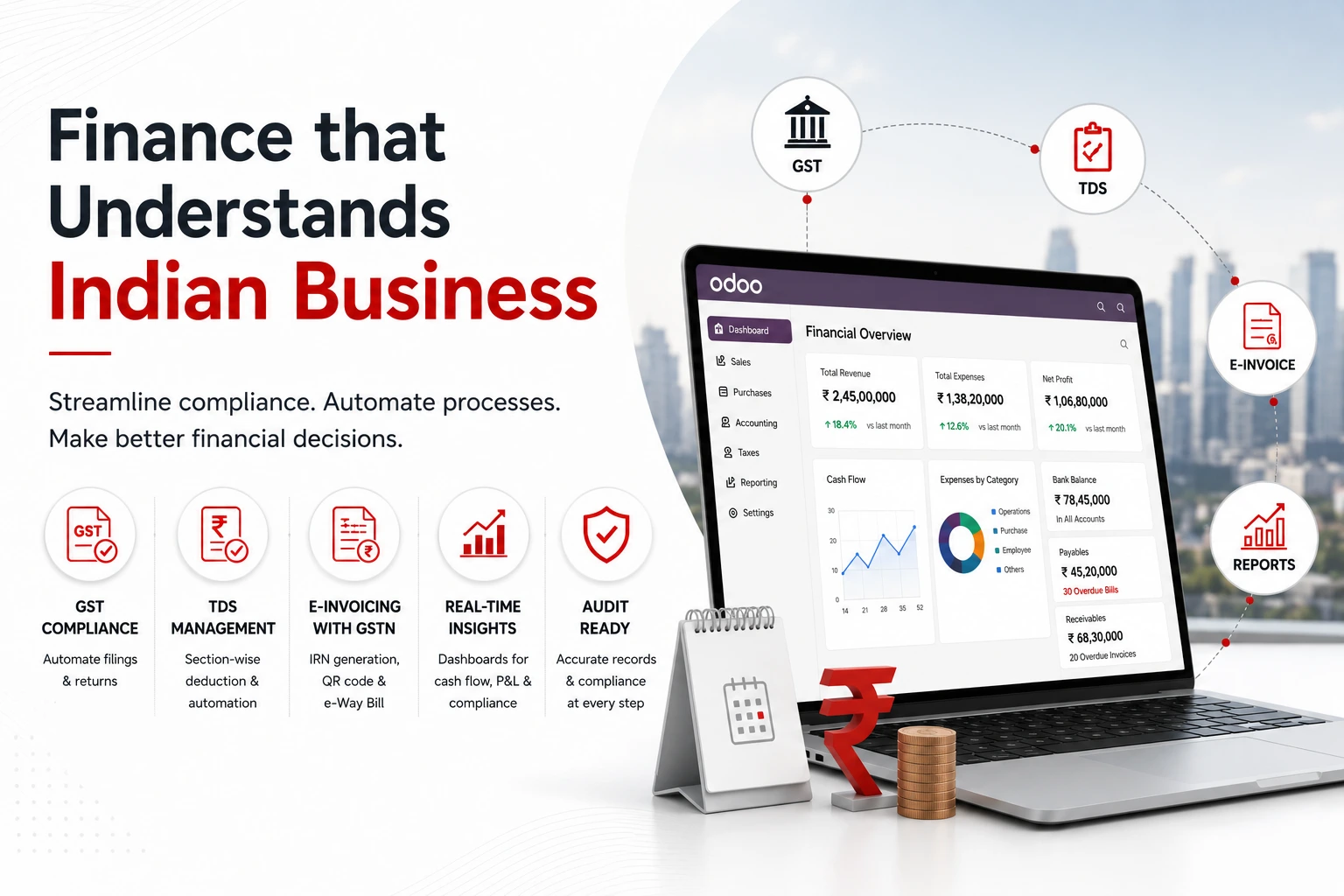
Odoo’s tax framework with LinkedERP’s India localization supports GST multi-slab rates, HSN/SAC mapping, CGST/SGST/IGST/UTGST splitting, fiscal position switching and Composition Scheme handling for downstream compliance.
2. GSTN API Integration
Odoo integrates with the GSTN portal for e-invoice generation, IRN creation, QR code stamping and e-Way Bill management, reducing manual work and invoice compliance risk.
3. TDS and TCS Automation
Configure TDS sections 194C, 194J, 194I, 194H and more with threshold-based deductions, automatic payable journal entries, challan tracking and TCS for scrap sales, minerals and e-commerce settlements.
4. Multi-Entity Financial Architecture
Odoo’s multi-company framework helps Indian group businesses manage subsidiaries and branches in one instance with inter-company automation, consolidated reporting and entity-level P&L, eliminating month-end spreadsheet consolidation.
5. Automated AP/AR and Collections
Automate invoice-to-payment, aging-based dunning workflows, payment reconciliation and vendor payment runs to reduce manual follow-ups and finance team bandwidth in Indian businesses.
6. MIS and Compliance Reporting
Scheduled MIS, GST return data extraction, TDS return compilation, budget variance reporting and real-time CFO dashboards are generated from the same transactional data without separate reporting effort.
The Five Financial Workflows Where Odoo Delivers Transformational Outcomes
Workflow 1: End-to-End GST Compliance Automation
What GST Automation Looks Like in Practice
As Indian mid-market businesses scale, manual GST management through basic Tally configurations increases manual entry mismatches, GST errors and ITC dispute risks, making automation essential.
What Odoo Finance Delivers for GST
Invoice Created → HSN/SAC Mapped → GST Slab Applied → CGST/SGST/IGST Split → E-Invoice Generated → IRN Stamped → GSTR Data Populated
In the Odoo finance module, GST configuration starts at the product master - HSN or SAC codes assigned at the product level, with corresponding tax rates linked. Fiscal positions handle the intra-state versus inter-state switch automatically based on the customer's registered state. From the moment a sales order is confirmed, every tax calculation downstream is automated.
Configure HSN/SAC codes under Inventory → Products → Accounting Tab with mapped tax rates for each GST slab
Set fiscal positions in Accounting → Configuration → Fiscal Positions to auto-apply IGST for inter-state and CGST/SGST for intra-state transactions
Enable the GSTN e-invoicing API integration for IRN generation, QR code stamping and e-Way Bill creation on eligible transactions
Extract GSTR-1 and GSTR-3B data in portal-ready formats directly from Accounting → Reporting → Tax Reports
LinkedERP clients using Odoo for accounting to automate GST workflows report a 70–80% reduction in manual data entry at return filing time - and near-zero GSTR mismatches compared to their previous manual process.
Workflow 2: Section-Wise TDS Automation
What TDS Management Looks Like Without Automation
Manual TDS management forces Indian finance teams to track vendor payments, statutory thresholds, deduction rates, journal entries, deposit due dates and 26Q data across scattered records - increasing errors, interest, penalties and notices.
What Odoo Finance Delivers for TDS
Vendor Bill Created → TDS Section Identified → Cumulative Threshold Checked → Deduction Calculated → TDS Payable Entry Posted → Deposit Due Date Tracked → 26Q Data Exported
Effective Odoo financial accounting for TDS starts at the vendor master. Each vendor is configured with the applicable TDS section - 194C for contractors, 194J for professional services, 194I for rent, 194H for commission. Odoo monitors cumulative payments against the statutory threshold and triggers the deduction automatically when the limit is crossed - eliminating both under-deduction risk and over-deduction errors.
Configure TDS tax groups under Accounting → Configuration → Taxes with section code, applicable rate and threshold amount
Tag each vendor with the relevant TDS section in the vendor master under the Accounting Tab - this drives automatic deduction on every bill for that vendor
Enable automatic TDS payable journal entry creation at bill validation - no manual journal posting required
Use Odoo's activity scheduler to track TDS deposit due dates and trigger alerts to the accounts team before the 7th of each month
Businesses that configure automated TDS workflows in the Odoo finance module eliminate an average of 12–15 manual journal entries per month - and report zero late-deposit penalties in the twelve months following LinkedERP implementation..
Workflow 3: Intelligent AP/AR and Collections Automation
The Real Cost of Manual Receivables Management
For most Indian mid-market finance teams, the daily grind is not month-end close - it is the relentless cycle of chasing payments, matching invoices, resolving disputes and managing vendor payment runs. This work is entirely necessary and entirely automatable. Every hour your team spends on it manually is an hour not spent on financial analysis, cash flow planning or business support.
What Odoo Finance Delivers for AP/AR
Invoice Raised → Payment Terms Applied → Automated Reminder Triggered → Escalation Sent → Payment Received → Auto-Reconciled → Ledger Updated
In Odoo finance and accounting, the AP/AR automation framework uses payment terms, aging thresholds and customer segment rules to drive automated follow-up without any manual scheduling. Vendor payment runs group outstanding bills by due date and bank account for batch processing. Every payment receipt is automatically matched against open invoices using Odoo's reconciliation engine.
Invoice due in 7 days: Auto-send a payment reminder from the assigned account manager's name - not a generic accounts inbox - with the outstanding amount and payment link
Invoice overdue by 1 day: Escalate to a formal dunning notice with invoice details, interest clause (if applicable) and a one-click payment portal link
Payment received: Automatically reconcile against the open invoice, post the ledger entry and close the follow-up activity in Odoo - zero manual steps
Vendor bill approved: Trigger a payment proposal grouped by due date and bank, ready for CFO review and one-click bank transfer instruction
Finance teams using Odoo's AP/AR automation collect outstanding invoices an average of 8 days faster than those relying on manual follow-up - directly improving working capital, reducing borrowing costs and increasing cash flow predictability.
Workflow 4: Multi-Entity Consolidation and Branch Accounting
The Multi-Entity Challenge Every Growing Indian Business Faces
Indian group businesses with multiple subsidiaries, branch offices or manufacturing units still rely on separate books, accountants, spreadsheets, email threads and manual inter-company eliminations for group P&L consolidation - causing delays, errors and outdated financial visibility.
What the Odoo Finance Module Delivers for Multi-Entity
Define Entities → Configure Inter-company Rules → Post Branch Transactions → Auto-eliminate Inter-company Entries → Generate Consolidated Reports → Branch P&L Available Real-Time
In Odoo financial accounting, each subsidiary or branch is created as a separate company within a single Odoo instance. Inter-company rules automate the mirror-image accounting - when Entity A raises a sale to Entity B, Odoo automatically posts the corresponding purchase in Entity B's books with matching amounts and dates. Elimination happens at the consolidation layer, not through manual journal entries.
Multi-company instance: A single Odoo deployment manages all entities with shared master data - vendors, customers, products - while keeping financials fully segregated by entity and GST registration
Inter-company automation: Configure inter-company rules under Accounting → Configuration → Inter-company to auto-generate bills and invoices across entities on confirmed transactions
Consolidated reporting: Generate group-level Balance Sheet, P&L and Cash Flow across all entities from a single report, with entity-level drill-down available for audit purposes
Branch-level cost centres: Use Odoo's analytic accounting to track revenue and cost at branch level independently of the legal entity structure - giving regional managers their own P&L without a separate accounting instance
Companies managing multi-entity structures through the Odoo finance module reduce month-end consolidation time by 65% compared to businesses manually consolidating in Excel - and eliminate the reconciliation errors that spreadsheet-based consolidation inevitably introduces.
Workflow 5: Automated MIS and Compliance Reporting
The Reporting Gap That Costs Indian CFOs Decision Time
Odoo for accounting transforms reporting from manual, request-based P&L preparation into automated finance reporting that helps Indian businesses make faster, timely decisions.
What Odoo Finance Delivers for MIS and Reporting
Period Closes → Scheduled Reports Triggered → MIS Pack Generated → Delivered to Recipients → GST Summary Ready → TDS Data Compiled → Budget Variance Flagged
Within Odoo's financial accounting and reporting modules, scheduled actions trigger automated report generation at defined intervals - daily cash position, weekly AR aging, monthly MIS pack, quarterly GST summary. Reports are delivered to defined recipients by email or accessible on role-based dashboards in Odoo - without any manual compilation step.
Month-end MIS pack: Auto-generate and email the full financial pack - P&L, Balance Sheet, Cash Flow, AR/AP Aging - to the CFO and board members within 24 hours of period close
GST return readiness: Trigger a GSTR-1 and GSTR-3B summary report 5 days before the filing deadline for finance review - zero scramble at filing time
Budget variance alerts: Send automated notifications to department heads when actuals deviate from budget by more than the defined threshold - enabling mid-month correction rather than month-end surprises
TDS deposit reminders: Trigger challan amount summaries and deposit reminders to the accounts team 3 days before the statutory due date - zero late deposits, zero interest liability
Finance teams that automate MIS reporting through Odoo financial accounting reclaim 20–25 person-hours per month previously spent on manual report compilation - redirecting that capacity toward financial analysis, business partnering and strategic support.
The Honest Capability Comparison
Factor | Tally / Legacy Tools | Odoo Finance Module |
|---|---|---|
GST multi-slab automation | Partial - manual config required | Full automation at product level |
E-invoicing / IRN generation | Via external add-ons | Built-in GSTN API integration |
TDS section-wise automation | Manual / spreadsheet-tracked | Automated deduction and posting |
Multi-entity consolidation | Manual Excel process | Native multi-company with auto-elimination |
AP/AR collections automation | Not available | Workflow-based dunning and reconciliation |
CRM and Sales integration | Not available | Same platform - real-time visibility |
Scheduled MIS delivery | Manual report preparation | Automated delivery to defined recipients |
Budget vs. actual tracking | Limited | Native analytic accounting with alerts |
Open-source customization | Not available | Full source code access |
True total cost of compliance | Lower licence, higher manual effort | Higher capability, lower compliance risk |
Why LinkedERP Is India's Trusted Odoo Finance Implementation Partner
LinkedERP delivers Odoo finance implementations for Indian businesses with a depth of platform expertise, India compliance knowledge and contractual commitment that defines what professional Odoo implementation should look like.
What LinkedERP Brings to Every Finance Implementation
India-First Configuration Methodology
Our implementations treat India compliance as core system behaviour from day one, with GST multi-slab configuration, TDS section mapping, e-invoicing integration and TCS handling built in - not added later.
Certified Odoo Finance Consultants
Every LinkedERP finance implementation is led by certified Odoo consultants with finance module credentials and India compliance expertise, with the lead consultant named before signing and retained through go-live.
Fixed-Fee Implementation Proposals
Every LinkedERP engagement uses fixed-fee pricing, documented change orders and upfront scope clarity - so there are no surprise invoices.
Client-Owned Configuration - Without Exception
LinkedERP fully documents and transfers all Odoo configurations, custom reports, India-specific tax logic and automation workflows at project completion - with no ongoing dependency, lock-in or proprietary middleware between your business and data.
Post-Implementation Managed Services
Our managed services offer a named support contact, SLA response times, proactive GST council, CBIC and GSTN API update management, plus bi-annual system health reviews.
LinkedERP's Odoo Finance Capability Stack
GST: Multi-slab configuration, e-invoicing, GSTR data extraction, ITC reconciliation, Composition Scheme
TDS/TCS: Section-wise automation, threshold tracking, challan management, 26Q/27Q data
AP/AR: Dunning workflows, payment reconciliation, vendor payment runs, aging analysis
Multi-entity: Inter-company automation, consolidated reporting, branch-level analytics
Banking: Bank statement import, auto-reconciliation, SFTP and API-based bank integration
MIS: Scheduled report delivery, CFO dashboards, budget vs. actual tracking, variance alerts
Migration: Tally, Busy, SAP B1 and legacy ERP to Odoo with full compliance continuity
Conclusion: Is Odoo Finance the Right Choice for Your Indian Business?
Stay with legacy tools when transaction volumes are low and stable, the business operates as a single entity without multi-branch or subsidiary complexity, GST compliance is simple with a single slab and low invoice volume, no e-invoicing mandate applies and the finance team can manage manual processes. Implement Odoo Finance when the e-invoicing mandate applies or is approaching, TDS management spans multiple sections and vendors, the business operates multiple entities, branches or state registrations, month-end close takes more than 5 working days, CFO decisions depend on outdated reports and you need CRM, sales, inventory and finance on a single platform with fixed-fee implementation and India compliance built in.
For the vast majority of Indian mid-market businesses, the compliance complexity, transaction volumes and multi-entity structures involved in meaningful growth make Odoo finance the clearly superior choice - not because legacy tools lack familiarity, but because the manual effort of keeping up with India's regulatory environment compounds significantly as the business scales.
Start
Your Odoo Finance Implementation with LinkedERP
Book a free finance configuration assessment with LinkedERP. Share your current accounting setup, compliance requirements and reporting needs. We will evaluate your situation honestly, recommend the right Odoo finance architecture and provide a fixed-fee proposal with named consultants and committed delivery dates.
www.linkederp.com | info@linkederp.com | Book a Free Finance Assessment
Frequently asked questions
The Odoo finance module covers the complete financial management stack - GST automation, TDS/TCS compliance, e-invoicing with GSTN integration, accounts payable and receivable, bank reconciliation, multi-entity consolidation, budget tracking and MIS reporting. With LinkedERP's India localization, every component is configured to meet the specific requirements of Indian tax law and statutory compliance.
Odoo financial accounting manages multi-slab GST through product-level HSN/SAC code mapping combined with tax rate configuration. Each product carries its correct GST rate and fiscal positions automatically switch between CGST/SGST and IGST based on the supply location. The result is correct tax application on every invoice without manual selection.
Yes. The Odoo finance and accounting module supports concurrent TDS configuration across all applicable sections with individual threshold tracking at the vendor level. When a vendor crosses the threshold for a specific section, the deduction triggers automatically - and not before.
A standard Odoo for accounting implementation covering GST, TDS, AP/AR automation and MIS reporting typically takes 6–10 weeks with LinkedERP, depending on data migration complexity and the number of entities involved. E-invoicing integration and multi-company configuration may extend the timeline by 2–3 weeks.
LinkedERP's managed services include proactive compliance update management. When CBIC notifications, GST council decisions or GSTN API changes affect your Odoo configuration, we assess the impact, implement the required changes and test them before the effective date - so your compliance is never disrupted by a regulatory update.
Odoo finance is a fully integrated financial management system that connects accounting with CRM, sales, inventory, manufacturing and HR on a single platform. Tally and similar tools handle bookkeeping and basic GST compliance but require manual data transfer from other business systems and offer no workflow automation. The difference compounds with scale - the larger and more complex the business, the wider the capability gap.